
Businesses at every stage rely on external expertise to solve problems, plan growth, and make better decisions. Two of the most common options are advisory services and consulting services. While these terms are often used interchangeably, they represent different approaches, expectations, and outcomes. Understanding advisory vs consulting helps business owners, executives, and founders choose the right type of support for their specific needs.
This article explains what advisory and consulting really mean, how they differ, when each makes the most sense, and how organizations can use them effectively to drive long term success.
What Is Advisory?
Advisory services focus on guidance, insight, and strategic direction. An advisor works closely with leadership to help them think through challenges, evaluate opportunities, and make informed decisions. Advisors are typically valued for their experience, judgment, and ability to see the bigger picture.
Rather than executing tasks, an advisor acts as a trusted resource. They help leaders avoid blind spots, consider alternative approaches, and stay aligned with long term goals.
Key Characteristics of Advisory Services
Advisory relationships are usually ongoing and flexible. They evolve as the business grows and priorities change.
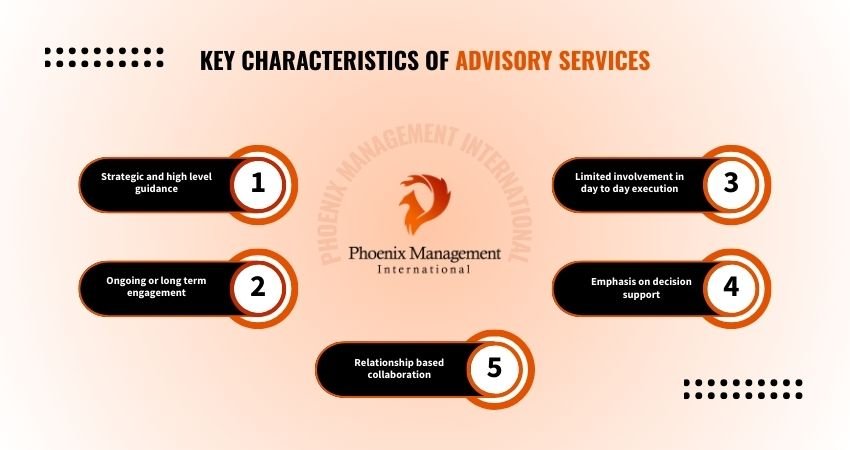
Common characteristics include:
- Strategic and high level guidance
- Ongoing or long term engagement
- Limited involvement in day to day execution
- Emphasis on decision support
- Relationship based collaboration
Advisors often work directly with founders, executives, or boards, providing perspective that internal teams may not have.
Typical Advisory Use Cases
Businesses commonly use advisory services for:
- Long term strategy and planning
- Market entry or expansion decisions
- Leadership development and mentorship
- Risk assessment and scenario planning
- Board or executive level guidance
In these situations, the advisor helps leaders decide what to do and how to approach it, but the organization executes the plan internally.
What Is Consulting?
Consulting services are more execution focused. Consultants are hired to solve a specific problem, improve a process, or deliver a defined outcome. Consulting engagements usually have a clear scope, timeline, and set of deliverables.
Consultants bring structured methods, specialized skills, and additional capacity to an organization. They often analyze data, design solutions, and help implement changes.
Key Characteristics of Consulting Services
Consulting engagements are typically project based and outcome driven.
Common characteristics include:
- Clearly defined scope and objectives
- Hands on analysis and execution
- Fixed timelines and milestones
- Deliverables such as reports or systems
- Measurable results
Consultants are expected to produce tangible outputs, not just recommendations.
Typical Consulting Use Cases
Organizations often hire consultants for:
- Process improvement and operational efficiency
- Technology implementation or system upgrades
- Organizational restructuring
- Market research and competitive analysis
- Short term expertise for complex projects
In these cases, the consultant is responsible for moving the work forward and delivering results.
Advisory vs Consulting: Core Differences
While both advisory and consulting provide external expertise, the way they do so is fundamentally different.
Role and Responsibility
Advisors guide decision making but do not usually take ownership of execution. Consultants are responsible for performing analysis, managing tasks, and delivering outcomes.
An advisor might help define a growth strategy, while a consultant builds the roadmap, conducts analysis, and supports implementation.
Engagement Style
Advisory relationships are conversational and flexible. Consulting engagements are structured and contractual.
Advisors often work on a retainer or hourly basis, adapting to changing needs. Consultants typically work under a statement of work with defined deliverables.
Time Commitment
Advisory services are often long term and continuous. Consulting services are usually short to medium term and end when the project is complete.
Businesses may keep an advisor for years, while hiring consultants only when specific needs arise.
Cost Structure
Advisory services are commonly priced as monthly retainers or hourly fees. Consulting services are often priced per project, milestone, or fixed fee.
Advisory can be more cost effective for ongoing guidance, while consulting may involve higher upfront costs for intensive projects.
Level of Authority
Advisors influence decisions but do not enforce them. Consultants may have more authority within the scope of a project, especially when managing implementation.
In both cases, final accountability remains with the business leadership.
When Advisory Is the Right Choice
Advisory services are most valuable when leaders need perspective rather than extra hands.
Advisory is a strong fit when:
- Leadership wants strategic guidance
- Internal teams can handle execution
- Decisions involve uncertainty or long term impact
- The business is growing or changing direction
- Ongoing insight is more valuable than quick fixes
Advisors help organizations think clearly and act intentionally, especially during periods of growth or transition.
When Consulting Makes More Sense
Consulting is ideal when specific work needs to be completed efficiently and professionally.
Consulting is the better option when:
- A defined problem needs a defined solution
- Internal resources are limited
- Specialized expertise is required
- Timelines and deliverables matter
- Execution support is critical
Consultants provide focus, structure, and momentum when internal teams are stretched or lack certain capabilities.
Using Advisory and Consulting Together
Many organizations benefit from using both advisory and consulting services at different stages.
A common approach looks like this:
- Engage an advisor to clarify goals and strategy
- Hire consultants to execute specific initiatives
- Continue working with the advisor to assess progress and adjust direction
This combination allows businesses to make smarter decisions while ensuring those decisions are executed effectively.
How to Decide Between Advisory and Consulting
Choosing between advisory and consulting starts with asking the right questions.
Consider the following:
- Do we need guidance or execution
- Is this an ongoing need or a one time project
- Do we have the internal capacity to implement recommendations
- How quickly do results need to be delivered
- What level of structure do we require
Clear answers will point toward advisory, consulting, or a blend of both.
Final Thoughts on Advisory vs Consulting
Advisory and consulting services serve different but complementary purposes. Advisory focuses on insight, experience, and strategic thinking. Consulting focuses on execution, structure, and results.
Understanding advisory vs consulting helps businesses invest in the right type of support at the right time. When aligned properly with organizational goals, both approaches can play a critical role in building stronger strategies, better operations, and sustainable growth.