
Self-directed investing platforms have never been more accessible, yet the number of investors turning to professional brokerage services is growing, not shrinking. Why? Because access to markets and skill in navigating them are two very different things.
Whether you’re an individual investor evaluating your options, a business owner managing treasury assets, or an institutional buyer exploring trade execution, this guide breaks down the real, tangible benefits of working with a professional broker in 2026 and why the value proposition has actually strengthened in today’s volatile, AI-influenced markets.
What are professional brokerage services?
Professional brokerage services refer to intermediary services provided by licensed firms or individuals who facilitate the buying and selling of financial assets including equities, bonds, derivatives, commodities, real estate, and foreign exchange on behalf of clients.
Unlike self-directed trading platforms where you execute your own decisions independently, a professional broker brings expertise, market access, regulatory compliance, and depending on the service tier, personalized advisory support to every transaction.
Key distinction: A broker executes trades on your behalf. An advisory broker also provides recommendations. A full-service broker offers comprehensive wealth planning, research, and ongoing portfolio management. Understanding which type you need is the first decision every investor should make.
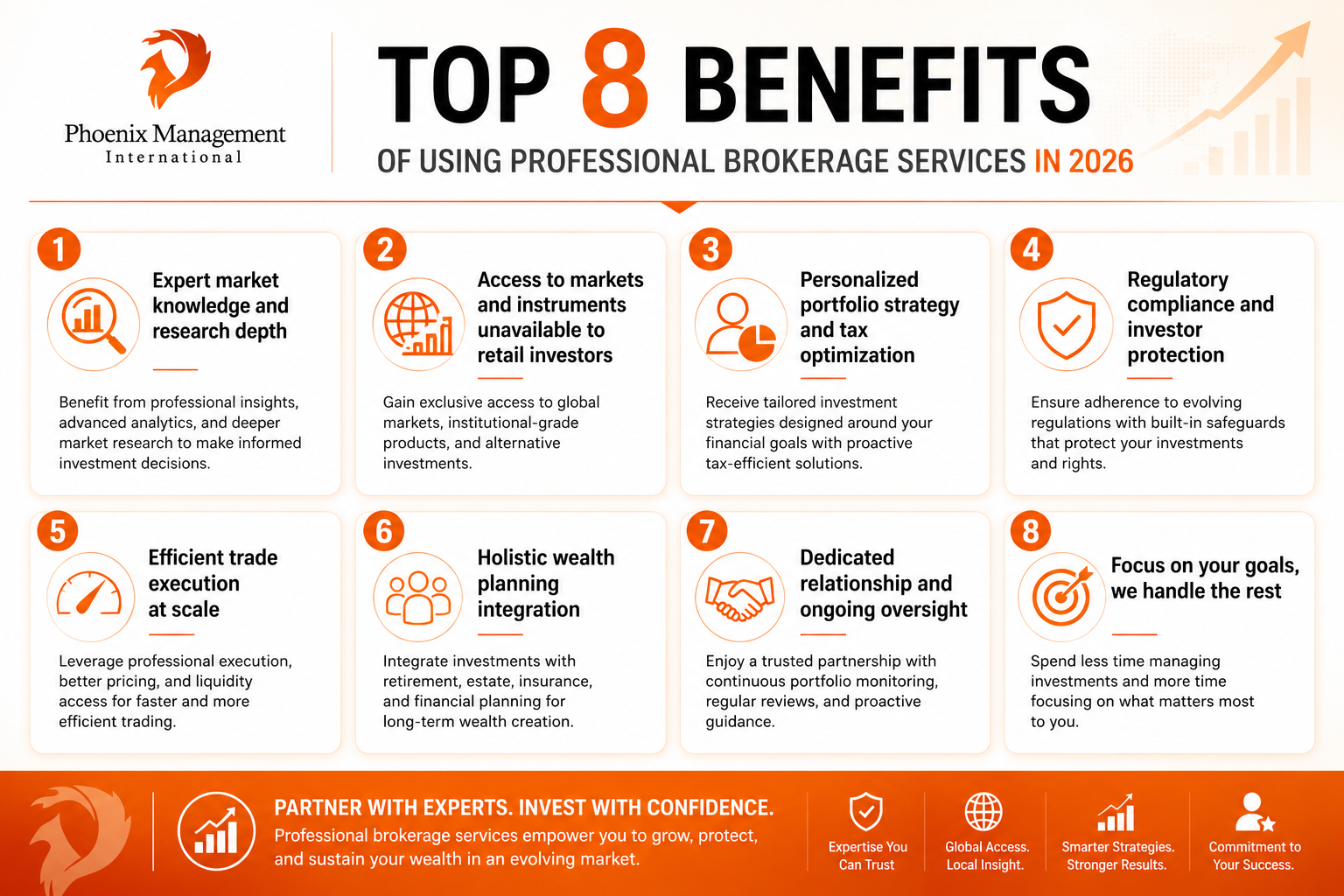
1. Expert market knowledge and research depth
The sheer volume of market data, regulatory updates, earnings reports, and macroeconomic signals that investors must process has grown exponentially. Professional brokers, especially those at full-service firms — have access to proprietary research, analyst networks, and institutional-grade data terminals that individual investors simply cannot replicate.
In 2026, this includes AI-augmented research tools used by brokers to screen opportunities and model risk scenarios at a granularity that was unavailable even three years ago. Critically, the broker provides the judgment layer that translates data into actionable strategy, something automated tools alone struggle to do reliably.
2. Access to markets and instruments unavailable to retail investors
Many of the most compelling investment opportunities are structurally inaccessible to self-directed retail investors:
- Pre-IPO allocations and secondary private equity markets
- Over-the-counter (OTC) bond markets and structured products
- Institutional share classes with significantly lower expense ratios
- Dark pools and algorithmic execution for large-block trades
- International markets with regulatory or currency complexities
- Certain hedge fund or alternative investment vehicles
A professional broker serves as your gateway to these instruments, often at pricing and terms unavailable through retail channels.
3. Personalized portfolio strategy and tax optimization
Perhaps the most underappreciated benefit of professional brokerage is the integration of tax strategy into investment management. A skilled broker or wealth manager considers:
- Tax-loss harvesting opportunities across your entire portfolio
- Asset location strategies (which accounts hold which assets for tax efficiency)
- Capital gains timing to minimize tax liabilities
- Coordination with your accountant for year-end planning
- Estate planning considerations for intergenerational wealth transfer
Vanguard research insight: The firm’s ongoing “Advisor’s Alpha” research has consistently found that a competent financial advisor can add approximately 3% in net returns annually — much of which comes from behavioral coaching and tax optimization rather than pure market selection.
4. Regulatory compliance and investor protection
In 2026, the regulatory landscape for financial services has become significantly more complex. AI-generated investment advice, crypto asset regulations, ESG disclosure requirements, and cross-border transaction monitoring have all intensified compliance obligations. A licensed professional broker carries this compliance burden on your behalf, ensuring:
- Trades are executed within legal parameters
- Anti-money laundering (AML) and KYC requirements are met
- Fiduciary or suitability standards are applied to recommendations
- Your assets are held in segregated, insured accounts
- Clear dispute resolution processes are available if issues arise
5. Behavioral coaching and emotional discipline
Research in behavioral finance consistently shows that individual investors underperform the very funds they invest in primarily due to poorly timed buying and selling driven by fear and greed. A professional broker provides an objective, external perspective that interrupts reactive decision-making.
This is particularly valuable during market volatility. In the corrections of 2022, 2023, and the AI-sector turbulence of early 2025, investors with advisors were statistically more likely to stay the course than those managing accounts alone.
6. Efficient trade execution at scale
For investors executing large trades, execution quality matters enormously. Slippage the difference between the expected and actual execution price can erode returns significantly on large orders. Professional brokers use direct market access (DMA), algorithmic execution, and relationships with liquidity providers to minimize slippage and transaction costs.
7. Holistic wealth planning integration
Full-service brokerage firms increasingly offer integrated wealth planning that extends beyond investment management to include:
- Retirement income planning and drawdown strategies
- Insurance needs analysis
- Business succession planning
- Estate and trust coordination
- Charitable giving and philanthropic strategy
This holistic approach ensures investment decisions are made within the context of your broader financial life, not in isolation.
8. Dedicated relationship and ongoing oversight
Markets don’t stand still, and neither should your portfolio. A professional broker provides proactive monitoring and rebalancing, flagging opportunities and risks as your situation and the market environment evolve. This ongoing stewardship particularly valuable at major life transitions is something no robo-advisor or self-directed platform can replicate.
Types of professional brokerage services explained
Not all brokers are the same. Understanding the spectrum of brokerage services helps you identify the right fit for your needs and budget.
| Service type | What they do | Best for | Typical fee model |
|---|---|---|---|
| Full-service broker | Investment advice, research, execution, wealth planning | High-net-worth individuals, complex portfolios | AUM % (0.5–1.5%) or flat retainer |
| Discount broker | Trade execution with limited advisory support | Self-directed investors needing execution infrastructure | Per-trade commission or $0 with spread markup |
| Robo-advisory | Algorithm-driven portfolio management | Beginner investors, small portfolios (<$100K) | AUM % (0.25–0.50%) |
| Prime brokerage | Institutional-level: custody, leverage, securities lending | Hedge funds, family offices, institutional traders | Negotiated, activity-based |
| Commodity/forex broker | Specialist execution in commodities, FX, derivatives | Traders and businesses with FX/commodity exposure | Spread or commission per lot |
| Real estate broker | Property transaction facilitation, valuation, negotiation | Property buyers, investors, developers | Transaction commission (1–3%) |
DIY investing vs. professional brokerage services
The right approach depends on your financial complexity, available time, knowledge depth, and the emotional discipline you can reliably bring to investing. Here is an honest, balanced comparison:
| Factor | DIY / self-directed | Professional broker |
|---|---|---|
| Cost | Lower $0–$10/trade or low fund fees | Higher AUM fees or retainer |
| Control | Full control over every decision | Delegated; collaborative depending on service tier |
| Market access | Retail markets and listed ETFs/stocks | Institutional products, OTC, private markets |
| Research quality | Public sources, free tools | Proprietary research, analyst networks |
| Tax optimization | Self-managed; easy to miss opportunities | Integrated into ongoing management |
| Behavioral risk | Higher — no external check on emotional decisions | Lower — advisor provides objective perspective |
| Time required | High — research, execution, monitoring all on you | Low — delegated to the broker |
| Complexity handling | Limited — hard to manage cross-asset, cross-border portfolios | Strong — built for complex scenarios |
Important nuance: “Low cost” DIY investing is only genuinely lower cost if you execute well. Behavioral errors, tax inefficiencies, and missed rebalancing opportunities often produce a hidden cost that exceeds the fee a professional would charge. The math is less obvious than the headline fee comparison suggests.
Who benefits most from professional brokerage services?
Professional brokerage services are not exclusively for the ultra-wealthy. The value proposition scales across a wide range of investor profiles and use cases.
How to choose the right brokerage service in 2026
Key criteria to evaluate
- Regulatory status — Always verify the firm is licensed with your jurisdiction’s financial regulator (FINRA/SEC, FCA, ASIC, etc.)
- Fee transparency — Understand all-in costs: management fees, transaction commissions, custody charges, and any performance fees
- Fiduciary vs. suitability standard — A fiduciary is legally required to act in your best interest; a suitability standard is a lower bar. Know which applies.
- Specialist expertise match — Does the broker have documented experience in your asset class, tax situation, or geographic market?
- Technology and reporting — In 2026, expect real-time portfolio dashboards, consolidated tax reporting, and digital account management as standard
- Client-to-advisor ratio — A broker managing 600+ clients cannot provide the same level of attention as one managing 80
- Custodian independence — Your assets should be held by a separate, regulated custodian not by the brokerage itself to protect against insolvency risk
FAQs
What is the main benefit of using a professional broker over a DIY platform?