
Mergers and acquisitions (M&A) can unlock new growth opportunities, strengthen market position, and increase business value. However, successful deals don’t happen overnight. They require careful planning, financial transparency, operational readiness, and strategic decision-making long before negotiations begin.
Whether you’re planning to sell your company, merge with another organization, or acquire a business, understanding how to prepare your business for a merger or acquisition can significantly improve your chances of achieving a successful outcome.
This guide explains the essential steps business owners should take before entering an M&A transaction, common challenges to avoid, and practical strategies that help maximize business value while minimizing risk.
What Is a Merger or Acquisition?
A merger occurs when two companies combine to form a single organization, often to increase market share, expand capabilities, or improve operational efficiency.
An acquisition happens when one company purchases another and assumes ownership. Depending on the structure of the deal, the acquired business may continue operating independently or become fully integrated into the buyer’s organization.
Both transactions involve extensive financial, legal, operational, and strategic evaluation to ensure long-term success.
Why Proper Preparation Matters Before an M&A Transaction
Preparing your business before entering negotiations helps you:
- Increase business valuation
- Identify and resolve operational weaknesses
- Build buyer confidence
- Accelerate due diligence
- Reduce legal and financial risks
- Improve negotiation leverage
- Minimize disruptions to employees and customers
Businesses that prepare early often experience smoother transactions and stronger post-deal performance.
Signs Your Business May Be Ready for a Merger or Acquisition
While every company is different, businesses often become good M&A candidates when they have:
- Consistent revenue growth
- Healthy profit margins
- Reliable financial reporting
- Strong customer retention
- Scalable operations
- Experienced leadership
- Clearly documented business processes
- Sustainable competitive advantages
Preparation begins well before discussions with potential buyers or partners.
Step-by-Step Guide to Preparing Your Business for a Merger or Acquisition
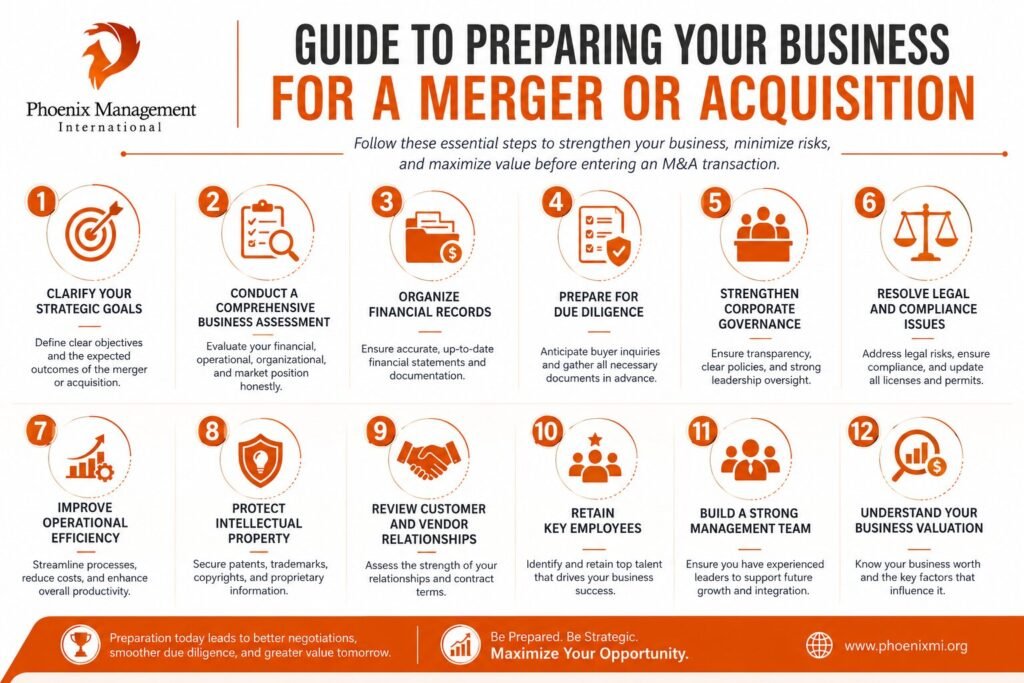
1. Clarify Your Strategic Goals
Every successful merger or acquisition starts with a clear objective.
Ask yourself:
- Why are you considering a merger or acquisition?
- Are you seeking growth?
- Looking for succession planning?
- Expanding into new markets?
- Improving operational capabilities?
- Increasing shareholder value?
Your goals will shape every decision throughout the transaction.
Example
A manufacturing company may pursue an acquisition to strengthen its supply chain, while a technology firm may merge with another business to expand its product offerings.
2. Conduct a Comprehensive Business Assessment
Before approaching investors or buyers, evaluate your business objectively.
Review areas such as:
Financial Performance
- Revenue trends
- Profitability
- Cash flow
- Debt obligations
- Working capital
- Tax compliance
Operational Performance
- Production efficiency
- Supply chain stability
- Technology infrastructure
- Customer service processes
Organizational Health
- Leadership structure
- Employee retention
- Company culture
- Succession planning
Understanding your strengths and weaknesses allows you to address concerns before buyers identify them.
3. Organize Financial Records
One of the most important aspects of M&A readiness is financial transparency.
Potential buyers will expect accurate documentation including:
- Audited financial statements
- Profit and loss statements
- Balance sheets
- Cash flow reports
- Tax returns
- Accounts receivable and payable
- Sales forecasts
- Budget reports
Incomplete or inconsistent financial records can delay or even derail a transaction.
Best Practice: Work with experienced accountants or financial advisors to ensure your records are accurate and up to date.
4. Prepare for Due Diligence
Due diligence is a detailed investigation conducted before closing a deal.
Buyers evaluate nearly every aspect of your company.
Typical Due Diligence Checklist
| Area | Documents Required |
|---|---|
| Financial | Financial statements, forecasts, tax filings |
| Legal | Contracts, licenses, permits, litigation history |
| Human Resources | Employee agreements, benefits, payroll records |
| Operations | SOPs, vendor contracts, inventory reports |
| Technology | Software licenses, cybersecurity policies |
| Intellectual Property | Patents, trademarks, copyrights |
Preparing these documents early speeds up negotiations and builds credibility.
Planning for a merger or acquisition? Phoenix Management International offers expert business management and consulting services to help you strengthen your business before every major decision.
5. Strengthen Corporate Governance
Strong governance demonstrates stability and professionalism.
Review:
- Shareholder agreements
- Board meeting records
- Corporate bylaws
- Ownership structure
- Compliance documentation
If ownership responsibilities are unclear, disputes can arise during negotiations.
6. Resolve Legal and Compliance Issues
Legal risks reduce business value.
Before entering a transaction:
- Resolve pending lawsuits
- Renew licenses
- Update permits
- Review regulatory compliance
- Ensure employment law compliance
- Verify intellectual property ownership
Buyers prefer businesses with minimal legal uncertainty.
7. Improve Operational Efficiency
Businesses with streamlined operations are generally more attractive acquisition targets.
Consider improving:
- Workflow automation
- Inventory management
- Customer support
- Vendor relationships
- Process documentation
- Performance reporting
Operational efficiency often translates directly into higher valuation.
8. Protect Intellectual Property
Your intellectual property may represent a significant portion of your company’s value.
Ensure protection for:
- Trademarks
- Patents
- Copyrights
- Proprietary software
- Trade secrets
- Confidential business processes
Maintain documentation proving ownership.
9. Review Customer and Vendor Relationships
Long-term contracts increase buyer confidence.
Evaluate:
- Customer concentration risk
- Contract renewal dates
- Vendor dependencies
- Partnership agreements
- Service-level agreements
Diversified revenue sources generally reduce acquisition risk.
10. Retain Key Employees
Employees often determine whether an acquisition succeeds after closing.
Develop retention strategies such as:
- Leadership succession plans
- Incentive programs
- Employment agreements
- Clear communication strategies
- Training documentation
Unexpected employee departures during negotiations can negatively affect valuation.
11. Build a Strong Management Team
Many buyers evaluate leadership as closely as financial performance.
An experienced management team demonstrates:
- Operational stability
- Strategic vision
- Decision-making capability
- Business continuity
Companies that rely entirely on the owner may appear riskier to buyers.
12. Understand Your Business Valuation
Knowing your company’s market value strengthens your negotiating position.
Valuation methods commonly include:
- Discounted Cash Flow (DCF)
- EBITDA multiples
- Asset-based valuation
- Comparable company analysis
- Market-based valuation
A professional valuation provides realistic expectations before negotiations begin.
A successful transaction starts with a well-prepared business. Let Phoenix Management International help you improve operations, reduce risk, and build long-term value.
Common Mistakes Businesses Make Before a Merger or Acquisition
Many transactions encounter delays because companies fail to prepare adequately.
Common mistakes include:
- Poor financial documentation
- Overestimating business value
- Ignoring operational inefficiencies
- Waiting too long to seek professional advice
- Incomplete legal records
- Weak cybersecurity practices
- Failing to communicate with leadership teams
- Lack of post-merger integration planning
Avoiding these issues can significantly improve transaction outcomes.
Merger vs. Acquisition: Key Differences
| Merger | Acquisition |
|---|---|
| Two companies combine into one | One company purchases another |
| Leadership may be shared | Buyer usually controls operations |
| Often collaborative | May be friendly or hostile |
| Brand identity may change | Acquired company may retain or lose branding |
| Focuses on combined growth | Focuses on ownership transfer |
Understanding these differences helps business owners prepare for the unique challenges of each transaction.
Post-Transaction Planning Is Just as Important
Preparation doesn’t end when the deal closes.
Successful organizations develop integration plans covering:
- Employee onboarding
- Systems integration
- Technology migration
- Customer communication
- Brand alignment
- Financial reporting
- Operational restructuring
- Performance monitoring
Early integration planning reduces disruption and accelerates long-term success.
Preparing your business now can lead to better outcomes later. Discover how Phoenix Management International’s business management services can support your growth goals.
Expert Tips to Increase Business Value Before an M&A Deal
Consider these practical strategies:
- Standardize operating procedures.
- Diversify revenue streams.
- Reduce unnecessary expenses.
- Strengthen recurring revenue.
- Invest in cybersecurity.
- Improve financial forecasting.
- Document key business processes.
- Modernize technology systems.
- Build scalable operations.
- Maintain regulatory compliance.
Small improvements made months before a transaction can have a meaningful impact on valuation.
Key Takeaways
- Define clear strategic objectives before pursuing a merger or acquisition.
- Keep financial, legal, and operational records organized and current.
- Prepare thoroughly for due diligence to avoid delays.
- Strengthen governance, compliance, and leadership structures.
- Focus on operational efficiency and customer stability to enhance business value.
- Develop a post-merger integration strategy before the transaction closes.
- Seek experienced professional guidance to navigate complex negotiations and maximize outcomes.
FAQs
How long does it take to prepare a business for a merger or acquisition?
Preparation timelines vary depending on the size and complexity of the business. Many companies begin preparing 6 to 24 months before entering formal negotiations to strengthen financial reporting, operations, and compliance.
What is the most important part of M&A preparation?
Financial transparency is one of the most critical factors. Accurate financial statements, organized documentation, and a clear understanding of business performance help build buyer confidence and streamline due diligence.
Should small businesses prepare for acquisitions differently than large companies?
The core preparation process is similar, but small businesses often place greater emphasis on reducing owner dependency, documenting processes, and demonstrating consistent revenue growth.
Why is due diligence so important?
Due diligence allows buyers to verify the company’s financial health, legal standing, operations, contracts, and potential risks before completing the transaction. Proper preparation helps prevent delays and unexpected issues.
Should I hire advisors before starting the process?
Yes. Experienced legal, financial, tax, and business advisory professionals can identify potential issues early, improve valuation readiness, and help structure a smoother transaction.
Conclusion
Preparing your business for a merger or acquisition is far more than organizing paperwork, it involves strengthening every aspect of your organization, from financial reporting and legal compliance to operational efficiency and leadership readiness. The more prepared your business is, the greater your ability to negotiate confidently, reduce risk, and achieve a successful outcome.
Ready to Prepare Your Business for a Successful Merger or Acquisition?
Whether you’re planning to grow through an acquisition, merge with another company, or position your business for a profitable sale, expert guidance can make all the difference. Phoenix Management International provides comprehensive Business Management Services in San Antonio, along with strategic business consulting tailored to your organization’s goals. From operational assessments and growth planning to merger readiness and transaction support, our experienced advisors help businesses make informed decisions with confidence.
Contact Phoenix Management International today to learn how our business management and consulting services can help you strengthen your business, maximize its value, and prepare for long-term success.