
Every business wants to improve productivity, but many organizations unknowingly lose valuable time, money, and opportunities because of inefficient business processes. Whether it’s unclear workflows, poor communication, outdated systems, or inconsistent decision-making, even small process issues can create significant operational challenges over time.
Understanding the most common business process problems is the first step toward building a more efficient, scalable, and profitable organization. By identifying these obstacles early, businesses can streamline operations, improve collaboration, reduce costs, and create a stronger foundation for sustainable growth.
In this guide, we’ll explore the 10 most common business process problems that reduce productivity, why they occur, how they impact your organization, and practical strategies to overcome them.
What Are Business Process Problems?
Business process problems are inefficiencies, bottlenecks, or breakdowns in the systems and workflows organizations use to carry out daily operations. These issues prevent teams from working efficiently, increase operating costs, create delays, and reduce overall productivity.
Common business process problems often involve:
- Manual and repetitive tasks
- Poor communication between departments
- Lack of standardized procedures
- Inefficient approval workflows
- Limited visibility into performance
- Technology gaps
- Poor resource allocation
When left unresolved, these challenges affect employee performance, customer satisfaction, profitability, and long-term business growth.
Struggling with inefficient business processes? Phoenix Management International helps businesses in San Antonio streamline operations, improve productivity, and build scalable management systems that support long-term growth.
Why Efficient Business Processes Matter
A well-designed business management process helps organizations operate consistently, make informed decisions, and respond quickly to changing business needs.
Strong business processes help organizations:
- Increase operational efficiency
- Reduce unnecessary costs
- Improve employee productivity
- Deliver better customer experiences
- Minimize errors and rework
- Support business scalability
- Improve compliance and accountability
Simply put, better processes allow teams to spend more time creating value instead of fixing avoidable problems.
10 Common Business Process Problems That Reduce Productivity
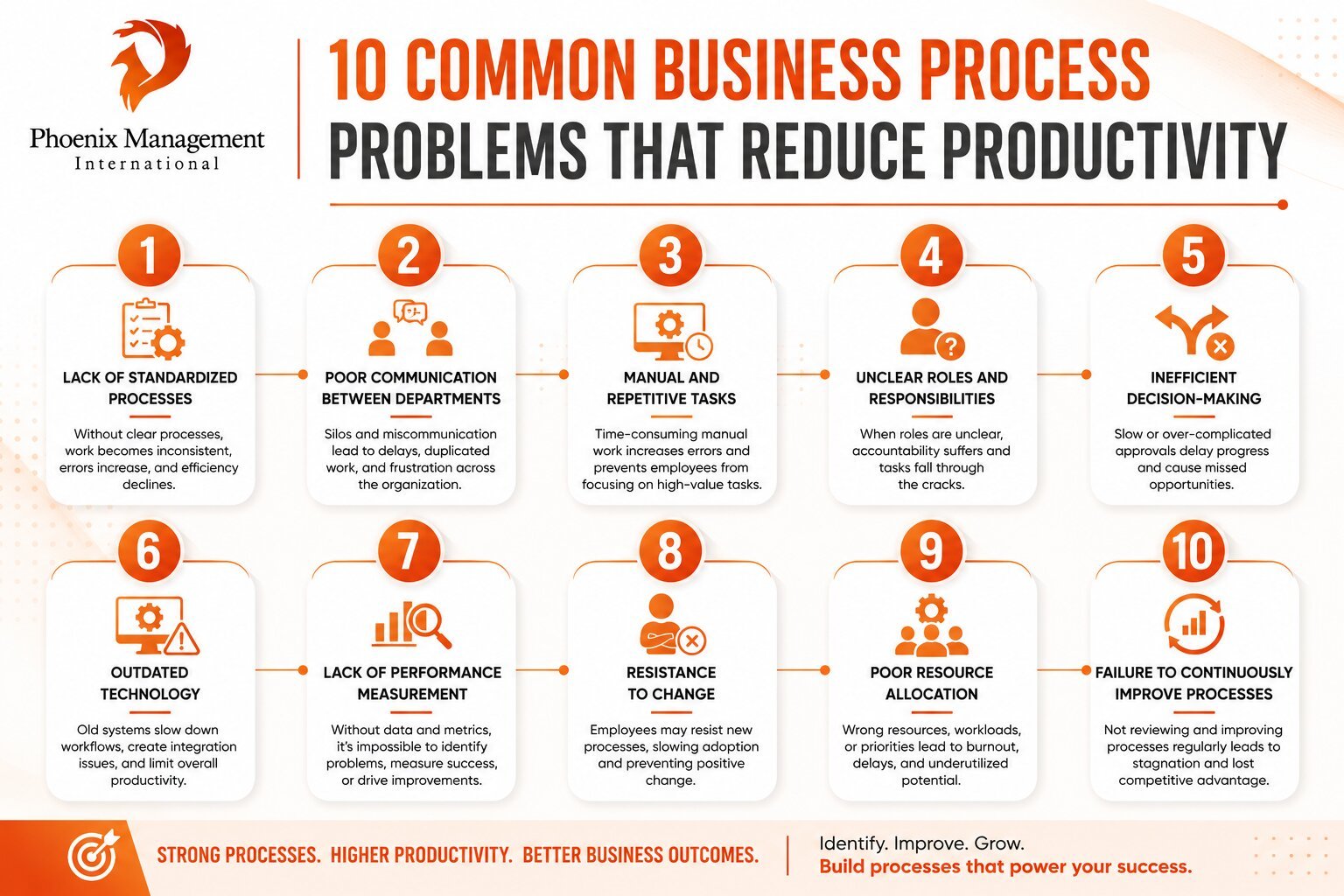
1. Lack of Standardized Processes
One of the biggest productivity killers is allowing employees to perform the same task in different ways.
Without documented procedures:
- Work quality becomes inconsistent.
- Training new employees takes longer.
- Mistakes become more frequent.
- Teams rely on individual knowledge rather than organizational systems.
Solution
Create standardized workflows, written procedures, and process documentation for recurring business activities.
2. Poor Communication Between Departments
Departments often operate independently, creating information silos that slow collaboration.
Common examples include:
- Sales and operations using different data
- Finance receiving incomplete information
- Customer service lacking order updates
- Marketing and leadership working toward different priorities
The result is duplicated work, delayed projects, and unnecessary confusion.
Solution
Encourage cross-functional communication through shared systems, regular meetings, and centralized project management tools.
3. Manual and Repetitive Tasks
Many organizations still rely heavily on spreadsheets, paper forms, emails, and manual data entry.
These repetitive tasks consume valuable employee time while increasing the likelihood of human error.
Common examples
- Manual invoice approvals
- Re-entering customer information
- Spreadsheet reporting
- Paper-based approvals
- Repetitive scheduling
Solution
Automate repetitive workflows wherever possible using workflow automation, CRM systems, ERP software, and digital collaboration tools.
4. Unclear Roles and Responsibilities
When employees don’t know who owns specific tasks, accountability suffers.
This often leads to:
- Missed deadlines
- Duplicate work
- Delayed decisions
- Team frustration
- Project bottlenecks
Solution
Clearly define responsibilities, ownership, approval levels, and reporting structures for every major process.
5. Inefficient Decision-Making
Businesses lose productivity when every decision requires multiple approvals or unclear authorization.
Slow decision-making often causes:
- Delayed projects
- Lost sales opportunities
- Frustrated employees
- Poor customer experiences
Solution
Simplify approval workflows and empower managers to make appropriate operational decisions without unnecessary bureaucracy.
6. Outdated Technology
Technology should improve productivity—not slow it down.
Older systems often create:
- Slow workflows
- Data inconsistencies
- Integration problems
- Increased maintenance costs
- Security risks
Employees spend more time working around outdated systems than completing meaningful work.
Solution
Evaluate current software regularly and invest in technologies that integrate with existing operations while supporting future growth.
7. Lack of Performance Measurement
Many businesses don’t measure how well their processes actually perform.
Without metrics, organizations struggle to answer questions like:
- Where are delays occurring?
- Which workflows waste the most time?
- Which departments need additional support?
- Which improvements create measurable value?
Important KPIs
| KPI | Purpose |
|---|---|
| Process Cycle Time | Measures workflow speed |
| Error Rate | Tracks quality issues |
| Customer Response Time | Measures service efficiency |
| Employee Productivity | Evaluates operational performance |
| Cost Per Process | Identifies inefficiencies |
Solution
Track meaningful performance indicators and continuously refine processes using real operational data.
8. Resistance to Change
Even beneficial improvements often face internal resistance.
Employees may worry about:
- Learning new systems
- Increased accountability
- Job security
- Temporary disruptions
Without effective change management, improvement initiatives often fail before delivering results.
Solution
Communicate the purpose of changes clearly, provide training, involve employees early, and celebrate progress throughout implementation.
9. Poor Resource Allocation
Assigning the wrong people, budgets, or tools to business activities creates unnecessary delays and burnout.
Signs include:
- Employees overloaded with work
- Frequent missed deadlines
- Underutilized talent
- Budget overruns
- Constant firefighting
Solution
Review workloads regularly and align staffing, budgets, and technology with operational priorities.
10. Failure to Continuously Improve Processes
Many organizations only review their processes after major problems occur.
Successful businesses treat process improvement as an ongoing initiative rather than a one-time project.
Continuous improvement includes:
- Regular workflow reviews
- Employee feedback
- Customer insights
- Performance analysis
- Technology upgrades
- Operational benchmarking
Small improvements made consistently often generate greater long-term productivity gains than large, infrequent changes.
Small process improvements can lead to significant business results. Discover how Phoenix Management International’s business management services in San Antonio, TX can help your organization operate more efficiently.
Comparison Table: Common Business Process Problems and Solutions
| Business Process Problem | Impact on Productivity | Recommended Solution |
|---|---|---|
| Lack of standardization | Inconsistent work quality | Document workflows |
| Poor communication | Delays and duplication | Improve collaboration |
| Manual tasks | Wasted time | Automate repetitive work |
| Unclear responsibilities | Low accountability | Define ownership |
| Slow decision-making | Missed opportunities | Streamline approvals |
| Outdated technology | Reduced efficiency | Modernize systems |
| No performance tracking | Limited improvement | Monitor KPIs |
| Resistance to change | Slow implementation | Invest in change management |
| Poor resource allocation | Burnout and delays | Optimize planning |
| No continuous improvement | Stagnant operations | Review processes regularly |
Signs Your Business Processes Need Improvement
Use this quick checklist to identify potential issues:
✔ Projects regularly miss deadlines
✔ Employees frequently repeat tasks
✔ Teams rely heavily on spreadsheets
✔ Customers experience inconsistent service
✔ Managers spend excessive time solving operational issues
✔ Approval processes take too long
✔ Departments struggle to communicate effectively
✔ Business growth creates operational bottlenecks
If several of these apply to your organization, it may be time to evaluate and improve your business management process.
The Business Management Benefits of Optimized Processes
Organizations that invest in process improvement often experience measurable gains across multiple areas of the business.
Some of the most significant Business Management Benefits include:
- Increased employee productivity
- Faster project completion
- Better customer satisfaction
- Reduced operating expenses
- Improved compliance
- Greater operational transparency
- Higher employee engagement
- Better decision-making through reliable data
- Easier scalability during business growth
Process optimization is not just about efficiency; it also strengthens an organization’s ability to adapt, compete, and grow.
Common Business Management Mistakes That Lead to Process Problems
Many process challenges stem from avoidable Business Management Mistakes, including:
- Relying on undocumented workflows
- Delaying technology upgrades
- Ignoring employee feedback
- Measuring activity instead of outcomes
- Failing to review processes regularly
- Overcomplicating approval chains
- Making decisions without operational data
Recognizing these mistakes early helps organizations build stronger, more resilient operations.
When Should a Business Review Its Processes?
A process review is recommended when your business experiences:
- Rapid growth
- Frequent operational errors
- Declining productivity
- Rising operating costs
- Customer complaints
- New technology implementation
- Organizational restructuring
- Expansion into new markets
Regular process reviews help businesses stay efficient as operations evolve.
FAQs
What is a business process?
A business process is a structured series of tasks or activities that an organization follows to achieve a specific objective, such as serving customers, processing orders, or managing finances.
What causes business process inefficiencies?
Common causes include manual workflows, poor communication, outdated technology, unclear responsibilities, insufficient training, and lack of performance measurement.
How can businesses improve productivity through process management?
Businesses can improve productivity by standardizing workflows, automating repetitive tasks, tracking key performance metrics, improving communication, and continuously reviewing operational performance.
Why is process documentation important?
Process documentation creates consistency, simplifies employee training, improves accountability, reduces errors, and makes continuous improvement easier.
What are the biggest Business Management Benefits of process improvement?
The biggest benefits include lower operational costs, improved efficiency, better customer experiences, stronger employee performance, and increased organizational scalability.
Key Takeaways
- Business process problems often develop gradually but can significantly reduce productivity over time.
- Standardized workflows, effective communication, automation, and performance measurement are essential for operational success.
- Avoiding common Business Management Mistakes helps organizations improve efficiency and support sustainable growth.
- Continuous process improvement enables businesses to adapt more effectively to changing market demands and customer expectations.
- Investing in a structured business management process creates lasting Business Management Benefits, from increased productivity to stronger long-term performance.
Conclusion
Productivity isn’t determined solely by how hard people work; it’s shaped by the systems that support their work. Identifying and addressing common business process problems can help eliminate inefficiencies, reduce operational costs, and create a more agile, high-performing organization. By standardizing workflows, embracing continuous improvement, and making informed decisions, businesses position themselves for sustainable success in an increasingly competitive marketplace.
If your organization is struggling with inefficient workflows, inconsistent operations, or growth-related challenges, professional guidance can make a measurable difference. Phoenix Management International provides expert Business Management in San Antonio, helping organizations optimize processes, improve productivity, and build scalable strategies for long-term success. Whether you’re refining daily operations or planning for future growth, partnering with experienced business management professionals can help your business operate more efficiently and confidently.