
Strategic growth consulting is a professional advisory service that helps business leaders evaluate growth opportunities, strengthen operations, and build a realistic plan for long-term expansion. Rather than focusing on a single fix, it looks at strategy, operations, and organizational structure together, so growth can be pursued without straining the systems that support it. For business owners weighing their next move, this type of consulting provides an outside, objective perspective on decisions that are often too close to see clearly from the inside.
What Is Strategic Growth Consulting?
Strategic growth consulting is a form of business advisory work focused specifically on helping companies grow in a way that is realistic, resourced, and sustainable over time.
It differs from general business consulting in emphasis. General consulting can cover almost any operational or managerial issue. Strategic growth consulting is narrower: it centers on the decisions and systems that determine whether a business can expand, whether through new markets, added capacity, or increased revenue, without creating risks that undermine the gains.
This typically involves assessing current business strategy, market positioning, financial planning, and organizational structure, then connecting the findings into one coordinated growth plan rather than a series of disconnected fixes.
How Does Strategic Growth Consulting Work?
The specifics vary by firm and by client, so there is no single universal process every strategic growth consultant follows. That said, most engagements move through a similar general arc:
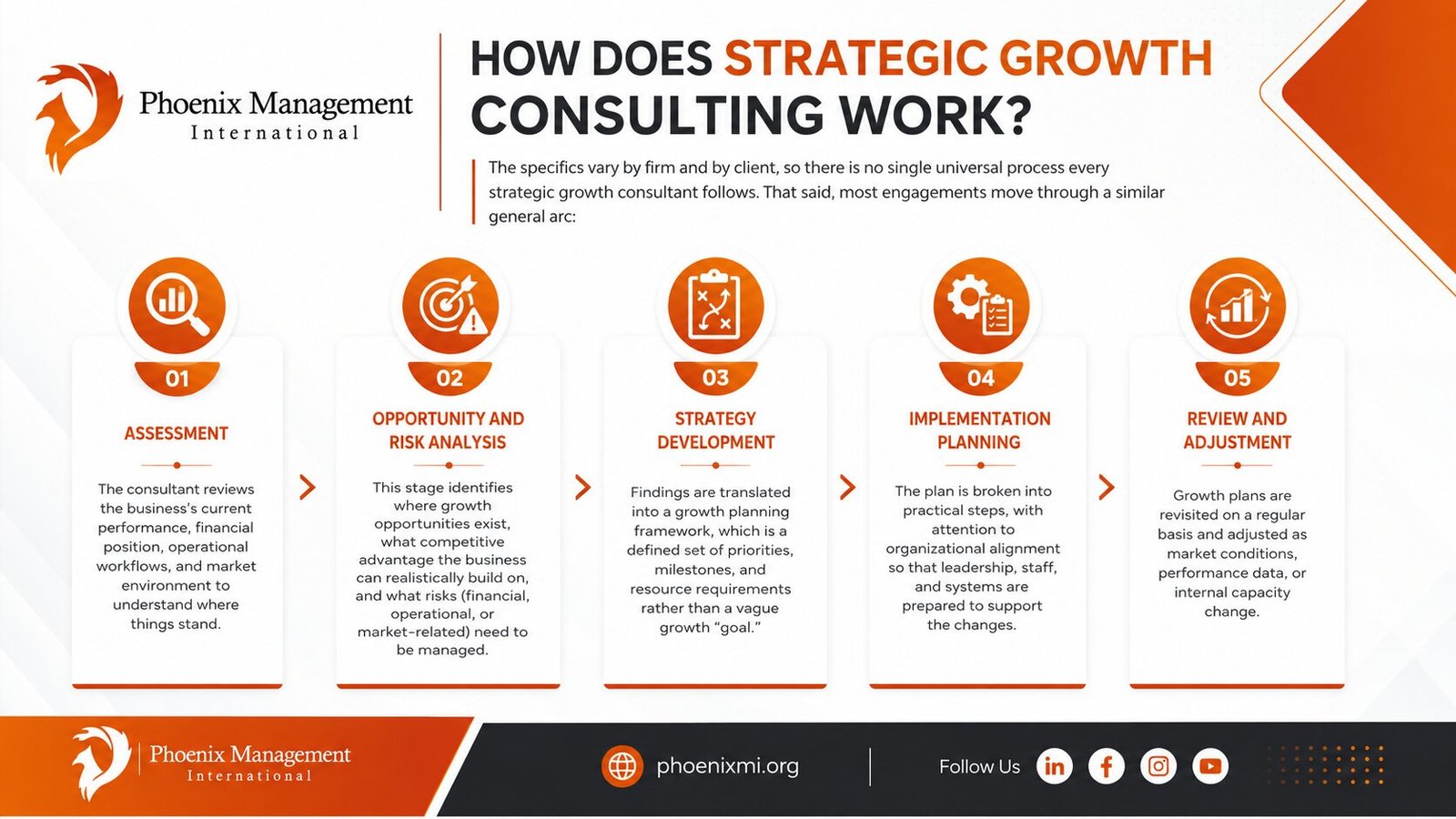
- Assessment. The consultant reviews the business’s current performance, financial position, operational workflows, and market environment to understand where things stand.
- Opportunity and risk analysis. This stage identifies where growth opportunities exist, what competitive advantage the business can realistically build on, and what risks (financial, operational, or market-related) need to be managed along the way.
- Strategy development. Findings are translated into a growth planning framework, which is a defined set of priorities, milestones, and resource requirements rather than a vague growth “goal.”
- Implementation planning. The plan is broken into practical steps, with attention to organizational alignment so that leadership, staff, and systems are prepared to support the changes.
- Review and adjustment. Growth plans are revisited on a regular basis and adjusted as market conditions, performance data, or internal capacity change.
The value of this process is coordination. A business might have a promising expansion idea, but if operational efficiency, staffing, or cash flow are not accounted for in the plan, growth can strain the business rather than strengthen it.
Why Is Strategic Growth Consulting Important for Sustainable Growth?
Sustainable growth matters because rapid, unplanned growth can be as damaging to a business as no growth at all. Increasing revenue without the operational capacity, financial planning, or organizational structure to support it often creates new problems instead of solving old ones.
Government data illustrates why staying power is not automatic. According to the U.S. Small Business Administration Office of Advocacy, roughly 49.2% of new employer businesses survive at least five years, and about 33.9% survive ten years. Survival and growth are different challenges, but both depend on the same underlying discipline: matching ambition to the resources and systems available to support it.
Strategy execution is its own hurdle even for larger, established organizations. Harvard Business Review has reported that some 60% to 90% of strategic plans never fully launch as intended, often because the strategy did not account for organizational capabilities, market pressures, or internal culture from the start. Strategic growth consulting is designed to close that gap between planning and execution, which is where many growth efforts quietly stall.
What Areas Can Strategic Growth Consulting Address?
Strategic growth consulting typically touches several interconnected areas rather than one isolated function:
- Strategic planning: Clarifying priorities and the roadmap for reaching them.
- Market opportunities: Evaluating new markets, segments, or offerings worth pursuing.
- Operational efficiency: Identifying bottlenecks or capacity limits that could slow growth, an area business management consulting often addresses directly.
- Business expansion: Assessing what new locations, products, or acquisitions actually require operationally and financially.
- Organizational alignment: Making sure leadership, teams, and structure can execute the plan.
- Competitive positioning: Understanding where the business stands relative to competitors.
- Risk management: Anticipating financial and operational risks tied to growth, closely connected to corporate advisory services.
What Are the Benefits of Strategic Growth Consulting?
Businesses that work with a strategic growth consultant generally gain:
- An outside perspective: leadership teams are often too close to daily operations to see structural issues clearly.
- A more realistic growth plan: built around actual financial and operational capacity, not just ambition.
- Better-informed decisions: market and competitive analysis replace guesswork.
- Improved operational efficiency: process and resource allocation issues are addressed before they limit growth.
- Reduced risk exposure: risk management is built into the plan rather than addressed after problems appear.
- A framework for accountability: milestones and performance measurement track whether the strategy is working.
How Can Businesses Build a Sustainable Growth Strategy?
While every business is different, a sustainable growth strategy generally requires the same core steps:
- Clarify the goal. Define what “growth” means: revenue, market share, geographic reach, or capacity, since each requires a different plan.
- Assess current capacity. Review financial planning, staffing, and operations honestly before committing to expansion.
- Identify real opportunities. Use market and competitive analysis to separate genuine opportunities from distractions.
- Build a growth planning framework. Put priorities, timelines, and resource needs in writing.
- Align the organization. Make sure leadership, teams, and structure can carry out the plan.
- Measure and adjust. Track performance and revise the plan as conditions change.
Growth Approach | Primary Focus | Best Use | Potential Limitation |
Organic Growth | Internal growth from existing operations | Established businesses with steady demand | May require more time to reach scale |
Market Expansion | Entering new markets or segments | Businesses with a scalable offering | Requires market research and investment |
Operational Optimization | Improving efficiency and reducing waste | Businesses experiencing inefficiencies | May require process or staffing changes |
Strategic Growth Consulting | Integrated growth strategy across functions | Businesses facing complex, multi-part growth decisions | Requires ongoing planning and follow-through to implement |
Practical example (hypothetical): Consider a growing service company with strong sales but frequent delays and staff turnover. Revenue looks healthy on paper, but operational strain is starting to affect customer retention. Strategic growth consulting would typically examine staffing, workflows, and resource allocation alongside the sales pipeline, rather than treating growth and operational strain as separate problems. This is a hypothetical example for illustration, not an actual client engagement.
What Challenges Can Prevent Sustainable Business Growth?
Several recurring issues can prevent growth from becoming sustainable:
- Operational bottlenecks: systems and staffing that worked at a smaller scale often break down under growth, a common starting point for improving operations and profitability.
- Weak financial planning: growth without adequate cash flow or financing can create solvency problems even when sales are strong.
- Unclear strategy: without a defined growth framework, decisions get made reactively.
- Organizational misalignment: leadership and staff working from different priorities slow execution.
- Underestimating risk: expansion and acquisitions carry risks that need identifying in advance, not after the fact.
- Leadership bottlenecks: too many decisions depending on one or two people limits how fast a business can move.
When Should a Business Consider Strategic Growth Consulting?
Strategic growth consulting tends to be most useful when a business is facing a decision or a strain that is bigger than day-to-day management can resolve. Common situations include:
- Growth in sales or demand is outpacing current systems and staffing
- Leadership is considering expansion, a new market, or a new location
- Recurring operational problems have resisted internal fixes
- The organization has grown complex enough that priorities feel unclear or conflicting
- A major strategic decision, such as an acquisition or restructuring, is on the table
- Leadership wants an objective, outside evaluation before committing resources
A closer look at when a business should consider hiring a consultant covers these situations in more depth.
How to Choose the Right Strategic Growth Consulting Partner
Because this work touches sensitive financial and operational information, the choice of partner matters. Consider:
- Relevant experience with businesses of a similar size, industry, or growth stage.
- A clear, explainable process for moving from assessment to strategy to implementation, not vague promises.
- A focus on execution, not just planning, given how often strategic plans stall after the document is finished.
- Transparent scope and communication about what’s included and how progress is measured.
- Genuine fit with your industry, market, and growth stage, rather than a generic template.
Useful questions to ask directly: What does your assessment process involve? How do you measure whether the strategy is working? What happens if market conditions change mid-engagement?
Consulting is not the only path forward. Some businesses address growth challenges through internal planning, additional in-house leadership, or industry-specific advisory groups. Outside consulting tends to add the most value when a business needs an objective perspective or expertise it doesn’t have internally.
How Phoenix Management International Supports Business Growth
Phoenix Management International is a management consulting and business advisory organization based in San Antonio, Texas, that works with business owners and executives on strategic planning, operational improvement, and growth decisions. Its services are organized around a few core areas: business management consulting for operational and financial strengthening, strategic consulting for strategic direction and execution, corporate advisory services for governance, risk, and transitions, and business brokerage services for owners evaluating a sale, partnership, or exit.
For businesses in San Antonio and beyond, this means access to strategic growth consulting that considers strategy, operations, and organizational structure together, rather than as separate projects. More on the firm’s background is available on its about page.
Frequently Asked Questions
What is strategic growth consulting?
A business advisory service focused on helping companies plan and manage growth to match their financial, operational, and organizational capacity, rather than pursuing growth for its own sake.
How can strategic growth consulting help a business?
It offers an outside perspective on strategy, operations, and structure, helping leadership identify realistic growth opportunities and build a plan that connects strategy to execution.
What does a strategic growth consultant do?
Typically assesses current performance and market position, identifies opportunities and risks, helps develop a growth strategy, and supports implementation and follow-up review.
What are the benefits of strategic growth consulting?
A more objective view of the business, a realistic growth plan, better-informed decisions, improved operational efficiency, and a clearer way to measure progress.
When should a business hire a strategic growth consultant?
When growth is outpacing current systems, a major strategic decision is on the table, operational problems persist, or leadership wants an objective evaluation before committing resources.
Can strategic growth consulting help a small business?
Yes, particularly when a small or growing business is approaching decisions, such as expansion, that exceed what internal resources can evaluate alone.
How do I choose a strategic growth consulting firm?
Look for relevant experience, an explainable process, a focus on implementation rather than planning alone, transparent communication, and genuine fit with your industry and growth stage.
What is the difference between business consulting and strategic growth consulting?
General business consulting can address a wide range of operational or managerial issues. Strategic growth consulting focuses specifically on the strategy, systems, and organizational readiness required to grow sustainably.
Key Takeaways
- Sustainable growth requires more than increasing revenue; it requires the operational and financial capacity to support that revenue.
- Strategic planning helps businesses align growth opportunities with the resources actually available to pursue them.
- Government data shows that long-term survival is not guaranteed by early success, which is part of why deliberate planning matters.
- Strategy execution, not just strategy design, is where many growth plans stall, according to Harvard Business Review research.
- Strategic growth consulting offers an outside, objective perspective for complex, multi-part growth decisions.
- The right consulting partner should understand your specific goals, challenges, and market, rather than apply a generic process.
Next Step
If your business is evaluating its next stage of growth, Phoenix Management International can help you assess strategic opportunities, review operational readiness, and build a practical plan for sustainable business growth. Contact the Phoenix Management International team to discuss your business goals, or explore the firm’s strategic consulting services to learn more.