
Business management services are generally more cost effective and flexible for small and mid-sized companies, while an in-house manager makes more sense for larger organizations that need a dedicated, full-time presence. The right choice depends on company size, budget, growth stage, and how much day-to-day oversight the business actually needs. Both options can improve operations, but they solve the problem in very different ways.
This comparison breaks down what each option actually involves, what it costs, and how to decide which one fits a specific business in San Antonio, TX or elsewhere.
What Are Business Management Services?
Business management services are outsourced professionals or firms that handle operational oversight, strategic planning, financial management, and administrative functions on behalf of a business, without becoming a full-time employee.
Instead of hiring one person to sit in an office every day, a company works with a management firm, like Phoenix Management International’s business management services, that brings a team of specialists to the table. That team typically includes people with different areas of expertise: operations, finance, strategy, and process improvement, all coordinated under one engagement.
Common services included under this model:
- Operational assessments and process improvement
- Financial oversight and budgeting support
- Strategic planning and growth roadmaps
- Vendor and cost management
- Performance tracking and reporting
- Interim or fractional leadership
Because the arrangement is contractual rather than an employment relationship, businesses can scale the level of support up or down as needs change.
What Does an In-House Manager Do?
An in-house manager is a full-time employee who oversees a specific area of the business, such as operations, finance, or general administration, and works exclusively for that one company.
An in-house manager becomes part of the internal team. They attend meetings daily, build institutional knowledge over time, and are available for immediate, hands-on decisions. This works well for businesses that need someone physically present, managing staff directly, and deeply embedded in day-to-day culture and workflow.
Business Management Services vs. In-House Manager: Key Differences
Feature | Business Management Services | In-House Manager |
Cost structure | Contract or retainer fee, often lower total cost | Salary, benefits, payroll taxes, and overhead |
Expertise access | Team of specialists across multiple disciplines | Single person’s skill set and experience |
Flexibility | Scales up or down based on business needs | Fixed cost regardless of workload |
Onboarding time | Faster, firm is already operational | Weeks to months for recruiting and training |
Day-to-day presence | Periodic or project-based, not always on-site | Full-time, on-site or consistently available |
Institutional knowledge | Builds over the length of the engagement | Builds continuously as a permanent team member |
Best suited for | Small to mid-sized businesses, project-based needs, growth phases | Larger organizations needing constant, direct oversight |
Neither option is universally better. The comparison above shows where each one has a natural advantage, and the right fit depends on what a specific business actually needs right now.
How Much Does Each Option Cost?
An in-house manager typically costs more overall once salary, benefits, payroll taxes, recruiting, and training are factored in, even though the base salary alone might look comparable to a management services retainer.
According to Business News Daily’s research on employee outsourcing, businesses often underestimate the full cost of an internal hire because benefits, taxes, equipment, and management overhead add significantly to the base salary. A management services engagement, by contrast, usually comes with a defined scope and fee structure, which makes budgeting more predictable.
That said, cost is not the only factor. A business with a stable, well-defined need for a permanent operational leader may find that a salaried hire pays for itself over time through consistency and direct control. A business in a growth phase, or one that needs specialized expertise for a limited period, often gets more value from an outsourced arrangement.
Benefits of Business Management Services
Outsourced business management gives a company access to a broader range of expertise than a single hire typically can, without the long-term financial commitment of a salaried position.
Key benefits include:
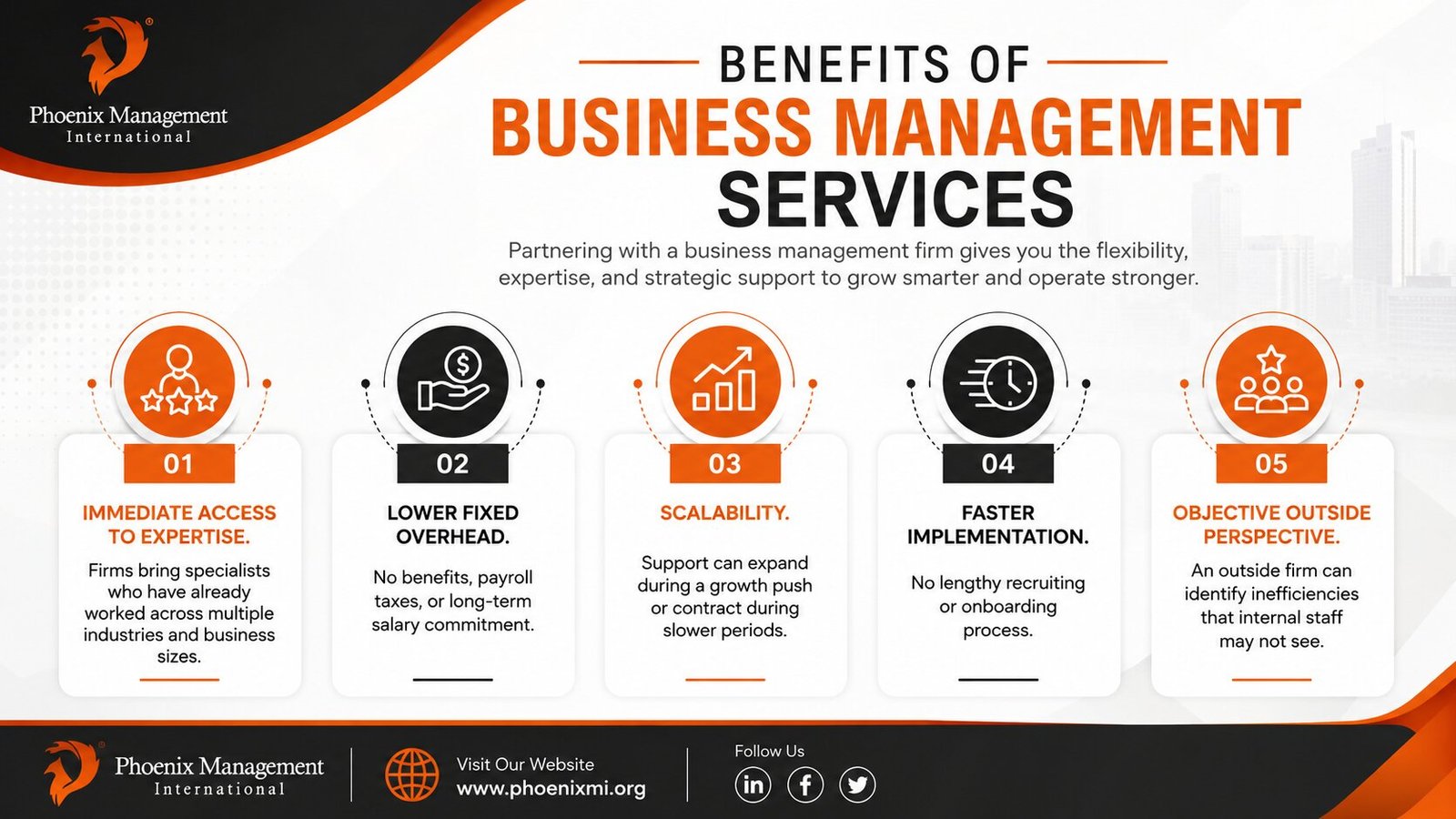
- Immediate access to expertise. Firms bring specialists who have already worked across multiple industries and business sizes.
- Lower fixed overhead. No benefits, payroll taxes, or long-term salary commitment.
- Scalability. Support can expand during a growth push or contract during slower periods.
- Faster implementation. No lengthy recruiting or onboarding process.
- Objective outside perspective. An outside firm can identify inefficiencies that internal staff may not see.
Disadvantages of Business Management Services
The main tradeoff with outsourced management is reduced day-to-day physical presence and a learning curve as the firm gets familiar with the business’s specific culture and systems.
Some businesses also find that outsourced support requires more structured communication, since the firm is not sitting in the building every day. This is usually addressed through regular check-ins, defined reporting cadences, and clear scope agreements at the start of the engagement.
Benefits of Hiring an In-House Manager
An in-house manager offers constant, direct oversight and builds deep familiarity with the company’s culture, staff, and daily operations over time.
Key benefits include:
- Full-time availability. Immediate access for decisions and staff management.
- Deep institutional knowledge. Familiarity with company history, culture, and internal relationships.
- Direct control. The business sets priorities and manages performance directly.
- Team integration. The manager becomes part of the internal culture and reporting structure.
Disadvantages of Hiring an In-House Manager
The biggest drawback of an in-house hire is total cost, since salary is only one part of the expense once benefits, payroll taxes, equipment, and recruiting are included.
There is also a skill ceiling. A single manager, no matter how capable, cannot match the combined expertise of a full outsourced team across operations, finance, and strategy at once. Magellan Solutions’ comparison of outsourcing versus in-house staffing points out that internal hires also carry higher fixed costs and slower scalability compared to outsourced arrangements, particularly for businesses whose needs fluctuate.
Who Should Use Business Management Services?
Business management services tend to fit best for small to mid-sized businesses, companies in a growth or transition phase, and organizations that need specialized expertise without the cost of multiple full-time hires.
This includes businesses that are:
- Scaling quickly and need operational structure to keep up
- Preparing for a merger, acquisition, or major transition
- Dealing with inefficient processes but lack internal expertise to fix them
- Looking to control costs while still improving performance
- Not yet ready to commit to a full executive team
Who Should Hire an In-House Manager?
An in-house manager is typically the better fit for larger organizations with complex, ongoing operational needs that require constant, hands-on leadership and direct staff supervision.
This includes businesses that:
- Have a large enough team to require daily, direct supervision
- Operate in an industry where physical presence is essential
- Have stable, predictable management needs that justify a permanent role
- Want full control over hiring, training, and performance management
What Should You Consider Before Choosing?
Before deciding, a business should evaluate its budget, growth stage, the complexity of its operations, and how much day-to-day physical oversight it genuinely requires.
A few practical questions to work through:
- Is the need ongoing and stable, or tied to a specific growth phase or project?
- Does the business need one generalist, or access to specialists across finance, operations, and strategy?
- What is the true cost comparison, including benefits, taxes, and onboarding time?
- How quickly does support need to be in place?
- Does the business have the internal structure to manage and support a new employee?
Businesses weighing this decision often benefit from talking with a firm that can assess their specific situation. Phoenix Management International’s team, for example, regularly works with San Antonio businesses to evaluate exactly this kind of tradeoff as part of their broader consulting and advisory services.
Business Management Services in San Antonio, TX
For businesses in San Antonio, TX, working with a local management services firm adds the advantage of market-specific knowledge, including familiarity with the regional business environment, local partnerships, and community networks.
Phoenix Management International, based in San Antonio, provides business management, strategic consulting, corporate advisory, and brokerage services to companies across the region. The firm’s strategic consulting services and corporate advisory services are often paired with business management engagements to give companies a more complete growth strategy, not just operational support.
This is a related question many San Antonio business owners ask early in the process, and it’s worth reading more in Phoenix Management International’s blog post on when a business should work with a management consultant, which walks through the signs that outside support is worth considering.
Frequently Asked Questions
What is the main difference between business management services and an in-house manager?
Business management services are outsourced and typically involve a team with varied expertise, while an in-house manager is a single full-time employee dedicated exclusively to one company.
Is it cheaper to outsource business management?
In most cases, yes. Outsourcing avoids the added costs of salary, benefits, payroll taxes, and recruiting that come with a full-time hire, though the exact savings depend on the scope of work involved.
Can a business use both options at the same time?
Yes. Some businesses use outsourced management services for specialized projects or strategic planning while keeping an in-house manager for daily operational supervision.
How long does it take to start working with a business management firm?
Most firms can begin an engagement much faster than the weeks or months it typically takes to recruit, interview, and onboard a new employee.
Is business management outsourcing worth it for a small business?
For many small businesses, outsourcing is worth it because it provides access to expertise and structure that would otherwise be unaffordable as a full-time hire. It works especially well during growth phases or when specific operational problems need outside expertise to solve.
Does an outsourced manager understand a business as well as an in-house manager?
Not immediately, but a good management firm builds that understanding quickly through structured onboarding, regular communication, and close collaboration with existing staff and leadership.
Key Takeaways
- Business management services generally cost less than a full-time in-house hire once benefits, taxes, and overhead are factored in.
- Outsourced services offer access to a broader team of specialists, while an in-house manager offers full-time, dedicated presence.
- Growing or transitioning businesses tend to benefit most from outsourced management support.
- Larger organizations with complex, ongoing operational needs often benefit more from a dedicated in-house hire.
- The right choice depends on budget, growth stage, and how much daily oversight the business truly requires.
- Some businesses successfully combine both approaches depending on the task.
Next Step
Businesses trying to decide between outsourced business management services and an in-house hire don’t have to work through the decision alone. Phoenix Management International offers a free 15-minute consultation to review a business’s specific operations, budget, and goals, and to recommend the approach that fits best. Schedule a consultation to talk through the options.