
Running a successful business requires more than a great idea. As companies grow, leaders often face decisions about improving operations, increasing profitability, managing teams, expanding into new markets, or preparing for long-term growth. This is where many business owners begin exploring Business Management Services and Business Consulting, but understanding the difference between the two is essential before investing.
Although these terms are sometimes used interchangeably, they serve different purposes. One focuses on helping manage and improve day-to-day business operations, while the other provides strategic expertise to solve specific challenges or achieve defined goals.
In this guide, you’ll learn the key differences between business management and business consulting, when each service is appropriate, their benefits, real-world examples, and how to determine which option best fits your organization’s needs.
What Is Business Management?
Business management is the process of planning, organizing, directing, and overseeing an organization’s daily operations to ensure long-term efficiency, profitability, and sustainable growth.
Businesses often rely on Business Management Services when they need ongoing operational support, leadership guidance, performance monitoring, or help improving internal systems.
Business management typically involves:
- Financial oversight
- Operational efficiency
- Workforce management
- Strategic planning
- Process improvement
- Risk management
- Performance measurement
- Organizational development
Rather than solving a single problem, business management focuses on creating systems that keep the organization running effectively over time.
What Is Business Consulting?
Business Consulting is a professional advisory service that helps organizations solve specific business challenges, improve performance, or achieve strategic objectives through expert recommendations.
Unlike business management, consultants generally do not manage daily operations. Instead, they analyze the business, identify opportunities or problems, develop solutions, and often assist with implementation.
Business consultants may specialize in areas such as:
- Growth strategy
- Operations
- Marketing
- Human resources
- Financial planning
- Technology implementation
- Organizational change
- Business transformation
Consulting engagements are often project-based and designed to address a particular need within a defined timeframe.
Business Management vs. Business Consulting: Quick Comparison
| Feature | Business Management | Business Consulting |
|---|---|---|
| Primary Purpose | Manage ongoing operations | Solve specific business challenges |
| Engagement | Long-term | Short-term or project-based |
| Focus | Execution and oversight | Strategy and recommendations |
| Involvement | Hands-on management | Advisory role |
| Goal | Operational excellence | Business improvement and transformation |
| Decision Making | Often participates in operational decisions | Provides expert guidance for decision-makers |
| Best For | Businesses needing continuous support | Businesses facing specific issues or growth opportunities |
The Key Differences Between Business Management and Business Consulting
Although both services aim to improve business performance, they differ in several important ways.
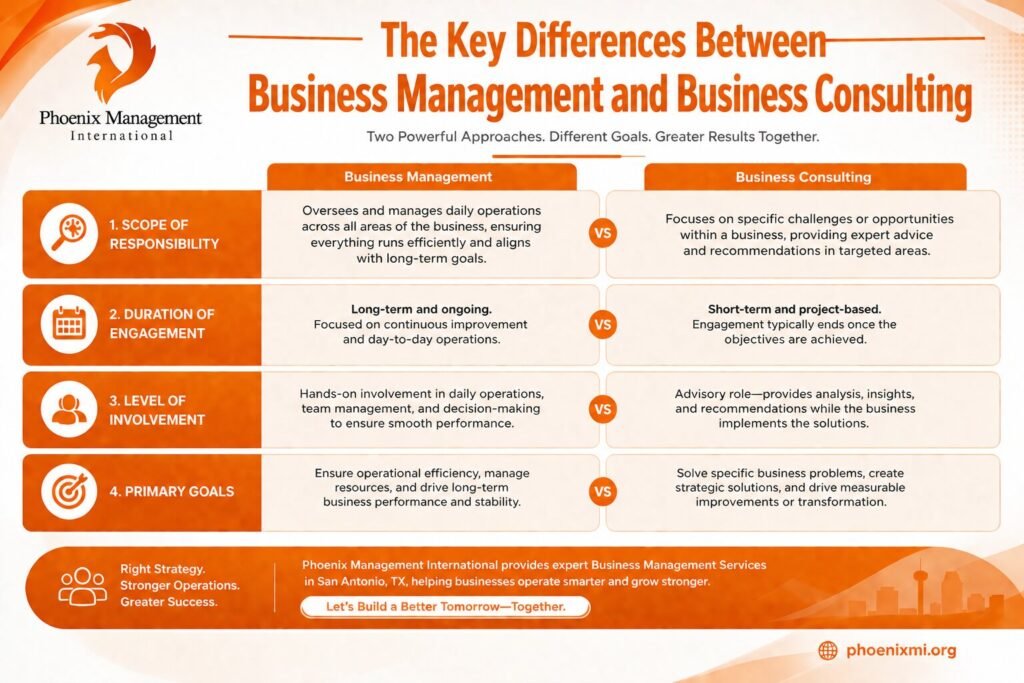
1. Scope of Responsibility
Business managers oversee multiple aspects of an organization’s operations, ensuring departments work together efficiently.
Business consultants typically focus on one area, such as improving sales processes, restructuring operations, implementing technology, or developing growth strategies.
Example:
A retail company struggling with declining revenue may hire:
- A business consultant to identify why sales are dropping.
- A business management team to oversee operational improvements after the strategy has been developed.
2. Duration of Engagement
Business management is generally an ongoing partnership.
Business consulting is often temporary and ends once objectives have been achieved.
Examples include:
- Expanding into a new market
- Preparing for acquisition
- Improving supply chain efficiency
- Developing a strategic growth plan
- Implementing new software
3. Level of Involvement
Business managers are directly involved in daily business operations.
Their responsibilities may include:
- Supervising teams
- Managing budgets
- Monitoring KPIs
- Improving workflows
- Coordinating departments
Business consultants usually provide:
- Analysis
- Strategic recommendations
- Action plans
- Executive coaching
- Implementation support
The company’s leadership remains responsible for ongoing management.
4. Primary Goals
Business management aims to maintain operational stability while improving long-term organizational performance.
Business consulting focuses on solving defined problems, identifying opportunities, and helping organizations achieve measurable outcomes.
When Does a Business Need Business Management Services?
Many growing companies eventually reach a point where operational complexity exceeds internal capacity.
You may benefit from Business Management Services if your business experiences:
- Rapid growth
- Inefficient operations
- Poor communication between departments
- Declining productivity
- Leadership capacity challenges
- Scaling difficulties
- Increased compliance requirements
- Need for better financial oversight
Management professionals help build sustainable systems that support future growth rather than simply addressing short-term issues.
When Should You Hire a Business Consultant?
A consultant is often the right choice when your business needs specialized expertise for a particular objective.
Common situations include:
- Launching a new product
- Entering new markets
- Improving profitability
- Digital transformation
- Organizational restructuring
- Leadership development
- Mergers and acquisitions
- Customer experience improvement
Rather than replacing management, consultants strengthen decision-making through expert analysis and recommendations.
Benefits of Business Management Services
Organizations that invest in effective management often experience improvements across multiple areas.
Key benefits include:
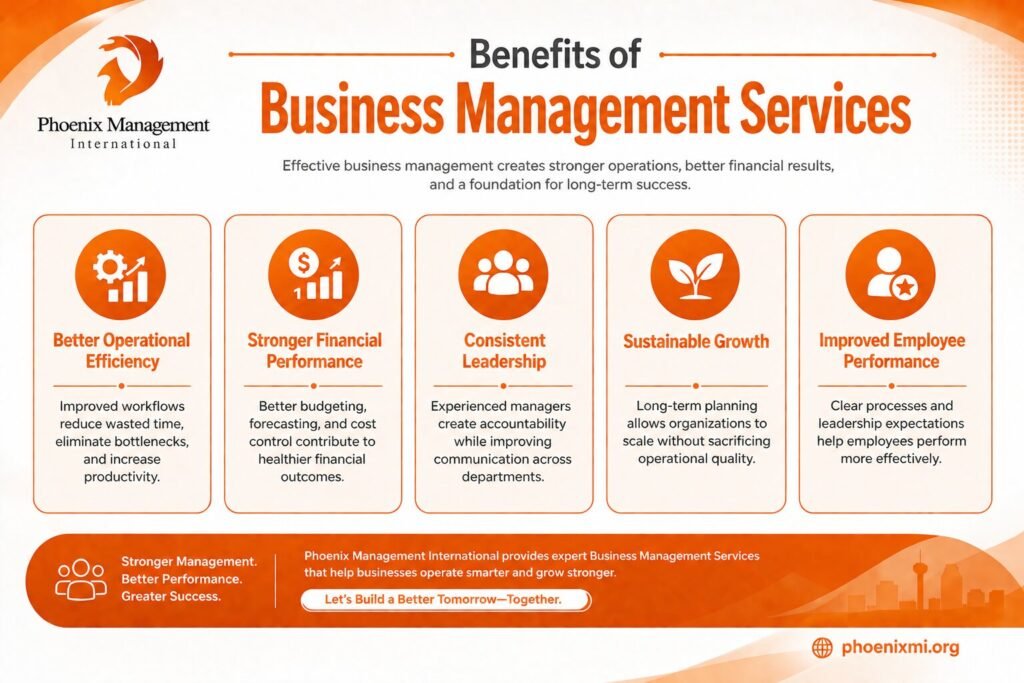
Better Operational Efficiency
Improved workflows reduce wasted time, eliminate bottlenecks, and increase productivity.
Stronger Financial Performance
Better budgeting, forecasting, and cost control contribute to healthier financial outcomes.
Consistent Leadership
Experienced managers create accountability while improving communication across departments.
Sustainable Growth
Long-term planning allows organizations to scale without sacrificing operational quality.
Improved Employee Performance
Clear processes and leadership expectations help employees perform more effectively.
Benefits of Business Consulting
Business Consulting offers significant value when organizations need outside expertise.
Benefits include:
- Objective business analysis
- Specialized industry knowledge
- Faster problem-solving
- Strategic planning support
- Innovation and fresh perspectives
- Reduced operational risks
- Improved decision-making
- Competitive advantage
Consultants often identify opportunities that internal teams may overlook due to familiarity with existing processes.
Can Businesses Benefit From Both?
Absolutely.
Many successful organizations combine business management with consulting services.
For example:
A manufacturing company wants to expand nationwide.
A consultant may:
- Conduct market research
- Develop an expansion strategy
- Analyze financial feasibility
- Recommend operational improvements
Meanwhile, the business management team:
- Oversees implementation
- Coordinates departments
- Manages staffing
- Monitors budgets
- Tracks project performance
Together, these services create a stronger foundation for successful growth.
Real-World Example
Imagine a healthcare company experiencing rapid expansion.
The leadership notices:
- Rising operating costs
- Inconsistent employee performance
- Delayed project completion
- Poor communication across departments
A business consultant first analyzes the business and identifies process inefficiencies.
Once the strategy has been developed, business management professionals oversee implementation by:
- Creating new operational procedures
- Managing departmental changes
- Monitoring performance metrics
- Training leadership teams
- Ensuring accountability
The result is a more efficient organization capable of sustaining future growth.
How to Choose the Right Service
Consider these questions before making a decision.
Choose Business Management Services if you need:
✔ Ongoing operational leadership
✔ Process improvement
✔ Team management
✔ Organizational structure
✔ Long-term performance improvement
✔ Continuous business oversight
Choose Business Consulting if you need:
✔ Expert advice
✔ Strategic planning
✔ Industry expertise
✔ Market expansion guidance
✔ Business transformation
✔ Short-term project support
If your organization needs both strategy and execution, combining these services often delivers the strongest results.
Common Misconceptions
“Business consultants manage my company.”
Not usually. Consultants provide recommendations and implementation support, but they generally do not oversee daily operations.
“Business management is only for large corporations.”
Small and mid-sized businesses often benefit the most because effective management systems support sustainable growth as the company expands.
“Consulting is only needed during a crisis.”
Many businesses hire consultants proactively to improve operations, identify growth opportunities, or prepare for future expansion.
Key Takeaways
- Business Management Services focus on overseeing daily operations and improving long-term organizational performance.
- Business Consulting helps businesses solve specific challenges through expert analysis and strategic recommendations.
- Business management is ongoing, while consulting is typically project-based.
- Many organizations achieve the best outcomes by combining both services.
- Choosing the right approach depends on your company’s goals, operational needs, and stage of growth.
FAQs
What is the main difference between business management and business consulting?
Business management focuses on overseeing daily operations and long-term organizational performance, while Business Consulting provides expert guidance to solve specific business problems or achieve strategic objectives.
Which businesses benefit most from Business Management Services?
Businesses experiencing growth, operational challenges, leadership gaps, or increasing complexity often benefit the most from Business Management Services, as they provide ongoing support to improve efficiency and maintain organizational stability.
Can a business consultant help implement recommendations?
Yes. Many consultants assist with implementation, monitor progress, and provide guidance throughout the project. However, they typically do not take over responsibility for managing the company’s daily operations.
Is business consulting only for large companies?
No. Small businesses, startups, and mid-sized organizations frequently hire consultants to improve operations, develop growth strategies, reduce costs, or prepare for expansion.
Can a company use both business management and consulting services?
Yes. Many organizations combine both approaches. Consultants develop strategic solutions, while management professionals oversee execution, monitor performance, and ensure long-term success.
Final Thoughts
Choosing between Business Management Services and Business Consulting isn’t about deciding which is better; it’s about identifying what your business needs most right now. If your priority is strengthening day-to-day operations and building a foundation for sustainable growth, management services may be the right fit. If you’re tackling a specific challenge or planning a major initiative, consulting can provide the expertise and strategic direction needed to move forward.
As your business evolves, you may find that a combination of both delivers the greatest value, helping you align strategy with execution and achieve long-term success.
Ready to Strengthen Your Business?
Whether you’re looking to improve daily operations, overcome business challenges, or create a long-term growth strategy, Phoenix Management International provides professional Business Management Services in San Antonio, TX tailored to your organization’s unique goals. Our experienced team helps businesses streamline operations, improve performance, and build a stronger foundation for sustainable success.
Contact Phoenix Management International today to discover how our business management experts can help your business grow with confidence.