
Choosing the right brokerage firm is one of the most important financial decisions for investors, traders, and businesses looking to grow wealth or access markets. Whether you’re investing in stocks, bonds, ETFs, or seeking professional brokerage services, the type of brokerage you choose directly impacts your fees, support level, investment options, and overall success.
Today’s financial ecosystem offers multiple types of brokerage firms, from traditional full-service providers to automated digital platforms. Understanding how each one works helps you make smarter, more cost-effective investment decisions aligned with your financial goals.
What Is a Brokerage Firm?
A brokerage firm is a licensed financial intermediary that executes buy and sell orders for clients in financial markets. These firms act as the bridge between investors and exchanges.
They typically provide:
- Stock and bond trading access
- Investment advisory services
- Portfolio management
- Market research and insights
- Retirement and wealth planning solutions
Some firms focus purely on execution, while others offer consulting and brokerage services that include personalized financial guidance.
Read More: What Is Business Brokerage and Why Do You Need It?
Types of Brokerage Firms
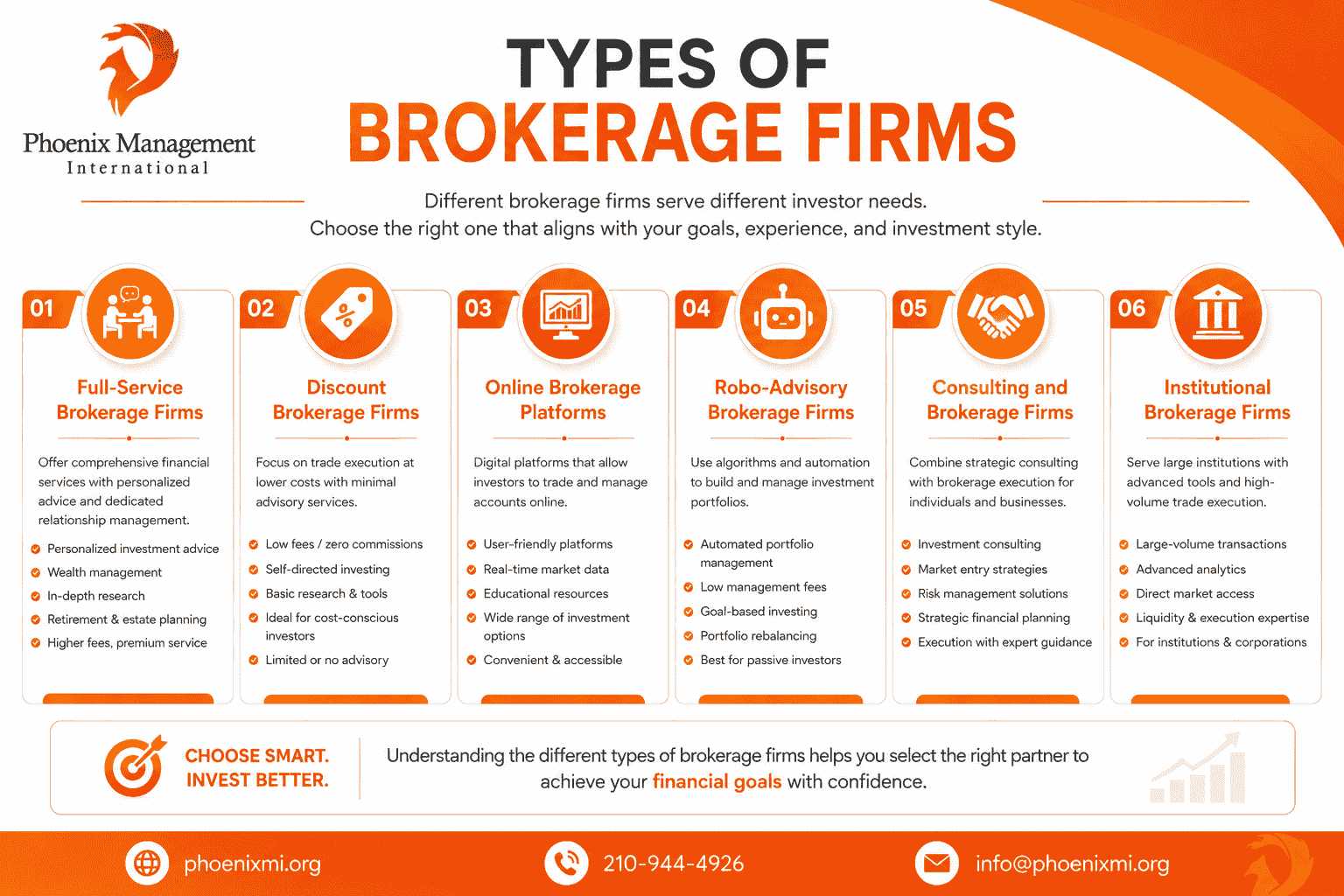
1. Full-Service Brokerage Firms
Full-service brokers offer a complete suite of financial services, including personalized investment advice, tax planning, retirement strategies, and wealth management.
They are ideal for:
- High-net-worth individuals
- Busy professionals
- Investors seeking expert guidance
These firms charge higher fees but provide a highly personalized experience.
Popular examples include:
- Charles Schwab
- Fidelity Investments
Key Features:
- Dedicated financial advisors
- Custom portfolio strategies
- In-depth research reports
- Estate and tax planning support
2. Discount Brokerage Firms
Discount brokers focus mainly on executing trades at lower costs without offering extensive advisory services.
They are suitable for:
- Self-directed investors
- Cost-conscious traders
- Experienced market participants
Key Features:
- Low trading fees or zero commissions
- Limited or no personalized advice
- Fast order execution
- Online trading platforms
3. Online Brokerage Platforms
Online brokers operate entirely through digital platforms, allowing users to trade independently from mobile or desktop applications.
Examples include:
- Vanguard
- Interactive Brokers
Key Features:
- User-friendly dashboards
- Real-time market data
- Educational resources
- Advanced trading tools
These platforms have made investing more accessible to beginners and global investors alike.
4. Robo-Advisory Brokerage Firms
Robo-advisors use algorithms and AI-driven systems to manage investment portfolios automatically based on user preferences and risk tolerance.
Best for:
- Beginners
- Passive investors
- Long-term wealth building
Key Features:
- Automated portfolio rebalancing
- Low management fees
- Goal-based investing
- Minimal human interaction
5. Consulting and Brokerage Firms
These firms combine advisory consulting with brokerage execution services. They are increasingly popular among businesses and institutional clients needing strategic financial planning along with trade execution.
Common services include:
- Investment consulting
- Market entry strategies
- Risk management solutions
- Institutional trading support
This model is often used in professional brokerage services where strategic financial consulting is as important as trade execution.
6. Institutional Brokerage Firms
Institutional brokers serve large organizations such as hedge funds, banks, pension funds, and corporations.
Key Features:
- Large-volume trade execution
- Advanced analytics tools
- Direct market access
- Liquidity optimization
They operate at a much higher scale compared to retail brokerage firms.
Brokerage Firms Comparison Table
| Type | Target Users | Services | Cost Level | Control |
|---|---|---|---|---|
| Full-Service Brokers | Individuals, HNWIs | Advisory + Trading | High | Low |
| Discount Brokers | Retail traders | Execution only | Low | High |
| Online Brokers | General investors | Digital trading tools | Low | High |
| Robo-Advisors | Beginners | Automated investing | Very Low | Very High |
| Consulting Brokers | Businesses, investors | Strategy + execution | Medium–High | Medium |
| Institutional Brokers | Large institutions | Bulk trading | High | Very Low |
How to Choose the Right Brokerage Firm
Selecting the right brokerage depends on your financial goals and experience level.
Consider the following factors:
- Investment goals (short-term vs long-term)
- Fee structure (commissions, management fees)
- Platform usability
- Customer support and advisory services
- Available asset classes
- Level of control you want
If you are a beginner, robo-advisors or online brokers may be ideal. If you need expert guidance, full-service or consulting brokers are better suited.
Brokerage Services in San Antonio
In regions like Texas, demand for brokerage services san antino (commonly searched variation) is growing due to increasing small business investments and retail trading activity. Local brokerage firms often provide hybrid models combining digital trading platforms with personalized advisory services to meet diverse client needs.
Common Mistakes to Avoid When Choosing a Brokerage Firm
- Choosing based only on low fees
- Ignoring hidden charges
- Not checking platform security
- Overlooking customer support quality
- Selecting a broker without clear investment goals
FAQs
1. What is the main role of a brokerage firm?
A brokerage firm acts as an intermediary that executes buy and sell orders for clients in financial markets.
2. Which brokerage type is best for beginners?
Robo-advisors and online brokerage platforms are generally best for beginners due to ease of use and low cost.
3. What is the difference between full-service and discount brokers?
Full-service brokers provide advisory and wealth management services, while discount brokers only execute trades at lower fees.
4. Are brokerage firms safe to use?
Yes, regulated brokerage firms are generally safe as they must comply with financial authority regulations and client protection laws.
5. What are consulting and brokerage services?
These services combine financial consulting with trade execution, helping clients with both strategy and transactions.
6. How do brokerage firms make money?
They earn through commissions, spreads, advisory fees, and account management charges.
Summary & Key Takeaways
Understanding the different types of brokerage firms helps investors choose the right platform based on their goals, experience, and budget. From full-service advisory firms to low-cost digital brokers and automated robo-advisors, each model serves a unique purpose in the financial ecosystem.
If you’re looking to take your investment strategy to the next level, Phoenix Management International is here to help. With a strong focus on professional brokerage services in San Antonio, the company delivers tailored solutions designed to meet the needs of both individual and business investors. Whether you require expert market guidance, portfolio support, or full-service brokerage assistance, Phoenix Management International combines experience, strategy, and market insight to help you make confident financial decisions.
Connect with Phoenix Management International today to explore smarter investment opportunities and experience brokerage services built around performance, trust, and long-term growth.