
Running a successful business isn’t just about increasing sales or attracting new customers. Sustainable growth comes from understanding what your numbers are telling you. Whether you’re managing a startup or an established company, measuring business performance helps you make informed decisions, identify opportunities, and solve problems before they become costly.
The most successful organizations don’t rely on assumptions; they track meaningful data that reflects financial health, operational efficiency, customer satisfaction, and long-term growth.
This guide explains how to measure business performance, the key metrics every business should monitor, common mistakes to avoid, and how a Business Management Consultant can help transform business data into strategic decisions.
What Is Business Performance?
Business performance refers to how effectively a company achieves its strategic objectives. It measures whether the business is growing profitably, serving customers well, managing resources efficiently, and maintaining a competitive position.
Rather than focusing on a single number like revenue, high-performing businesses evaluate multiple Key Performance Indicators (KPIs) that provide a complete picture of organizational success.
Why Measuring Business Performance Matters
Consistently tracking performance helps businesses:
- Make data-driven decisions
- Improve profitability
- Increase operational efficiency
- Monitor customer satisfaction
- Identify risks early
- Allocate resources more effectively
- Set realistic business goals
- Build sustainable long-term growth
Businesses that regularly monitor KPIs can react faster to market changes and make strategic improvements before minor issues become major challenges.
The Business Management Process Behind Performance Measurement
Effective performance tracking isn’t just about collecting numbers. It follows a structured Business Management Process that includes:
- Setting measurable business goals
- Identifying relevant KPIs
- Collecting accurate data
- Analyzing trends
- Taking corrective action
- Monitoring improvements continuously
Without this process, businesses often collect data without using it to improve decision-making.
Key Metrics Every Business Should Track
No single metric tells the entire story. Instead, business owners should monitor several categories of KPIs.
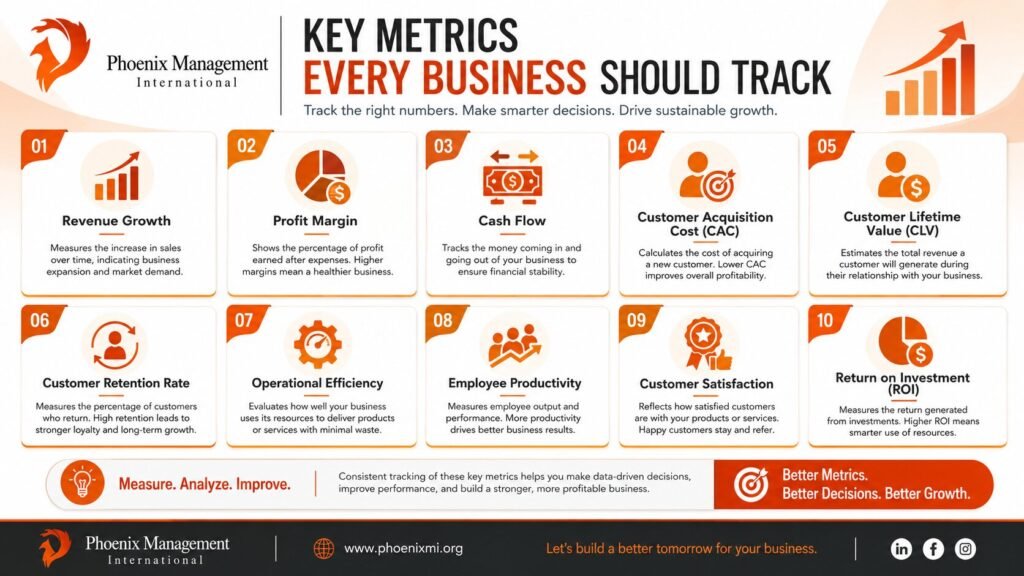
1. Revenue Growth
Revenue growth measures whether your company is generating more income over time.
Track:
- Monthly revenue
- Quarterly revenue
- Annual revenue
- Growth percentage
- Revenue by product or service
Steady revenue growth generally indicates increasing market demand and successful business strategies.
2. Profit Margin
Revenue alone doesn’t indicate success.
A business can generate millions in sales while earning very little profit.
Monitor:
- Gross profit margin
- Operating profit margin
- Net profit margin
Healthy profit margins indicate efficient cost management and pricing strategies.
3. Cash Flow
Cash flow determines whether your business has enough money to cover day-to-day operations.
Positive cash flow allows businesses to:
- Pay employees
- Purchase inventory
- Invest in growth
- Handle unexpected expenses
Even profitable businesses can fail if cash flow is poorly managed.
4. Customer Acquisition Cost (CAC)
Customer Acquisition Cost measures how much it costs to gain a new customer.
Formula:
Customer Acquisition Cost = Total Marketing & Sales Costs ÷ Number of New Customers
Lower acquisition costs typically improve overall profitability.
5. Customer Lifetime Value (CLV)
Customer Lifetime Value estimates the total revenue generated by a customer throughout their relationship with your business.
When CLV exceeds Customer Acquisition Cost by a healthy margin, your business model becomes significantly more sustainable.
6. Customer Retention Rate
Keeping existing customers is often more cost-effective than acquiring new ones.
Track:
- Repeat purchases
- Customer loyalty
- Renewal rates
- Churn rate
High retention often reflects excellent customer experience and consistent value.
7. Operational Efficiency
Operational efficiency measures how effectively your company uses time, people, and resources.
Common indicators include:
- Production costs
- Employee productivity
- Project completion time
- Inventory turnover
- Resource utilization
Improving operational efficiency often leads to higher profits without increasing revenue.
8. Employee Productivity
Employees are one of every organization’s greatest assets.
Useful metrics include:
- Revenue per employee
- Sales per employee
- Project completion rates
- Employee engagement
- Staff turnover
Businesses with engaged teams often experience stronger customer satisfaction and higher profitability.
9. Customer Satisfaction
Satisfied customers are more likely to return and recommend your business.
Track using:
- Customer Satisfaction Score (CSAT)
- Net Promoter Score (NPS)
- Online reviews
- Customer feedback surveys
- Complaint resolution time
Customer satisfaction often predicts future revenue better than sales alone.
10. Return on Investment (ROI)
ROI evaluates whether your investments generate meaningful returns.
Measure ROI for:
- Marketing campaigns
- Technology upgrades
- Equipment purchases
- Employee training
- Business expansion
Businesses should regularly compare investment costs against measurable outcomes.
Business Performance Metrics at a Glance
|
Metric |
What It Measures |
Why It Matters |
|
Revenue Growth |
Sales increase over time |
Indicates business expansion |
|
Profit Margin |
Profit after expenses |
Measures profitability |
|
Cash Flow |
Available operating cash |
Ensures financial stability |
|
Customer Acquisition Cost |
Cost to gain customers |
Evaluates marketing efficiency |
|
Customer Lifetime Value |
Long-term customer revenue |
Supports sustainable growth |
|
Customer Retention |
Repeat customers |
Improves profitability |
|
Operational Efficiency |
Resource utilization |
Reduces waste |
|
Employee Productivity |
Workforce performance |
Boosts efficiency |
|
Customer Satisfaction |
Customer experience |
Drives loyalty |
|
ROI |
Investment effectiveness |
Improves strategic decisions |
Business Management Benefits of Tracking KPIs
Consistent performance measurement delivers several important Business Management Benefits.
Businesses can:
- Improve strategic planning
- Increase operational efficiency
- Reduce unnecessary expenses
- Identify growth opportunities
- Make faster decisions
- Improve customer experiences
- Strengthen financial management
- Build accountability across teams
Organizations that monitor meaningful metrics are typically better prepared for market changes and long-term growth.
Common Business Management Mistakes That Affect Performance
Many businesses collect data but fail to use it effectively.
Some of the most common Business Management Mistakes include:
Tracking Too Many Metrics
Measuring everything often creates confusion.
Instead, focus on KPIs directly connected to your business objectives.
Ignoring Customer Feedback
Financial metrics matter, but customer experience often predicts future performance.
Negative reviews, complaints, and declining satisfaction scores should never be ignored.
Measuring Only Revenue
Revenue without profitability provides an incomplete picture.
Always analyze profit margins alongside sales.
Failing to Review KPIs Regularly
Performance reports lose value if they’re reviewed only once a year.
Monthly or quarterly reviews allow businesses to identify trends early.
Making Decisions Based on Assumptions
Successful businesses validate ideas with accurate data rather than intuition alone.
How a Business Management Consultant Can Help
Many business owners understand the importance of KPIs but struggle to interpret data or develop actionable strategies.
A Business Management Consultant can help by:
- Identifying the most meaningful KPIs
- Creating customized performance dashboards
- Improving operational efficiency
- Developing growth strategies
- Streamlining business operations
- Optimizing financial performance
- Supporting leadership decision-making
- Building long-term strategic plans
Professional guidance helps businesses move beyond reporting numbers to making better business decisions.
For businesses seeking local expertise, working with a Business Management Consultant in San Antonio can provide personalized insights into regional market conditions, operational challenges, and sustainable growth strategies.
Best Practices for Measuring Business Performance
To maximize the value of performance tracking:
Set SMART Goals
Ensure objectives are:
- Specific
- Measurable
- Achievable
- Relevant
- Time-bound
Automate Reporting
Use business intelligence tools or dashboards to reduce manual reporting and improve accuracy.
Review KPIs Consistently
Monthly reviews help identify patterns before they become larger issues.
Align Metrics With Business Goals
Every KPI should support a strategic objective.
If a metric doesn’t influence decisions, it may not need to be tracked.
Encourage Team Accountability
Share performance data with leadership and employees to promote transparency and continuous improvement.
Key Takeaways
✔ Business performance should be measured using multiple financial and operational KPIs—not revenue alone.
✔ Profitability, cash flow, customer satisfaction, employee productivity, and operational efficiency all contribute to long-term success.
✔ Following a structured Business Management Process helps businesses turn data into actionable improvements.
✔ Avoid common Business Management Mistakes such as tracking too many metrics, ignoring customer feedback, or relying solely on intuition.
✔ Partnering with a qualified Business Management Consultant can help businesses develop smarter strategies and achieve sustainable growth.
Frequently Asked Questions
What is the most important business performance metric?
There isn’t a single most important metric. Businesses should monitor a combination of revenue growth, profit margin, cash flow, customer satisfaction, and operational efficiency to gain a complete understanding of performance.
How often should businesses measure performance?
Most businesses benefit from reviewing key performance metrics monthly, while strategic performance evaluations are often conducted quarterly and annually.
Why are KPIs important for business growth?
KPIs provide measurable insights into business performance, helping leaders identify strengths, address weaknesses, allocate resources effectively, and make informed decisions.
Can small businesses benefit from performance measurement?
Yes. Even small businesses can improve profitability, reduce costs, and make better strategic decisions by consistently tracking relevant performance metrics.
When should a business hire a Business Management Consultant?
Businesses often benefit from hiring a consultant when experiencing stagnant growth, operational inefficiencies, declining profitability, organizational changes, or when planning expansion.
Conclusion
Measuring business performance is essential for making informed decisions and building a resilient organization. By tracking the right KPIs, following a structured business management process, and regularly reviewing results, business owners can uncover opportunities, address challenges early, and position their companies for long-term success. The goal isn’t simply to collect data; it’s to use meaningful insights to improve every aspect of your business.
Ready to Improve Your Business Performance?
Whether you’re looking to streamline operations, strengthen financial performance, or develop a long-term growth strategy, Phoenix Management International provides professional Business Management Services in San Antonio, TX. Our experienced consultants work closely with business owners to identify opportunities, optimize processes, and implement practical strategies that drive measurable results. Contact Phoenix Management International to learn how expert business management support can help your organization achieve sustainable growth.