
Growing revenue is often seen as the primary path to business success. However, increasing sales isn’t always the fastest—or the most sustainable, way to improve your bottom line. Many profitable companies focus on maximizing the value of the revenue they already generate by improving efficiency, reducing waste, optimizing operations, and making smarter business decisions.
If you’re looking for practical ways to improve business profitability without increasing revenue, this guide explains proven strategies that help businesses strengthen profit margins, improve operational performance, and build long-term financial stability. Whether you’re a startup, small business, or established company, these approaches can often produce measurable results faster than chasing additional sales.
What Does It Mean to Improve Business Profitability Without Increasing Revenue?
Improving business profitability without increasing revenue means earning more profit from your existing income by reducing unnecessary costs, improving operational efficiency, optimizing pricing, streamlining workflows, and making better use of available resources.
In simple terms:
Revenue is how much money your business earns. Profitability is how much money your business keeps.
A business can generate millions in revenue yet remain barely profitable because of high operating costs, inefficient processes, poor inventory management, or weak financial controls.
Revenue vs. Profitability
| Revenue | Profitability |
|---|---|
| Total income from sales | Money remaining after expenses |
| Focuses on growth | Focuses on efficiency |
| Can increase expenses | Can improve without additional sales |
| Doesn’t always indicate success | Better reflects financial health |
Why Improving Profitability Matters More Than Chasing Revenue
Many businesses become trapped in a cycle of pursuing higher sales while overlooking operational inefficiencies.
Increasing revenue often requires:
- Higher marketing budgets
- More employees
- Larger inventory
- Increased customer acquisition costs
- Greater operational complexity
Improving profitability, on the other hand, often involves making smarter use of existing resources.
Benefits include:
- Stronger cash flow
- Higher business valuation
- Better resilience during economic downturns
- Increased reinvestment opportunities
- Greater financial stability
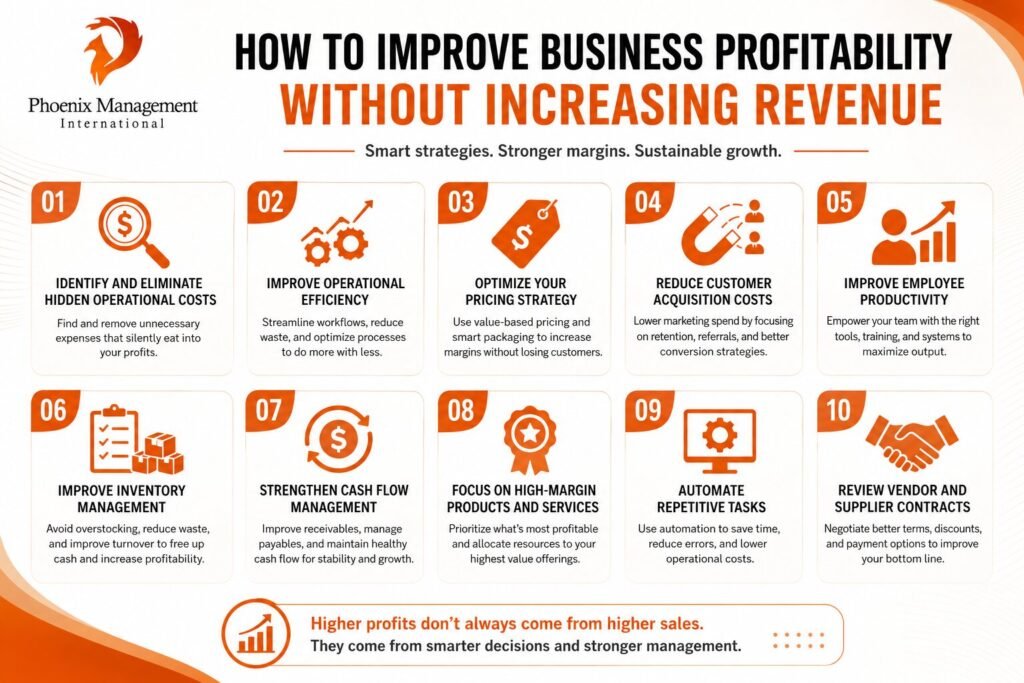
1. Identify and Eliminate Hidden Operational Costs
One of the fastest ways to improve profitability is identifying expenses that quietly reduce margins.
Common hidden costs include:
- Duplicate software subscriptions
- Inefficient workflows
- Excess overtime
- Poor inventory management
- Equipment downtime
- Unnecessary administrative work
- High utility expenses
- Manual processes that could be automated
Practical Example
A manufacturing company discovers three departments using separate project management platforms. Consolidating into one platform reduces annual software expenses while improving collaboration.
2. Improve Operational Efficiency
Operational efficiency directly affects profitability.
Review every major business process and ask:
- Can this step be eliminated?
- Can it be automated?
- Is it adding value?
- Can responsibilities be simplified?
Examples include:
- Automating invoice generation
- Digitizing approvals
- Standardizing documentation
- Creating repeatable workflows
- Reducing unnecessary meetings
These improvements reduce labor costs while increasing productivity.
3. Optimize Your Pricing Strategy
Many businesses hesitate to adjust pricing because they fear losing customers.
However, profitability often improves through smarter pricing rather than higher sales volume.
Consider:
- Value-based pricing
- Bundled services
- Tiered pricing
- Premium offerings
- Minimum order requirements
Even a modest pricing adjustment can significantly improve margins if customer value remains strong.
4. Reduce Customer Acquisition Costs
Finding new customers is expensive.
Instead of increasing marketing spend, improve profitability by reducing acquisition costs through:
- Referral programs
- Customer retention
- Email marketing
- Upselling existing customers
- Cross-selling complementary services
- Improved conversion rates
Keeping existing customers engaged typically costs far less than acquiring new ones.
5. Improve Employee Productivity
Employees don’t necessarily need to work harder, they need better systems.
Focus on:
- Clear responsibilities
- Better communication
- Training programs
- Performance metrics
- Process documentation
- Eliminating repetitive work
Higher productivity means more output without increasing payroll.
6. Improve Inventory Management
For product-based businesses, inventory directly affects profitability.
Poor inventory management creates:
- Overstocking
- Dead stock
- Storage costs
- Cash flow issues
- Product obsolescence
Best practices include:
- Demand forecasting
- Inventory tracking software
- ABC inventory analysis
- Regular stock audits
- Supplier optimization
7. Strengthen Cash Flow Management
Profitability and cash flow are closely connected.
Improve cash flow by:
- Sending invoices promptly
- Reducing payment delays
- Negotiating supplier terms
- Monitoring receivables
- Forecasting expenses
Healthy cash flow reduces borrowing costs and supports long-term growth.
8. Focus on High-Margin Products and Services
Not every product contributes equally to profitability.
Conduct a profitability analysis to determine:
- Highest-margin services
- Lowest-margin products
- Most profitable customer segments
- Best-performing locations
Allocate more resources to your most profitable offerings instead of trying to grow everything equally.
9. Automate Repetitive Tasks
Automation reduces labor costs while minimizing human error.
Examples include:
- Payroll
- Appointment scheduling
- Inventory updates
- CRM workflows
- Customer support chatbots
- Expense reporting
Automation allows employees to focus on higher-value activities.
10. Review Vendor and Supplier Contracts
Many businesses continue paying outdated pricing simply because contracts aren’t reviewed regularly.
Negotiate:
- Better pricing
- Volume discounts
- Flexible payment terms
- Multi-year agreements
- Consolidated purchasing
Small savings across multiple vendors often create significant annual improvements.
11. Improve Financial Reporting
Businesses cannot improve what they don’t measure.
Monitor key metrics including:
- Gross profit margin
- Net profit margin
- Operating expenses
- Customer acquisition cost
- Customer lifetime value
- Inventory turnover
- Cash conversion cycle
Accurate reporting helps leaders make informed decisions instead of reacting to problems.
12. Standardize the Business Management Process
One of the most overlooked profitability strategies is improving the Business Management Process itself.
A structured management process helps businesses:
- Reduce decision delays
- Improve accountability
- Standardize operations
- Improve communication
- Reduce operational waste
- Increase consistency across departments
Organizations with documented processes often operate more efficiently than those relying on informal systems.
Common Business Management Mistakes That Hurt Profitability
Many businesses lose profits because of avoidable operational issues rather than weak sales.
Some common Business Management Mistakes include:
- Failing to monitor expenses regularly
- Making decisions without financial data
- Ignoring process improvements
- Poor delegation
- Weak inventory control
- Inconsistent employee training
- Overstaffing during slow periods
- Delaying technology investments
- Lack of performance tracking
Identifying these mistakes early can significantly improve profit margins.
Business Management Benefits That Improve Long-Term Profitability
Strong management practices create measurable financial advantages.
Some key Business Management Benefits include:
- Better resource allocation
- Improved operational efficiency
- Stronger financial control
- Increased employee accountability
- Better customer satisfaction
- Faster decision-making
- Reduced operational risks
- Sustainable business growth
These benefits compound over time, helping businesses remain competitive even during changing market conditions.
Practical Profitability Improvement Checklist
Use this checklist to identify immediate opportunities:
✔ Review monthly operating expenses
✔ Eliminate unnecessary subscriptions
✔ Analyze product profitability
✔ Improve pricing strategy
✔ Reduce manual tasks through automation
✔ Review supplier contracts
✔ Improve employee productivity
✔ Optimize inventory levels
✔ Track financial KPIs
✔ Document core business processes
Real-World Example
Imagine a service business generating $2 million annually with a 5% profit margin.
Instead of spending heavily to increase sales, the company:
- Reduces software costs
- Automates scheduling
- Improves employee productivity
- Negotiates vendor pricing
- Eliminates unnecessary administrative work
Without generating additional revenue, its profit margin increases from 5% to 9%.
That nearly doubles annual profit while reducing operational stress.
When Should You Focus on Profitability Instead of Revenue?
Prioritize profitability when:
- Revenue is growing but profits remain flat.
- Operating expenses continue to increase.
- Cash flow is inconsistent.
- Your team is overwhelmed despite strong sales.
- Profit margins are shrinking.
- Expansion is creating operational inefficiencies.
Improving profitability first often creates a stronger foundation for future revenue growth.
Key Takeaways
- Profitability depends on how efficiently your business operates, not just how much it sells.
- Reducing unnecessary costs can improve margins without increasing revenue.
- Process improvements, automation, pricing optimization, and financial discipline often deliver faster returns than aggressive sales growth.
- Regularly reviewing operations helps identify hidden opportunities for sustainable profit improvement.
- Businesses that prioritize efficiency are often better positioned for long-term success and resilience.
FAQs
Can a business become more profitable without increasing sales?
Yes. Businesses can improve profitability by reducing operating expenses, increasing efficiency, optimizing pricing, improving productivity, and eliminating waste without generating additional revenue.
What is the quickest way to improve business profitability?
The fastest improvements often come from identifying unnecessary expenses, streamlining business processes, renegotiating vendor contracts, and automating repetitive tasks.
How do operational efficiencies increase profit?
Operational efficiencies reduce the resources required to deliver products or services. Lower labor, administrative, and production costs increase profit margins while maintaining revenue.
Why is cash flow important for profitability?
Strong cash flow helps businesses meet financial obligations, reduce borrowing costs, invest strategically, and operate more efficiently. While profitability and cash flow are different, healthy cash flow supports long-term profitability.
Should small businesses prioritize profitability over revenue growth?
In many cases, yes. Sustainable profitability provides financial stability and allows businesses to invest in future growth without relying solely on increasing sales.
Conclusion
Improving business profitability isn’t always about selling more, it’s about operating smarter. By refining processes, controlling costs, improving productivity, and making data-driven decisions, businesses can significantly strengthen their financial performance without increasing revenue. These strategies create healthier margins, better cash flow, and a more resilient organization prepared for long-term success.
Whether you’re evaluating operations, addressing Business Management Mistakes, or strengthening your overall Business Management Process, focusing on efficiency today can create lasting financial benefits tomorrow. For businesses seeking Business Management in san antino, expert guidance can also help uncover operational improvements that are difficult to identify internally.
Phoenix Management International Can Help Your Business Grow Profitably
If you’re looking to improve efficiency, streamline operations, and increase profitability without relying solely on higher sales, Phoenix Management International provides professional business management services in San Antonio, TX. Our experienced consultants help organizations optimize processes, strengthen financial performance, and build sustainable strategies for long-term success. Whether you’re addressing operational challenges or planning for future growth, we’re here to help your business achieve stronger, more profitable results.