
Growing a business isn’t just about increasing revenue this quarter. Sustainable success comes from making deliberate decisions that position your company for steady growth over the coming years. Whether you’re a startup founder, a small business owner, or an established company looking to expand, having a long-term business growth strategy provides the direction needed to navigate market changes, seize new opportunities, and build lasting value.
Unlike short-term tactics that focus on immediate sales or quick wins, a long-term growth strategy aligns your vision, operations, finances, marketing, and leadership around measurable business objectives. It helps you prioritize investments, reduce unnecessary risks, and create a business that can adapt as customer expectations and market conditions evolve.
In this guide, you’ll learn what a long-term business growth strategy is, why it matters, and the essential steps to build one that supports sustainable, scalable success.
What Is a Long-Term Business Growth Strategy?
A long-term business growth strategy is a structured plan that outlines how a business intends to achieve sustainable growth over several years. It establishes clear goals, identifies growth opportunities, allocates resources effectively, and creates measurable milestones that guide decision-making.
Rather than reacting to short-term challenges, businesses with long-term strategies proactively prepare for industry changes, customer needs, technological advancements, and competitive pressures.
In simple terms:
A long-term business growth strategy answers four essential questions:
- Where is the business today?
- Where does it want to be in three to five years?
- What actions will get it there?
- How will progress be measured?
Why Every Business Needs a Long-Term Growth Strategy
Many businesses experience periods of rapid growth followed by stagnation because they focus solely on day-to-day operations. Without a clear strategic direction, decision-making often becomes reactive rather than intentional.
A well-developed growth strategy helps businesses:
- Create a clear long-term vision
- Improve financial planning
- Allocate resources more effectively
- Build operational efficiency
- Increase profitability
- Strengthen competitive advantage
- Reduce business risks
- Improve customer retention
- Support innovation
- Scale sustainably
Organizations that consistently evaluate and refine their strategic plans are generally better positioned to adapt to changing economic conditions and evolving customer expectations.
If these challenges sound familiar, it may be time to reassess your business strategy. At Phoenix Management International, we help organizations identify growth opportunities, improve operational efficiency, and create practical strategies for sustainable business growth.
Long-Term Growth vs. Short-Term Growth
Understanding the difference between short-term and long-term planning is critical for sustainable business success.
| Short-Term Growth | Long-Term Growth |
|---|---|
| Focuses on immediate revenue | Focuses on sustainable profitability |
| Tactical decisions | Strategic planning |
| Quarterly goals | Multi-year objectives |
| Quick marketing campaigns | Brand building and customer loyalty |
| Immediate operational fixes | Continuous operational improvement |
| Short-term financial gains | Long-term business value |
Successful companies balance both approaches rather than relying exclusively on one.
The Core Pillars of Sustainable Business Growth
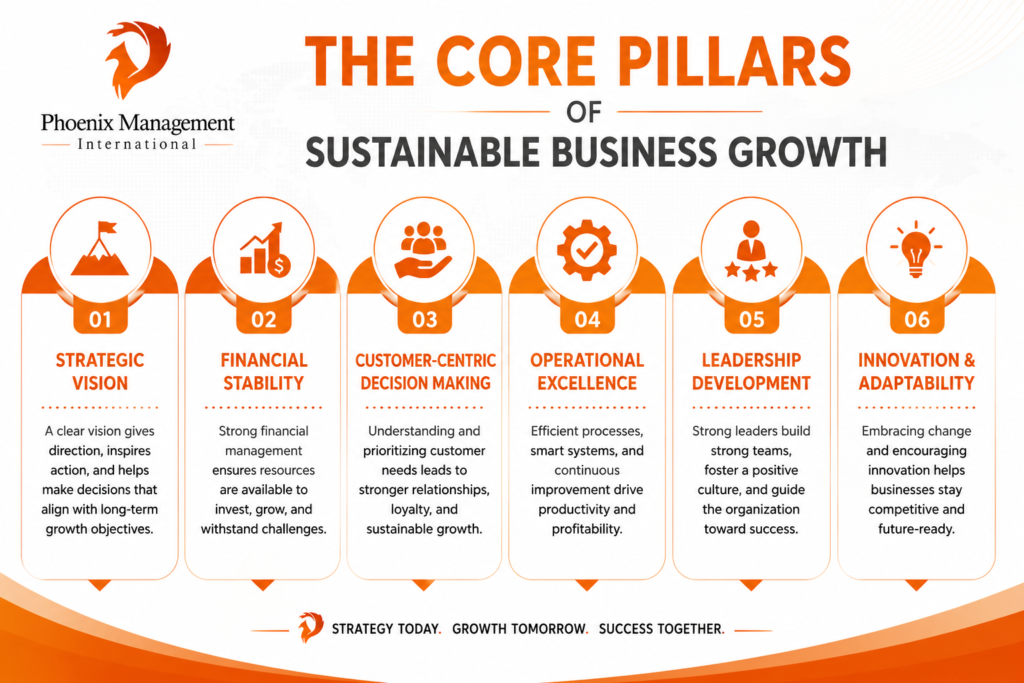
Every successful long-term growth strategy is built upon several interconnected pillars. Weakness in one area often affects overall business performance.
1. Strategic Vision
A clear vision gives the organization direction and helps leaders make decisions that align with future objectives.
An effective strategic vision should be:
- Specific
- Realistic
- Inspiring
- Measurable
- Adaptable
Example:
Instead of saying:
“We want to grow.”
A stronger vision would be:
“Increase annual recurring revenue by 40% over the next three years while expanding into two new regional markets.”
2. Financial Stability
Growth requires capital, but sustainable growth requires financial discipline.
Businesses should regularly evaluate:
- Cash flow
- Profit margins
- Budget allocation
- Operating expenses
- Investment priorities
- Emergency reserves
Financial planning enables businesses to pursue growth opportunities without overextending resources.
3. Customer-Centric Decision Making
Businesses grow when they consistently solve customer problems better than competitors.
Long-term strategies should include:
- Customer research
- Buyer personas
- Customer feedback analysis
- Customer retention initiatives
- Loyalty programs
- Improved customer experience
Retaining existing customers is often more cost-effective than constantly acquiring new ones, making customer satisfaction a key driver of sustainable growth.
4. Operational Excellence
As businesses grow, inefficient processes become increasingly expensive.
Operational improvements may include:
- Process automation
- Standard operating procedures
- Workflow optimization
- Technology integration
- Performance monitoring
- Employee training
Efficient operations allow businesses to scale without sacrificing quality or customer service.
5. Leadership Development
Growth depends on people just as much as processes.
Strong leadership helps organizations:
- Navigate change
- Build healthy workplace cultures
- Improve employee engagement
- Make strategic decisions
- Foster innovation
Developing future leaders ensures continuity as the business expands.
6. Innovation and Adaptability
Markets evolve constantly.
Businesses that continue learning, experimenting, and adapting are more likely to remain competitive.
Innovation doesn’t always mean launching new products.
It may involve:
- Improving existing services
- Adopting new technology
- Streamlining operations
- Exploring new business models
- Entering emerging markets
Building a sustainable growth strategy often requires an outside perspective. If your business needs help aligning its goals, improving operations, or planning for future expansion, explore our Business Management Consulting and Corporate Advisory Services to see how strategic guidance can support long-term success.
Signs Your Business Needs a Better Growth Strategy
Many organizations unknowingly outgrow their existing business model.
Common warning signs include:
- Revenue has plateaued
- Profit margins continue shrinking
- Customer acquisition costs keep increasing
- Teams lack alignment
- Business decisions feel reactive
- Operational bottlenecks slow growth
- Employees experience burnout
- Customer retention declines
- Expansion efforts repeatedly fail
Recognizing these indicators early allows businesses to address underlying issues before they become significant obstacles.
Key Components of an Effective Long-Term Growth Strategy
Although every organization is different, most successful growth strategies include the following elements.
Clear Business Goals
Objectives should follow the SMART framework:
- Specific
- Measurable
- Achievable
- Relevant
- Time-bound
Examples include:
- Increase annual revenue by 25% within three years.
- Expand into two additional geographic markets.
- Improve customer retention to 90%.
- Reduce operational costs by 15%.
Market Analysis
Growth starts with understanding your market.
Businesses should evaluate:
- Industry trends
- Customer behavior
- Competitor positioning
- Emerging technologies
- Economic factors
- Regulatory changes
Regular market analysis helps identify opportunities before competitors do.
Competitive Positioning
Ask important strategic questions such as:
- What differentiates our business?
- Why do customers choose us?
- What problems do we solve better than competitors?
- Where are competitors vulnerable?
A strong value proposition becomes the foundation for long-term market success.
Scalable Operations
Growth often exposes weaknesses in business processes.
Before expanding, assess whether your business can handle increased demand without compromising quality.
Areas to evaluate include:
- Staffing
- Technology
- Inventory management
- Customer support
- Sales systems
- Project management
Building scalability early prevents costly operational challenges later.
Why Strategic Planning Often Fails
Even well-written business plans sometimes produce disappointing results.
Common reasons include:
- Unrealistic expectations
- Lack of measurable goals
- Poor communication across departments
- Failure to monitor progress
- Ignoring market changes
- Inconsistent leadership
- Insufficient financial planning
A successful growth strategy is not a document that sits on a shelf, it is a living framework that evolves alongside the business.
Key Performance Indicators (KPIs) to Track
| Business Area | Key Metrics |
|---|---|
| Financial Performance | Revenue growth, profit margin, cash flow, return on investment (ROI) |
| Customer Success | Customer retention rate, customer lifetime value (CLV), Net Promoter Score (NPS), customer satisfaction |
| Sales | Lead conversion rate, average deal size, sales cycle length |
| Marketing | Website traffic, qualified leads, cost per acquisition (CPA), organic search visibility |
| Operations | Productivity, project completion time, operational costs, process efficiency |
| Employee Performance | Employee engagement, retention rate, training completion, productivity |
Review these metrics regularly monthly for operational performance and quarterly for strategic goals, to ensure your business remains on track.
Common Mistakes That Limit Long-Term Business Growth
Even businesses with ambitious goals can struggle if they overlook common strategic pitfalls.
1. Chasing Every Opportunity
Not every opportunity aligns with your long-term objectives. Expanding too quickly or pursuing unrelated markets can dilute resources and distract from your core strengths.
2. Ignoring Customer Feedback
Your customers provide valuable insights into changing expectations and emerging market needs. Regularly gather and analyze feedback to improve products, services, and customer experiences.
3. Failing to Adapt
Markets, technologies, and customer behaviors change over time. A strategy should be reviewed and adjusted periodically rather than remaining static.
4. Overlooking Financial Planning
Rapid growth without sound financial management can create cash flow challenges. Forecast expenses, monitor profitability, and maintain reserves for unexpected changes.
5. Neglecting Leadership Development
As businesses grow, leaders must delegate effectively, develop management teams, and build systems that support continued expansion.
6. Working Without Clear Priorities
Trying to accomplish too many initiatives at once often leads to slow progress. Focus on a few high-impact objectives and execute them consistently.
Best Practices for Sustainable Business Growth
Successful organizations rarely rely on one growth tactic. Instead, they build resilient businesses through continuous improvement.
Consider these best practices:
- Set clear long-term goals supported by measurable milestones.
- Invest in employee development and leadership training.
- Strengthen customer relationships through exceptional service.
- Use data to guide strategic decisions rather than assumptions.
- Diversify revenue streams where appropriate.
- Embrace technology that improves efficiency and scalability.
- Review your strategic plan regularly and adjust as market conditions evolve.
- Build a culture of innovation and accountability across the organization.
Every business follows a different growth journey. Whether you’re improving operations, expanding into new markets, or planning for the next stage of growth, our team provides strategic guidance to help you make informed decisions and build a stronger business.
Long-Term Business Growth Strategy Checklist
Use this checklist to evaluate your current strategy:
Vision and Goals
- ☐ Have you defined a clear three- to five-year vision?
- ☐ Are your business goals measurable and time-bound?
Market Understanding
- ☐ Do you regularly analyze competitors and industry trends?
- ☐ Have you identified your ideal customer and their evolving needs?
Financial Readiness
- ☐ Do you have a sustainable budget for growth initiatives?
- ☐ Are you monitoring cash flow and profitability consistently?
Operations
- ☐ Are your systems and processes scalable?
- ☐ Have you identified operational bottlenecks?
Leadership and Team
- ☐ Are managers equipped to support business growth?
- ☐ Is your team aligned with company objectives?
Performance Measurement
- ☐ Are you tracking KPIs regularly?
- ☐ Do you review and refine your strategy based on performance data?
If you answered “No” to several of these questions, it may be time to revisit your strategic planning process.
When Should You Seek Professional Business Advice?
While many organizations develop strategic plans internally, an outside perspective can help uncover blind spots, identify new opportunities, and improve decision-making.
Working with experienced professionals in Business Management Consulting can provide valuable insights into financial planning, operational efficiency, leadership development, and long-term growth planning. Likewise, Corporate Advisory Services can help businesses evaluate expansion opportunities, manage risk, improve organizational performance, and develop strategies that align with long-term objectives.
FAQs
What is a long-term business growth strategy?
A long-term business growth strategy is a structured plan that outlines how a company will achieve sustainable growth over several years by setting measurable goals, improving operations, managing resources effectively, and adapting to market changes.
How often should a business growth strategy be updated?
Most businesses should review their strategy quarterly and conduct a comprehensive evaluation annually. However, significant economic changes, industry disruptions, or shifts in customer behavior may require more frequent updates.
Can small businesses benefit from long-term strategic planning?
Absolutely. Long-term planning helps small businesses prioritize investments, manage risk, improve decision-making, and prepare for future growth. It also creates a stronger foundation for scaling operations as the business expands.
Key Takeaways
- Long-term business growth requires strategic planning rather than reactive decision-making.
- Sustainable growth depends on clear goals, financial discipline, customer focus, operational efficiency, innovation, and strong leadership.
- Businesses should regularly evaluate their performance and adapt strategies as market conditions change.
- A comprehensive growth strategy helps organizations scale while minimizing unnecessary risks.
Ready to Build a Smarter Growth Strategy?
Creating a long-term business growth strategy doesn’t have to be overwhelming. With the right guidance, you can identify opportunities, strengthen operations, and develop a clear roadmap for sustainable success.
If you’re looking for expert Business Management Services in San Antonio, TX, Phoenix Management International helps businesses improve performance through strategic planning, leadership development, operational optimization, financial guidance, and customized growth strategies. Whether you’re planning to scale your business, overcome operational challenges, or prepare for future expansion, our experienced advisors are here to help.