
Whether you’re buying a business, selling a company, or exploring investment opportunities, understanding the brokerage process can make the difference between a smooth transaction and a costly mistake. A successful brokerage deal involves far more than simply finding a buyer or seller. It requires careful planning, accurate valuation, strategic marketing, negotiation expertise, due diligence, and a well-structured closing process.
Professional Brokerage Services help business owners and investors navigate each stage with confidence, reducing risk while maximizing value. In this guide, we’ll walk through the complete step-by-step process of a successful brokerage deal, explain what happens behind the scenes, and highlight key factors that contribute to successful outcomes.
What Is a Brokerage Deal?
A brokerage deal is a transaction facilitated by a business broker who helps connect buyers and sellers while managing the process from initial valuation through closing. Brokers act as intermediaries, providing market knowledge, negotiation support, confidentiality protection, and transaction management.
Quick Definition
A successful brokerage deal is a structured transaction where a qualified broker helps a buyer and seller reach mutually beneficial terms while ensuring proper valuation, due diligence, and legal compliance.
Why Professional Brokerage Services Matter
Many business owners underestimate the complexity of buying or selling a business. A transaction often involves financial analysis, legal documentation, negotiations, confidentiality concerns, and extensive market research.
Professional Brokerage Services provide:
- Accurate business valuations
- Access to qualified buyers and sellers
- Confidential marketing strategies
- Skilled negotiation support
- Transaction management expertise
- Reduced risk during due diligence
- Assistance through closing
Businesses represented by experienced brokers often achieve smoother transactions and avoid common pitfalls that can derail deals.
Read More: Top Reasons to Use a Professional Broker
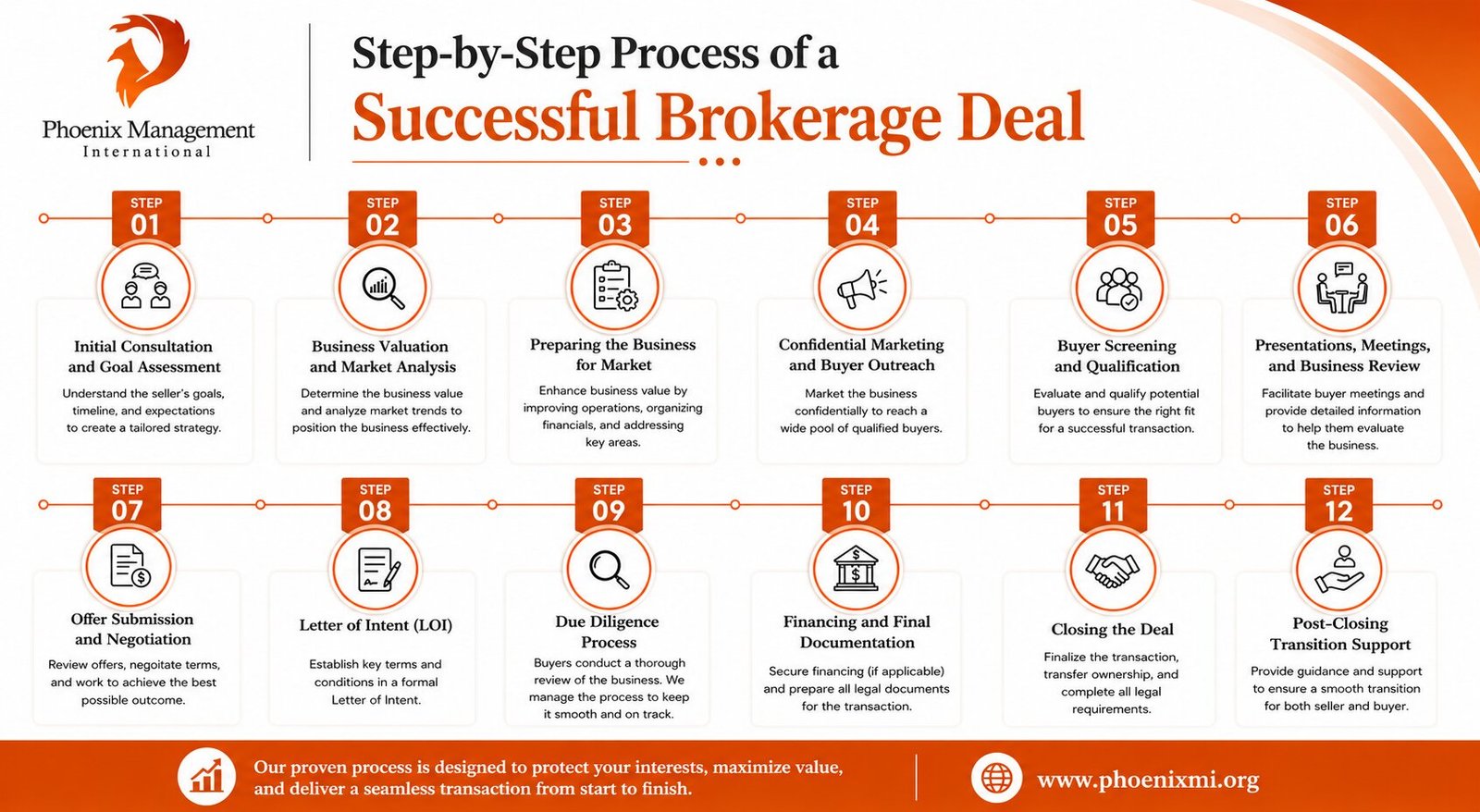
Step 1: Initial Consultation and Goal Assessment
Every successful brokerage deal begins with understanding the client’s objectives.
During the initial consultation, the broker evaluates:
- Business goals
- Desired timeline
- Financial expectations
- Industry conditions
- Potential challenges
- Exit strategy requirements
For sellers, this stage focuses on determining readiness for sale. For buyers, it involves identifying acquisition criteria and investment goals.
Key Questions Asked
For Sellers:
- Why are you selling?
- What is your ideal timeline?
- What financial outcome are you seeking?
For Buyers:
- What type of business interests you?
- What is your acquisition budget?
- What level of involvement do you want?
Step 2: Business Valuation and Market Analysis
Accurate valuation is one of the most important stages in any brokerage transaction.
A business that is overpriced may struggle to attract serious buyers. A business that is undervalued can leave significant money on the table.
Factors Used in Business Valuation
| Valuation Factor | Why It Matters |
|---|---|
| Revenue Trends | Shows growth potential |
| Profitability | Indicates financial health |
| Industry Conditions | Affects demand and value |
| Assets | Adds tangible worth |
| Customer Base | Reflects business stability |
| Market Position | Impacts competitiveness |
| Future Opportunities | Influences buyer interest |
Common Valuation Methods
Asset-Based Valuation
Focuses on tangible and intangible assets.
Earnings-Based Valuation
Evaluates profitability and cash flow.
Market Comparison Approach
Compares similar businesses that recently sold.
An experienced broker typically uses multiple valuation methods to determine a realistic market price.
Step 3: Preparing the Business for Market
Before marketing begins, the business must be positioned attractively for potential buyers.
This stage often includes:
- Organizing financial statements
- Updating operational records
- Identifying growth opportunities
- Addressing potential weaknesses
- Improving documentation
Seller Preparation Checklist
✔ Profit and loss statements updated
✔ Tax records organized
✔ Employee information documented
✔ Customer contracts reviewed
✔ Operational procedures documented
✔ Legal issues addressed
A well-prepared business creates buyer confidence and often leads to stronger offers.
Step 4: Confidential Marketing and Buyer Outreach
One of the most overlooked aspects of a successful brokerage deal is maintaining confidentiality.
Public knowledge of a pending sale can create uncertainty among:
- Employees
- Customers
- Vendors
- Competitors
Professional brokers use confidential marketing strategies to attract qualified buyers without revealing sensitive information.
Marketing Methods Often Used
- Broker networks
- Investor databases
- Industry contacts
- Targeted outreach campaigns
- Online business marketplaces
- Strategic advertising
Rather than marketing to everyone, brokers focus on reaching buyers most likely to complete a transaction.
Step 5: Buyer Screening and Qualification
Not every interested buyer is capable of completing a purchase.
A major responsibility of brokers is screening prospects before sharing sensitive information.
Buyer Qualification Criteria
- Financial capability
- Industry experience
- Funding availability
- Acquisition goals
- Management skills
- Serious intent to purchase
This process helps prevent wasted time and protects confidential business information.
Why This Step Matters
Many failed transactions occur because sellers engage with unqualified buyers. Effective screening significantly improves deal success rates.
Step 6: Presentations, Meetings, and Business Review
Once qualified buyers are identified, the broker facilitates introductions and meetings.
During this stage, buyers evaluate:
- Financial performance
- Business operations
- Growth opportunities
- Management structure
- Market position
The broker coordinates communication and ensures information is shared appropriately.
Example
A manufacturing company may provide:
- Financial reports
- Equipment inventories
- Customer concentration reports
- Supplier agreements
- Growth projections
Providing transparent information builds trust and accelerates decision-making.
Step 7: Offer Submission and Negotiation
After reviewing the business, interested buyers may submit offers.
Negotiation extends beyond purchase price.
Items Commonly Negotiated
| Negotiation Item | Description |
| Purchase Price | Overall transaction value |
| Payment Structure | Cash, financing, installments |
| Seller Financing | Owner-assisted financing |
| Transition Support | Training period after sale |
| Inventory Terms | Included inventory value |
| Asset Allocation | Tax and accounting considerations |
| Non-Compete Agreements | Seller restrictions post-sale |
Professional Brokerage Services play a critical role during negotiations by helping both parties reach practical agreements while preserving deal momentum.
Step 8: Letter of Intent (LOI)
Once preliminary terms are agreed upon, the buyer submits a Letter of Intent.
The LOI generally outlines:
- Proposed purchase price
- Deal structure
- Financing terms
- Due diligence timeline
- Closing expectations
Although not typically the final purchase agreement, the LOI establishes the framework for the transaction.
Step 9: Due Diligence Process
Due diligence is often the most critical phase of the brokerage deal.
Buyers thoroughly verify information before finalizing the acquisition.
Areas Examined During Due Diligence
Financial Review
- Revenue verification
- Profit analysis
- Tax records
- Outstanding liabilities
Operational Review
- Business processes
- Employee structure
- Vendor relationships
Legal Review
- Contracts
- Licenses
- Compliance requirements
- Pending litigation
Market Review
- Competitive position
- Industry outlook
- Customer retention
Common Reasons Deals Fail During Due Diligence
- Inaccurate financial records
- Undisclosed liabilities
- Legal complications
- Revenue inconsistencies
- Unrealistic growth projections
Proper preparation before listing significantly reduces these risks.
Step 10: Financing and Final Documentation
After successful due diligence, financing arrangements are finalized.
Depending on the transaction, funding may come from:
- Traditional lenders
- SBA loans
- Private investors
- Seller financing
- Strategic buyers
Legal professionals then prepare final documentation, including purchase agreements and closing documents.
Step 11: Closing the Deal
Closing is the final stage where ownership officially transfers.
Activities may include:
- Signing agreements
- Funding transfer
- Asset transfer
- Inventory verification
- Ownership documentation
- Regulatory filings
At this point, the transaction is legally completed.
Step 12: Post-Closing Transition Support
Many successful deals include a transition period.
This helps ensure:
- Customer retention
- Employee stability
- Operational continuity
- Knowledge transfer
The seller may remain involved temporarily to train the new owner and facilitate a smooth handoff.
Benefits of Transition Support
- Reduced operational disruptions
- Improved employee confidence
- Faster buyer integration
- Greater likelihood of long-term success
Common Mistakes That Can Derail a Brokerage Deal
Even promising transactions can encounter challenges.
Avoid these common mistakes:
- Setting unrealistic valuation expectations
- Failing to prepare financial records
- Delaying responses during due diligence
- Ignoring confidentiality concerns
- Negotiating emotionally
- Working without professional guidance
- Failing to qualify buyers properly
Many of these issues can be prevented through experienced brokerage representation.
Successful Brokerage Deal Checklist
For Sellers
- Define exit goals
- Obtain professional valuation
- Organize financial records
- Prepare business documentation
- Maintain confidentiality
- Respond promptly during due diligence
- Plan post-sale transition
For Buyers
- Clarify acquisition criteria
- Secure financing early
- Review financial statements carefully
- Conduct thorough due diligence
- Seek professional advisors
- Understand industry risks
- Develop a transition plan
Read More: How Brokerage Services Help You Make Smarter Financial Decisions?
Benefits of Working With a Business Broker
Choosing experienced brokerage professionals offers several advantages:
Time Savings
Brokers manage marketing, screening, negotiations, and transaction coordination.
Increased Buyer Access
Established networks provide exposure to qualified prospects.
Better Valuation Accuracy
Professional analysis helps establish realistic pricing.
Stronger Negotiations
Experienced brokers help maximize value while keeping discussions productive.
Reduced Transaction Risk
Proper due diligence management minimizes surprises.
Businesses seeking Brokerage Services in San Antonio often benefit from local market expertise combined with a structured transaction process that improves efficiency and confidence for all parties involved.
Key Takeaways
A successful brokerage deal follows a structured process that begins with planning and ends with a smooth ownership transition. Every stage, from valuation and confidential marketing to buyer qualification, negotiation, due diligence, and closing plays an important role in achieving a successful outcome.
Professional Brokerage Services help buyers and sellers navigate complex transactions, reduce risk, maintain confidentiality, and maximize value throughout the process. When managed correctly, a brokerage transaction becomes more than a sale, it becomes a strategic opportunity for long-term success.
FAQs
How long does a typical brokerage deal take?
Most business brokerage transactions take between three and twelve months, depending on business size, industry conditions, valuation complexity, and financing requirements.
What is the most important step in a brokerage deal?
Accurate valuation and thorough due diligence are often considered the most critical stages because they directly influence pricing, risk assessment, and transaction success.
Why do brokerage deals fail?
Common reasons include unrealistic pricing expectations, financing issues, poor documentation, undisclosed liabilities, and complications discovered during due diligence.
How does a broker find qualified buyers?
Brokers use professional networks, investor databases, industry contacts, confidential marketing campaigns, and buyer screening processes to identify qualified prospects.
Can a business owner sell without a broker?
Yes, but doing so often requires handling valuation, marketing, negotiations, due diligence, and transaction management independently, which can increase risk and extend timelines.
What are the benefits of Professional Brokerage Services?
Professional Brokerage Services provide market expertise, valuation support, buyer access, confidentiality protection, negotiation guidance, and transaction management that help improve the likelihood of a successful closing.
Final Thoughts
Buying or selling a business is one of the most significant financial transactions many individuals will ever undertake. Understanding each step of the brokerage process helps reduce uncertainty and improves decision-making. Whether you’re preparing to exit a business or acquire a new opportunity, taking a structured approach and working with qualified professionals can help create a smoother, more successful transaction from start to finish.
Ready to Take the Next Step?
Whether you’re buying, selling, or growing a business, Phoenix Management International offers professional brokerage services in San Antonio and expert business consulting to help you achieve your goals. Contact our team today to discuss your opportunities and create a plan for success.