
Running a business becomes more complicated as it grows. What worked when you had five employees, a small customer base, and a simple operating model may no longer work when your company expands into new markets, adds employees, faces stronger competition, or struggles with profitability.
That is where professional management consulting can make a meaningful difference.
The right management consultant does more than provide generic advice. A qualified consultant examines how your business operates, identifies inefficiencies, evaluates strategic opportunities, and helps leadership make better-informed decisions. The goal is not to take control of your company. It is to provide objective expertise, structured analysis, and practical strategies that help your business perform more effectively.
But how do you know when your company actually needs a management consultant?
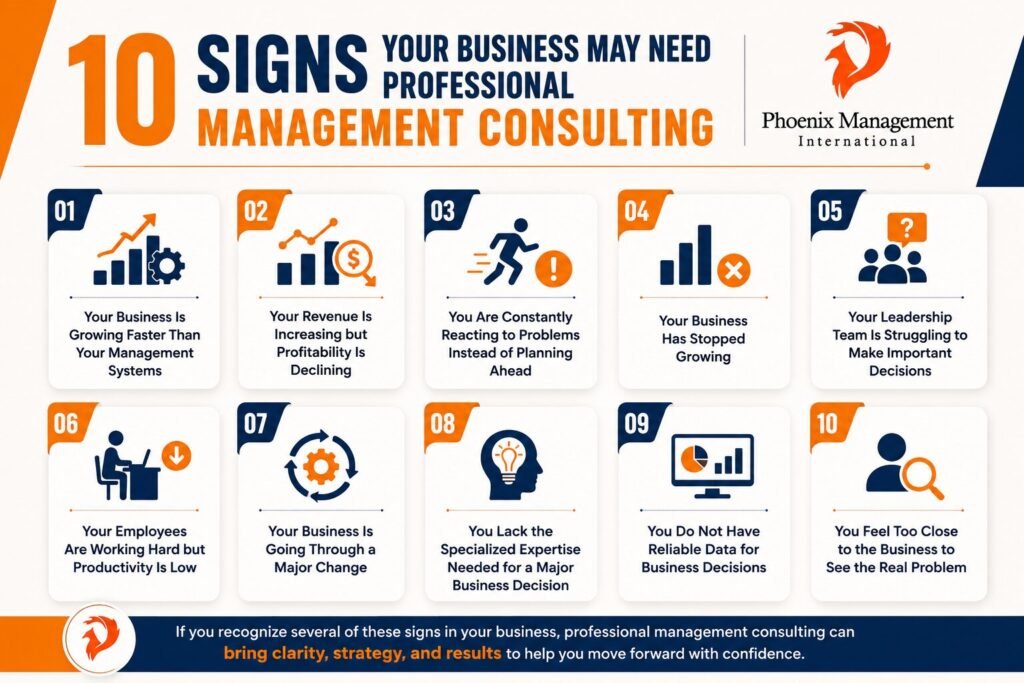
The following 10 signs your business needs professional management consulting can help you determine whether external expertise could improve your operations, strategy, financial performance, or long-term growth.
Quick Answer: When Does a Business Need Management Consulting?
A business may need professional management consulting when it experiences persistent operational problems, declining profitability, stalled growth, internal leadership challenges, poor strategic direction, inefficient processes, or major changes that require specialized expertise.
Consulting can be especially valuable when business leaders recognize that something is wrong but cannot clearly identify the root cause or determine the best solution.
10 Signs Your Business May Need Professional Management Consulting
1. Your Business Is Growing Faster Than Your Management Systems
Growth is a positive sign, but rapid expansion can expose weaknesses that were previously hidden.
A company may grow its revenue while its internal systems remain outdated. Employees may rely on informal communication, manual processes, spreadsheets, or decisions made by a small number of individuals.
As the organization expands, these systems can create delays, confusion, and inconsistent results.
Common signs of growth-related management problems include:
- Employees are unclear about their responsibilities.
- Managers are constantly solving operational problems.
- Important decisions depend on one or two people.
- Communication becomes fragmented between departments.
- Customer service quality begins to decline.
- Processes that worked in the past no longer scale.
- Revenue increases but profitability does not improve.
A management consultant can evaluate your organizational structure, workflows, leadership responsibilities, and operating processes. The objective is to help build systems that support continued growth instead of allowing growth to create operational chaos.
Example: A company may increase its customer base by 40% but continue using the same manual order processing system. The result may be longer delivery times, more errors, and customer complaints. A consultant can identify the bottleneck and recommend process improvements, technology investments, or organizational changes.
2. Your Revenue Is Increasing but Profitability Is Declining
Revenue alone does not indicate business health.
A company can generate more sales while earning less profit because of rising costs, inefficient operations, poor pricing, excessive overhead, low-margin customers, or uncontrolled expenses.
This is one of the most important reasons businesses seek professional management consulting.
A consultant may analyze:
- Revenue by product or service
- Profit margins
- Operating expenses
- Customer acquisition costs
- Pricing strategy
- Labor costs
- Supplier expenses
- Departmental performance
- Cash flow patterns
- Resource utilization
Sometimes the problem is not a lack of sales. The problem is that the company is generating revenue from activities that are not financially sustainable.
Revenue Growth vs. Profitable Growth
|
Business Situation |
What It May Indicate |
|
Revenue increases and profit increases |
Healthy growth |
|
Revenue increases but profit declines |
Margin or cost problem |
|
Revenue remains flat but costs increase |
Operational inefficiency |
|
Sales increase but cash flow worsens |
Working capital or collection problem |
|
High sales but low customer retention |
Customer experience or value problem |
A management consultant can help leadership move beyond surface-level revenue figures and evaluate the underlying economics of the business.
3. You Are Constantly Reacting to Problems Instead of Planning Ahead
Some businesses operate in a permanent state of crisis.
Every week brings a new urgent issue:
- A major customer threatens to leave.
- An employee resigns unexpectedly.
- A supplier misses a deadline.
- A project falls behind schedule.
- A department exceeds its budget.
- A competitor launches a new service.
- A technology system stops working.
When leadership spends most of its time responding to emergencies, strategic planning becomes difficult.
This is often a sign that the business lacks effective management systems, performance metrics, risk planning, or clearly defined processes.
A professional management consultant can help identify the difference between:
Symptoms: The immediate problem that leadership sees.
Root causes: The underlying system, process, communication, or management issue creating the problem.
For example, repeated project delays may appear to be an employee performance problem. However, the root cause could be unrealistic deadlines, unclear project ownership, poor resource planning, or ineffective communication between departments.
Solving the root cause is usually more valuable than repeatedly fixing the same symptom.
4. Your Business Has Stopped Growing
A company can become successful and still reach a growth plateau.
You may have a strong customer base, experienced employees, and a recognizable brand, yet sales remain stagnant for several years.
A growth plateau may occur because:
- The target market has changed.
- The company relies too heavily on one product.
- The sales strategy is outdated.
- Competitors offer stronger value.
- The business has not entered new markets.
- Customer needs have changed.
- Internal processes limit capacity.
- Leadership lacks a clear growth strategy.
A consultant can provide an outside perspective that internal teams may not be able to develop because they are too close to the business.
Strategic management consulting may involve:
- Market analysis
- Competitive positioning
- Business model evaluation
- Growth opportunity assessment
- Customer segmentation
- Product or service portfolio analysis
- Market expansion planning
- Strategic prioritization
The goal is not simply to “grow faster.” Sustainable growth requires understanding where growth should come from and whether the organization can support it.
5. Your Leadership Team Is Struggling to Make Important Decisions
Business decisions become more complex as companies grow.
Leadership may disagree about:
- Which markets to enter
- Whether to hire or outsource
- How much to invest in technology
- Which products to discontinue
- How to structure departments
- Whether to acquire another company
- How to respond to competitors
Disagreement is not necessarily a problem. In fact, healthy debate can improve decision-making.
The problem occurs when decisions are consistently delayed, based on assumptions rather than data, or driven by internal politics.
A management consultant can introduce a structured decision-making process based on:
- Clearly defining the business problem
- Collecting relevant information
- Identifying available options
- Evaluating risks and potential outcomes
- Establishing decision criteria
- Creating an implementation plan
- Measuring results
An independent advisor can also help leadership challenge assumptions without being influenced by internal organizational relationships.
6. Your Employees Are Working Hard but Productivity Is Low
Low productivity is not always caused by employees.
In many organizations, employees work hard but spend significant time dealing with:
- Repetitive manual tasks
- Unclear procedures
- Poor communication
- Unnecessary approvals
- Outdated software
- Duplicate work
- Poorly designed workflows
- Unclear priorities
This is why management consulting should examine the system of work, not simply individual performance.
Signs of process inefficiency include:
- Employees frequently ask who is responsible for a task.
- Multiple people perform similar work.
- Projects require repeated corrections.
- Managers spend too much time approving routine decisions.
- Employees regularly work overtime to complete normal workloads.
- Customer issues are transferred between departments.
- Important information is stored in disconnected systems.
A consultant can conduct an operational assessment and map how work moves through the organization.
This may reveal opportunities to:
- Eliminate unnecessary steps
- Clarify responsibilities
- Improve workflow design
- Automate repetitive tasks
- Reduce approval bottlenecks
- Improve communication
- Establish measurable performance indicators
The result is often not simply “working harder.” It is creating a business system that allows employees to work more effectively.
7. Your Business Is Going Through a Major Change
Major business changes can create significant operational and strategic risks.
Examples include:
- Mergers and acquisitions
- Leadership transitions
- Business restructuring
- Expansion into a new market
- Digital transformation
- New technology implementation
- Succession planning
- Rapid workforce growth
- Business model changes
During periods of change, internal teams are often focused on maintaining day-to-day operations. This can make it difficult to objectively plan and manage the transformation.
Professional management consulting can support:
- Change management
- Organizational restructuring
- Integration planning
- Strategic implementation
- Communication planning
- Risk assessment
- Process redesign
- Leadership alignment
A consultant can also help identify potential resistance to change before it becomes a serious operational problem.
Why change initiatives fail
Many transformation projects fail because leadership focuses on the technology or strategy but underestimates:
- Employee adoption
- Communication
- Training
- Process changes
- Leadership alignment
- Organizational culture
A successful change initiative requires both a strong strategy and effective implementation.
8. You Lack the Specialized Expertise Needed for a Major Business Decision
Businesses do not need to hire full-time experts for every challenge they face.
A company may need temporary expertise in areas such as:
- Strategic planning
- Organizational development
- Financial management
- Business restructuring
- Market entry
- Mergers and acquisitions
- Supply chain optimization
- Technology implementation
- Risk management
- Performance improvement
Hiring a management consulting firm can provide access to specialized knowledge without the long-term cost of building an entirely new internal department.
This is particularly useful when the business is facing a complex issue that requires expertise it does not currently have.
For example, a company considering expansion into a new market may need market research, competitive analysis, financial modeling, and operational planning. A consultant can provide an objective assessment before the company commits significant resources.
9. You Do Not Have Reliable Data for Business Decisions
Many business owners believe they are making data-driven decisions because they track revenue and expenses.
However, effective business decision-making may require a much broader set of information.
Depending on the organization, relevant metrics may include:
- Customer acquisition cost
- Customer lifetime value
- Gross margin
- Net profit margin
- Employee turnover
- Customer retention
- Conversion rates
- Operational cycle time
- Inventory turnover
- Project profitability
- Cash flow
- Return on investment
A management consultant can help determine which performance indicators actually matter for the business.
The goal is not to create hundreds of reports. It is to identify the key metrics that help leadership answer important questions:
- What is working?
- What is underperforming?
- Where are resources being wasted?
- Which customers are most valuable?
- Which products generate the strongest margins?
- What risks are increasing?
- Which investments are producing results?
Good data does not replace leadership judgment. It improves the information available for making that judgment.
10. You Feel Too Close to the Business to See the Real Problem
This may be one of the most overlooked reasons to work with a management consultant.
Business owners and executives often have years of experience with their companies. That experience is valuable, but it can also make it difficult to objectively evaluate familiar problems.
You may know that:
- A department is underperforming.
- A process is inefficient.
- A product is no longer profitable.
- The manager is overwhelmed.
- A customer segment is becoming less valuable.
Yet making a major change can be difficult because of history, relationships, assumptions, and emotional investment.
An external consultant can provide a neutral perspective.
A qualified consultant should not simply agree with leadership. Their value comes from asking difficult questions, examining evidence, identifying patterns, and helping the organization evaluate options objectively.
Important: The purpose of management consulting is not to replace the knowledge of business leaders. It is to combine internal knowledge with an independent perspective and specialized expertise.
What Does a Management Consultant Actually Do?
A management consultant helps organizations improve performance by analyzing business challenges and developing practical recommendations.
Depending on the engagement, a consultant may:
- Assess the current state of the business.
- Identify operational or strategic problems.
- Analyze data and performance trends.
- Interview stakeholders and employees.
- Benchmark current performance.
- Develop strategic options.
- Recommend specific improvements.
- Support implementation.
- Establish performance measurements.
- Evaluate results.
The scope of consulting varies significantly. Some projects may last a few weeks, while larger transformation initiatives may continue for several months or longer.
Management Consulting vs. Internal Management
Many business owners ask whether they should hire a consultant or solve the issue internally.
The answer depends on the nature of the challenge.
|
Situation |
Internal Management |
Professional Consultant |
|
Daily operational decisions |
Usually appropriate |
Usually unnecessary |
|
Complex strategic problem |
May require support |
Often valuable |
|
Major organizational change |
Can lead internally |
Provides structure and expertise |
|
Need for an objective viewpoint |
Limited |
Strong advantage |
|
Specialized short-term expertise |
May require hiring |
Flexible access to expertise |
|
Long-term employee management |
Essential |
Supports leadership |
|
Independent business assessment |
May be difficult |
Core consulting value |
In practice, the strongest approach is often collaborative. Internal leaders understand the company, while consultants bring external experience, analytical methods, and specialized knowledge.
When Should a Small Business Hire a Management Consultant?
Small businesses do not need to wait until they experience a major crisis.
Professional consulting may be valuable when a small business is:
- Growing rapidly
- Preparing to expand
- Experiencing declining margins
- Adding new locations
- Restructuring its team
- Planning succession
- Adopting new technology
- Struggling with operational inefficiencies
- Preparing for a major investment or acquisition
The earlier a business identifies structural problems, the easier it may be to address them.
However, hiring a consultant should be based on a clearly defined business need—not simply because consulting sounds like a good idea.
How to Choose the Right Management Consulting Firm
Not every consulting firm is right for every business.
Before selecting a consultant, evaluate:
Relevant Experience
Has the consultant worked with businesses facing challenges similar to yours?
Industry experience can be valuable, although a consultant with experience across industries may also bring useful outside perspectives.
Problem-Solving Approach
Ask how the consultant approaches a new engagement.
A strong consultant should want to understand:
- Your business model
- Your goals
- Your current challenges
- Your organizational structure
- Your financial and operational performance
- The outcomes you want to achieve
Be cautious of firms that promise a solution before understanding the problem.
Communication Style
Consulting projects require collaboration.
The consultant should be able to explain complex findings clearly and communicate recommendations to different stakeholders.
Practical Implementation
A strategy is only valuable if the organization can implement it.
Ask whether the consultant provides:
- Action plans
- Priorities
- Timelines
- Ownership recommendations
- Performance indicators
- Implementation support
Clear Scope and Expectations
Before beginning an engagement, clarify:
- Project objectives
- Deliverables
- Timeline
- Responsibilities
- Fees
- Communication process
- Success measurements
Clear expectations reduce misunderstandings and improve the consulting relationship.
A Simple Checklist: Does Your Business Need Consulting?
Answer “yes” or “no” to the following questions:
- Is your business growing faster than your systems can support?
- Are profits declining despite stable or increasing revenue?
- Are the same operational problems occurring repeatedly?
- Has your business experienced a prolonged growth plateau?
- Are important leadership decisions consistently delayed?
- Are employees busy but productivity remains low?
- Are you planning a major organizational change?
- Do you lack specialized expertise for an important project?
- Are business decisions being made without reliable performance data?
- Do you suspect there is a problem but cannot identify its root cause?
How to Interpret the Results
0–2 yes answers: Your business may not need a formal consulting engagement right now, although targeted advice could still be useful.
3–5 yes answers: A focused management assessment may help identify inefficiencies and strategic opportunities.
6 or more yes answers: Your business may benefit significantly from an independent professional evaluation and structured improvement plan.
This checklist is a starting point—not a formal diagnostic assessment.
What Are the Benefits of Professional Management Consulting?
The potential benefits depend on the specific business challenge, but professional consulting can help organizations:
- Improve strategic decision-making
- Identify operational inefficiencies
- Strengthen organizational structure
- Improve resource allocation
- Develop growth strategies
- Reduce avoidable costs
- Improve performance measurement
- Manage organizational change
- Address complex business problems
- Provide independent expertise
The most valuable benefit is often clarity.
A business may already have capable employees and sufficient resources. The problem may be that leadership lacks a clear understanding of where those resources are being lost or how they should be prioritized.
Common Mistakes Businesses Make When Hiring Consultants
Hiring a Consultant Without a Clear Problem
A vague objective such as “improve the business” is difficult to measure.
A better objective may be:
“Identify the primary causes of declining profitability and develop a 12-month improvement plan.”
Expecting the Consultant to Fix Everything
Consultants can provide analysis, recommendations, and implementation support. Leadership still needs to make decisions and execute changes.
Choosing Based Only on Price
The lowest-cost option may not provide the expertise required for a complex business problem.
Ignoring Internal Stakeholders
Employees often understand operational problems that leadership cannot see. Their input can improve the quality of the assessment.
Failing to Measure Results
Before implementing recommendations, define how success will be measured.
Possible metrics include:
- Revenue growth
- Profit margin
- Operating costs
- Customer retention
- Employee productivity
- Project completion time
- Customer satisfaction
Key Takeaways
Professional management consulting may be valuable when a business is experiencing problems that internal leadership cannot easily diagnose or solve.
The strongest indicators include:
- Rapid growth that has outpaced internal systems
- Declining profitability
- Repeated operational problems
- Stagnant growth
- Difficult strategic decisions
- Low productivity
- Major organizational change
- Lack of specialized expertise
- Poor business data
- The need for an objective outside perspective
The right consultant should not offer generic advice. They should understand the business, investigate the underlying problem, provide evidence-based recommendations, and help leadership turn strategy into practical action.
FAQs
What is management consulting?
Management consulting is a professional service that helps organizations solve strategic, operational, organizational, and performance-related business problems. Consultants analyze the current situation, identify opportunities or challenges, and provide recommendations or implementation support.
When should a business hire a management consultant?
A business should consider hiring a management consultant when it faces complex challenges such as declining profitability, stalled growth, operational inefficiency, major organizational change, strategic uncertainty, or a lack of specialized expertise.
Is management consulting only for large companies?
No. Small and mid-sized businesses can also benefit from management consulting, particularly during periods of rapid growth, restructuring, expansion, succession planning, or operational difficulty.
How can a management consultant help improve business performance?
A consultant may analyze business processes, financial performance, organizational structure, strategy, and key performance indicators. Based on the findings, the consultant can recommend improvements designed to address root causes and improve business effectiveness.
How long does a management consulting project take?
The timeline depends on the scope of the engagement. A focused business assessment may take several weeks, while a larger organizational transformation or strategic implementation project may take several months or longer.
What should I look for in a management consulting firm?
Look for relevant experience, a clear problem-solving process, strong communication, practical recommendations, transparent project expectations, and a willingness to understand your specific business rather than offering a generic solution.
Final Thoughts
The decision to hire a management consultant should not be based on the idea that your business is failing. In many cases, consulting becomes valuable because a company is growing, changing, or facing a challenge that requires a level of objectivity and expertise unavailable internally.
If your business is experiencing repeated problems, declining performance, stalled growth, or uncertainty about its next strategic move, an independent assessment may help reveal what is actually happening beneath the surface.
The first step is to define the problem clearly. Once the problem is understood, the right professional management consulting partner can help you evaluate your options, prioritize improvements, and create a practical path forward.
Need help improving your business operations or planning for growth? Phoenix Management International provides business management consulting in San Antonio to help businesses make informed decisions, improve performance, and achieve their goals. Contact us today to learn more.