
A business can have talented employees, strong products, and a clear strategy, and still lose time and money because the way work gets done is inefficient.
That is where business process optimization comes in.
Business process optimization is the systematic practice of examining how work moves through an organization, identifying inefficiencies, and improving the process so the business can achieve better results with fewer unnecessary steps, delays, errors, or resources.
It is more than automating tasks or creating new software. Effective optimization looks at the entire workflow, including people, technology, approvals, communication, data, handoffs, performance measures, and customer outcomes.
For growing companies, this can make a meaningful difference. A well-optimized process can help reduce operating costs, improve productivity, strengthen consistency, speed up decision-making, and create a better experience for employees and customers.
This guide explains what business process optimization is, how it works, its benefits, common examples, optimization methods, mistakes to avoid, and when a business should consider professional support.
Key takeaway: Business process optimization focuses on improving how work gets done so that business operations become more efficient, measurable, scalable, and aligned with strategic goals.
What Is Business Process Optimization?
Business process optimization is the structured analysis and improvement of an existing business process to increase efficiency, effectiveness, quality, speed, or business value.
A business process is a repeatable sequence of activities designed to achieve a specific business outcome. Examples include:
- Processing customer orders
- Onboarding employees
- Approving invoices
- Managing customer inquiries
- Handling sales leads
- Purchasing supplies
- Processing payroll
- Managing contracts
- Delivering services
- Resolving customer complaints
Optimization examines these activities from beginning to end rather than looking at isolated tasks.
For example, a company may discover that approving a customer order takes five days. The problem may not be that employees work slowly. Instead, the workflow may contain unnecessary approval levels, duplicate data entry, unclear responsibilities, outdated software, or poor communication between departments.
Business process optimization identifies those underlying problems and redesigns the workflow around the desired outcome.
Modern process management increasingly emphasizes end-to-end processes, rather than optimizing individual departments in isolation. APQC’s recent research highlights the importance of moving from function-based thinking toward process-based thinking and improving end-to-end process mapping.
How Does Business Process Optimization Work?
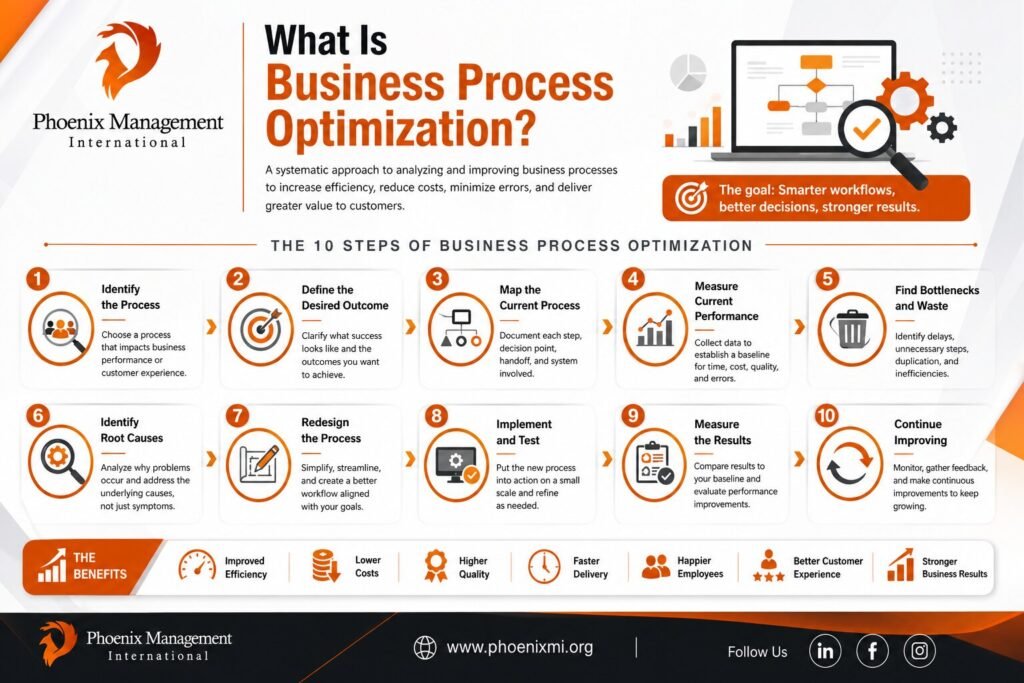
A successful optimization initiative usually follows a structured cycle:
- Identify the process
- Define the desired outcome
- Document the current workflow
- Measure current performance
- Identify bottlenecks and waste
- Determine root causes
- Design an improved process
- Implement changes
- Measure the results
- Continue improving
The exact methodology can vary depending on the organization, process, industry, and objective.
The important point is that optimization should not be based solely on assumptions.
1. Identify the Process
Start with a process that is causing a measurable business problem.
Examples include:
- Orders are taking too long to fulfill.
- Employees repeatedly enter the same information.
- Customers wait too long for responses.
- Managers spend excessive time approving routine requests.
- Invoices are frequently returned for corrections.
- Sales leads are not followed up consistently.
A clearly defined problem gives the optimization project a measurable purpose.
2. Define the Desired Outcome
Before changing a process, determine what success looks like.
Potential goals include:
- Reducing processing time
- Lowering costs
- Reducing errors
- Improving customer satisfaction
- Increasing productivity
- Improving compliance
- Increasing capacity
- Eliminating duplicate work
- Improving employee experience
This step is important because a process should not be optimized simply because it appears complicated.
The real question is:
What business outcome needs to improve?
3. Map the Current Process
Document how the process actually works—not how management assumes it works.
A process map can show:
- Tasks
- Decision points
- Employees or departments involved
- Systems used
- Inputs and outputs
- Approvals
- Handoffs
- Delays
- Exceptions
Process mapping makes hidden complexity easier to see. It can also expose unnecessary handoffs and activities that are difficult to identify when looking at individual departments.
A particularly important principle is to involve the people who perform the work. Their experience often reveals exceptions, workarounds, and recurring problems that formal procedures do not capture.
4. Measure Current Performance
You cannot reliably determine whether a process improved unless you know where it started.
Depending on the process, useful metrics may include:
- Cycle time
- Processing time
- Cost per transaction
- Error rate
- Rework rate
- Number of approvals
- Customer wait time
- Employee productivity
- First-pass yield
- Customer satisfaction
- On-time completion rate
These measurements establish a baseline.
5. Find Bottlenecks and Waste
Look for points where work slows down, stops, repeats, or creates unnecessary effort.
Common examples include:
- Multiple approvals for low-risk decisions
- Manual data entry
- Duplicate documentation
- Unclear ownership
- Repeated quality checks
- Outdated systems
- Poorly defined procedures
- Departmental silos
- Unnecessary meetings
- Delayed information
- Frequent rework
The objective is not simply to remove steps.
A step should be removed only when the business can do so without creating unacceptable risk, quality problems, compliance issues, or customer impact.
6. Identify Root Causes
One of the most common business management mistakes is treating symptoms instead of causes.
For example:
Problem: Customer orders are delayed.
Possible symptom: Employees are not processing orders quickly enough.
Possible root causes:
- Orders require unnecessary approvals.
- Information is incomplete when orders arrive.
- Sales and operations use different systems.
- Inventory information is not updated promptly.
- Employees manually transfer information between platforms.
Hiring more employees might temporarily reduce the backlog, but it does not necessarily solve the underlying process problem.
Root-cause analysis helps organizations determine what is actually driving poor performance.
7. Redesign the Process
Once the causes are understood, redesign the workflow.
Possible changes include:
- Removing unnecessary steps
- Combining related activities
- Clarifying responsibilities
- Creating standardized procedures
- Reducing approval layers
- Improving communication between teams
- Introducing workflow automation
- Integrating systems
- Establishing better performance measures
The redesigned process should be simpler without compromising quality, security, compliance, or customer experience.
8. Implement and Test
Do not assume that a redesigned process will work perfectly on the first attempt.
A controlled rollout or pilot can help identify problems before a company applies the new workflow across the entire organization.
Employees should understand:
- What changed
- Why it changed
- Who owns each step
- Which systems they should use
- What performance standards apply
- How exceptions should be handled
Change management is therefore an important part of optimization.
9. Measure the Results
Compare the optimized process with the original baseline.
For example:
|
Metric |
Before Optimization |
After Optimization |
|
Average processing time |
5 days |
2 days |
|
Approval steps |
6 |
3 |
|
Manual data entries |
12 |
5 |
|
Error rate |
8% |
3% |
|
Customer response time |
24 hours |
8 hours |
The numbers above are illustrative rather than industry benchmarks.
The point is to establish measurable evidence that the process is actually performing better.
10. Continue Improving
Optimization should not be treated as a one-time event.
Business conditions change. Customers change. Technology changes. Employees change. Regulations change.
A process that works well today may become inefficient later.
APQC describes continuous improvement as ongoing improvement in areas such as quality, cost, and cycle time and cautions against isolated improvement efforts that are disconnected from broader process management.
Why Is Business Process Optimization Important?
Businesses rarely become inefficient overnight.
Inefficiency often develops gradually.
A new approval is added here. A spreadsheet is introduced there. A department creates its own workaround. A legacy system remains in place because replacing it seems difficult.
Eventually, employees may be spending significant time working around the process instead of completing the actual work.
Business process optimization helps organizations step back and examine the entire system.
Key Business Management Benefits
Effective process optimization can contribute to several business management benefits, including:
1. Improved Operational Efficiency
Removing unnecessary activities and reducing delays can allow employees to complete important work more efficiently.
2. Lower Operating Costs
Organizations may reduce costs by eliminating redundant work, improving resource allocation, reducing rework, and increasing productivity.
3. Better Productivity
Employees spend less time on repetitive administrative work and more time on activities that require judgment, expertise, and customer interaction.
4. Fewer Errors
Standardized processes and better controls can reduce inconsistencies and prevent avoidable mistakes.
5. Faster Decision-Making
Clear roles, better information, and streamlined approvals can help managers make decisions faster.
6. Better Customer Experience
Customers typically benefit when businesses respond faster, communicate more clearly, and deliver services consistently.
7. Greater Scalability
A process that depends entirely on informal knowledge or individual employees can become difficult to scale.
Documented and optimized workflows provide a stronger operational foundation for growth.
8. Greater Transparency
Process documentation and performance metrics make it easier to determine where work is progressing and where problems are occurring.
9. Improved Employee Experience
Poor processes create frustration.
Employees may become overwhelmed when they have to repeatedly fix errors, search for information, complete unnecessary paperwork, or work around inefficient systems.
Better processes can reduce this operational friction.
10. Stronger Strategic Alignment
Process optimization is most valuable when it supports a larger business objective.
APQC emphasizes that business process management should connect processes to organizational strategy and measurable business value rather than being treated simply as documentation or software implementation.
Business Process Optimization Examples
Optimization can apply to almost any repeatable business activity.
Example 1: Customer Onboarding
Before
A new customer completes a form. An employee manually enters the information into several systems. Another employee verifies it. A manager approves the account. The customer waits for confirmation.
Potential improvements
- Use a standardized digital intake form.
- Eliminate duplicate data entry.
- Automatically route information to the appropriate employee.
- Establish approval thresholds.
- Create automated status notifications.
Potential result
The business may reduce processing time while creating a more consistent onboarding experience.
Example 2: Invoice Approval
Before
An invoice arrives by email and is manually forwarded between several employees.
Potential improvements
- Centralize invoice intake.
- Establish approval rules.
- Automate routing.
- Create visibility into invoice status.
- Track processing time and exceptions.
This can reduce unnecessary email communication and make outstanding invoices easier to monitor.
Example 3: Sales Lead Management
Before
Leads arrive through multiple channels and are manually assigned to sales representatives.
Some leads receive immediate attention while others are forgotten.
Potential improvements
- Centralize lead capture.
- Define lead qualification criteria.
- Automatically assign leads.
- Establish follow-up timelines.
- Monitor conversion and response metrics.
The goal is not simply to automate lead management. It is to create a reliable process that moves qualified prospects toward the appropriate next step.
Example 4: Employee Onboarding
An employee onboarding process may involve HR, IT, payroll, management, and the employee.
Without a coordinated process, employees may experience:
- Missing equipment
- Delayed system access
- Repeated paperwork
- Unclear responsibilities
- Inconsistent training
An optimized process can coordinate these activities around the employee’s start date.
Business Process Optimization vs. Business Process Improvement
The terms business process optimization and business process improvement are closely related, and organizations sometimes use them interchangeably.
There is a useful distinction, however.
|
Business Process Improvement |
Business Process Optimization |
|
Focuses on making an existing process better |
Focuses on achieving the best practical performance for a defined objective |
|
May involve incremental changes |
May involve incremental or more substantial redesign |
|
Often addresses specific problems |
Considers the broader end-to-end workflow |
|
Can be part of continuous improvement |
Often uses data, analysis, technology, and performance measures |
|
May focus on efficiency or quality |
Can balance efficiency, quality, cost, risk, customer experience, and scalability |
IBM describes process improvement as a systematic approach to improving the efficiency and effectiveness of business processes, while process optimization incorporates structured methods and technologies to remove inefficiencies and increase business value.
The distinction is less important than having a disciplined approach to improving how work gets done.
Business Process Optimization vs. Business Process Reengineering
Optimization should also be distinguished from business process reengineering (BPR).
Process optimization generally works from an existing process and improves it.
Business process reengineering can involve a much more fundamental redesign.
|
Optimization |
Reengineering |
|
Usually improves an existing process |
May replace or radically redesign the process |
|
Often incremental |
Often transformational |
|
Lower disruption in many cases |
Can involve significant organizational change |
|
Focuses on removing inefficiencies |
Challenges fundamental assumptions about how work is performed |
|
Suitable for continuous improvement |
Often used when existing processes no longer meet strategic needs |
IBM characterizes BPR as a radical redesign approach aimed at significant improvements, distinguishing it from the more incremental nature of BPM.
Business Process Optimization and Automation
Automation is often associated with process optimization, but the two are not the same.
Automation performs work automatically. Optimization determines whether the work should be performed that way in the first place.
This distinction matters.
Imagine a company has a 10-step approval workflow containing four unnecessary steps.
Automating all 10 steps may make the inefficient process faster—but it does not necessarily make the process better.
A stronger approach is:
Understand → Simplify → Standardize → Automate → Measure
Automation can be valuable for:
- Data entry
- Notifications
- Workflow routing
- Appointment scheduling
- Invoice processing
- Report generation
- Document management
- Routine approvals
- Customer communications
But automation should support a well-designed process rather than conceal a poorly designed one.
Modern process optimization may also incorporate analytics, automation, and AI, particularly where organizations need greater visibility into workflows or repetitive activities.
Technologies Used in Business Process Optimization
Technology can support optimization in several ways.
Common tools include:
Process Mapping Software
Used to visualize workflows and identify process relationships.
Workflow Management Platforms
Help route tasks, approvals, and information between people or systems.
Business Process Management Software
BPM platforms can support process modeling, execution, monitoring, and optimization across repeatable workflows.
Business Intelligence Tools
Help managers analyze KPIs and identify performance trends.
Robotic Process Automation
Can automate repetitive, rule-based digital activities.
Artificial Intelligence
AI can potentially support activities such as document processing, classification, forecasting, knowledge retrieval, and decision support. Its use should still be governed according to the organization’s risk, privacy, security, and compliance requirements.
System Integration
Connecting systems can reduce duplicate data entry and improve information flow between departments.
Technology, however, should not become the starting point.
The starting point should always be the business problem.
Common Business Management Mistakes That Prevent Optimization
Some organizations invest in new software while leaving the underlying process unchanged.
That is one of several common mistakes.
Mistake 1: Optimizing Without a Clear Goal
If nobody knows what success means, it becomes difficult to determine whether the project worked.
Mistake 2: Automating a Bad Process
Technology cannot automatically fix unnecessary steps or unclear responsibilities.
Mistake 3: Ignoring Employees
Employees who perform the work often understand the process better than anyone else.
Ignoring their experience can result in solutions that look good on paper but fail in practice.
Mistake 4: Optimizing One Department at the Expense of Another
A department may improve its own performance while making the overall process worse.
For example, reducing processing time in one department may simply move the work or create a bottleneck downstream.
End-to-end thinking helps prevent this problem.
Mistake 5: Measuring Only Cost
Lower cost does not automatically mean a better process.
A process can be cheaper but produce more errors, lower employee satisfaction, or a worse customer experience.
Optimization should consider multiple dimensions of performance.
Mistake 6: Treating Optimization as a One-Time Project
Processes require monitoring and adjustment as business conditions change.
Mistake 7: Failing to Manage Change
Even a well-designed process can fail if employees do not understand how or why it changed.
How to Know If Your Business Needs Process Optimization
Your organization may benefit from a closer look at its processes if you notice several of these warning signs:
- Employees frequently complain about inefficient workflows.
- The same information is entered into multiple systems.
- Customers experience unnecessary delays.
- Employees rely heavily on spreadsheets or manual workarounds.
- Managers cannot easily determine where work is stuck.
- Approvals take too long.
- Different employees perform the same process differently.
- Departments frequently blame one another for delays.
- Errors and rework are common.
- New employees struggle to learn how work is performed.
- Growth is increasing operational complexity.
- Employees spend significant time on repetitive administrative work.
- Performance varies significantly between teams.
- Business leaders lack reliable process KPIs.
Quick Process Optimization Checklist
Before changing a process, ask:
- What business outcome are we trying to improve?
- Who owns the process?
- Where does the process begin and end?
- Who participates in it?
- What systems are involved?
- Where do delays occur?
- Where does rework occur?
- Which steps create measurable value?
- Which steps create risk or unnecessary effort?
- What does the data show?
- What do employees performing the work say?
- Which KPIs will determine success?
- Can the process be simplified before it is automated?
- How will the new process be monitored?
What Does a Business Management Consultant Do in Process Optimization?
A Business Management Consultant can provide an independent perspective when internal teams are too close to a process to identify its weaknesses objectively.
Depending on the engagement, a consultant may help with:
- Operational assessments
- Process mapping
- Workflow analysis
- Organizational structure
- Performance measurement
- Process redesign
- Standard operating procedures
- Technology evaluation
- Automation opportunities
- Change management
- Strategic planning
- Performance improvement
Professional Business Management Services can be especially valuable when a company is growing, restructuring, integrating systems, entering a new market, or experiencing operational inefficiencies.
A consultant should not simply recommend more software or more employees.
The better question is:
What is preventing the organization from achieving the desired business outcome, and what changes will address that cause?
How to Build a Sustainable Business Management Process
Optimization works best when it becomes part of the organization’s broader business management process.
That means creating a repeatable approach to managing operations.
A practical framework is:
1. Establish Ownership
Every important process should have clear accountability.
2. Define Performance Measures
Determine which metrics demonstrate whether the process is working.
3. Document the Workflow
Make the process understandable and repeatable.
4. Monitor Performance
Review KPIs regularly rather than waiting for major problems.
5. Gather Employee Feedback
People who work inside the process can identify practical problems that data alone may miss.
6. Review Customer Impact
Internal efficiency should not come at the expense of service quality.
7. Improve Continuously
Use performance information to identify the next improvement opportunity.
This approach aligns with the broader principles of business process management, which treats process design, measurement, improvement, and optimization as an ongoing management discipline.
When Should a Business Consider Professional Business Management Services?
Not every process problem requires outside consulting.
Internal teams may be perfectly capable of improving straightforward workflows.
Professional support can become more useful when:
- Multiple departments are involved.
- The problem affects customers or revenue.
- Processes have become difficult to manage as the company grows.
- Leaders disagree about the root cause.
- A major restructuring is underway.
- Technology investments need strategic evaluation.
- The company needs objective benchmarking.
- Operational problems are persistent despite internal efforts.
- Management needs a structured improvement roadmap.
The right approach depends on the organization’s size, complexity, resources, and goals.
Key Takeaways
Business process optimization is about improving the way work gets done.
The most important principles are:
- Start with a measurable business problem.
- Understand the current process before redesigning it.
- Map the workflow from beginning to end.
- Involve employees who perform the work.
- Use data to identify bottlenecks and performance gaps.
- Address root causes rather than symptoms.
- Simplify processes before automating them.
- Balance efficiency with quality, risk, compliance, and customer experience.
- Establish clear process ownership and KPIs.
- Treat optimization as continuous improvement rather than a one-time project.
The strongest optimization efforts connect operational changes to actual business outcomes. They do not simply make individual tasks faster; they improve how people, processes, technology, and information work together.
FAQs
What is business process optimization in simple terms?
Business process optimization means improving how a business performs repeatable work. It involves identifying unnecessary steps, delays, errors, bottlenecks, and inefficiencies and redesigning the workflow to achieve better results.
What are examples of business process optimization?
Examples include streamlining employee onboarding, reducing invoice approval steps, automating repetitive data entry, improving customer service workflows, standardizing sales lead management, and redesigning order fulfillment processes.
What are the main benefits of business process optimization?
Common benefits include improved efficiency, lower operating costs, greater productivity, fewer errors, faster processing, better customer experiences, improved transparency, and more scalable operations.
Is business process optimization the same as automation?
No. Automation uses technology to perform tasks with less manual involvement, while optimization examines whether the overall process is designed effectively. Automation can be one component of an optimized process.
What tools are used for business process optimization?
Organizations may use process mapping tools, workflow management systems, BPM software, business intelligence platforms, automation technologies, system integrations, and AI-supported tools. The appropriate technology depends on the process and business objective.
When should a business hire a business management consultant?
A business may consider a consultant when operational problems are persistent, multiple departments are involved, growth has increased complexity, internal teams lack the time or expertise to analyze the process, or leadership needs an objective strategy for improving operations.
Improve How Your Business Works
Business process optimization is not about making a company complicated with more systems, procedures, or technology. It is about understanding how work actually happens, removing unnecessary friction, and creating processes that support measurable business goals.
For companies that are struggling with inefficient workflows, operational bottlenecks, inconsistent procedures, or growth-related complexity, a structured assessment can be a practical first step.
Phoenix Management International is providing business management services in San Antonio, TX to help organizations evaluate operations, strengthen management processes, identify improvement opportunities, and build more effective business practices.
If your business has outgrown the way it currently operates, reviewing the underlying processes may reveal opportunities that are difficult to see from inside the day-to-day operation.