
Every business experiences periods of growth, change, and uncertainty. While some challenges can be solved through operational improvements or strategic planning, others require a more comprehensive transformation. This is where corporate restructuring becomes an important consideration.
Corporate restructuring is not only for struggling businesses. Many successful organizations restructure to improve efficiency, prepare for expansion, adapt to changing markets, or strengthen long-term financial performance.
In this guide, you’ll learn when a business should consider corporate restructuring, the warning signs to watch for, the different types of restructuring strategies, and how to determine whether it’s the right decision for your organization.
What Is Corporate Restructuring?
Corporate restructuring is the process of reorganizing a company’s financial, operational, legal, or organizational structure to improve performance, reduce risk, increase profitability, or support future growth.
The goal isn’t simply to fix problems, it is to position the business for sustainable success.
Restructuring may involve:
- Reorganizing departments
- Streamlining operations
- Refinancing debt
- Improving leadership structures
- Divesting non-core business units
- Merging or acquiring businesses
- Updating corporate governance
- Redesigning business processes
Unlike routine operational changes, restructuring typically involves strategic decisions that affect multiple areas of the organization.
Planning a major business change? Explore Phoenix Management International’s Corporate Advisory Services to develop a strategy that supports sustainable growth.
When Should a Business Consider Corporate Restructuring?
Businesses should consider corporate restructuring when their current organizational structure, financial position, or operational processes no longer support their strategic goals.
The need may arise from internal challenges, external market shifts, or opportunities for growth.
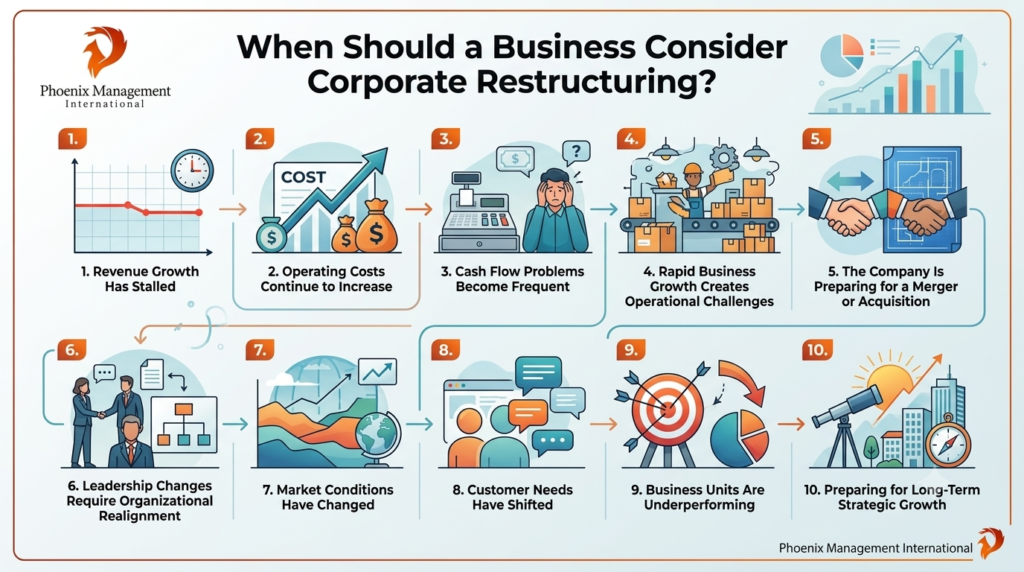
1. Revenue Growth Has Stalled
One of the earliest signs is stagnant revenue despite ongoing investments in marketing, sales, or product development.
Common indicators include:
- Flat year-over-year revenue
- Declining profit margins
- Reduced customer acquisition
- Lower market competitiveness
- Rising operational costs
Restructuring can help identify inefficiencies and redirect resources toward higher-value initiatives.
2. Operating Costs Continue to Increase
Growing businesses often accumulate unnecessary expenses over time.
Examples include:
- Duplicate departments
- Inefficient workflows
- Outdated technology
- Excess management layers
- Underperforming business units
Operational restructuring focuses on improving productivity while reducing waste.
3. Cash Flow Problems Become Frequent
Even profitable businesses can experience cash flow issues.
Warning signs include:
- Difficulty paying suppliers
- Increasing short-term borrowing
- Delayed payroll
- High interest expenses
- Limited working capital
Financial restructuring may involve:
- Debt refinancing
- Capital restructuring
- Expense optimization
- Asset sales
- Improved cash management
4. Rapid Business Growth Creates Operational Challenges
Growth often exposes weaknesses that weren’t apparent during earlier stages.
Examples include:
- Communication breakdowns
- Decision-making delays
- Inconsistent customer experiences
- Leadership bottlenecks
- Resource shortages
Rather than limiting growth, restructuring helps build systems capable of supporting expansion.
5. The Company Is Preparing for a Merger or Acquisition
Before a merger or acquisition, businesses often restructure to:
- Simplify legal entities
- Improve financial reporting
- Increase valuation
- Reduce liabilities
- Align operational processes
A well-organized company is generally more attractive to investors and acquisition partners.
6. Leadership Changes Require Organizational Realignment
A new CEO or executive leadership team frequently reassesses the organization’s structure.
Restructuring may involve:
- Redefining leadership roles
- Updating reporting relationships
- Establishing new performance metrics
- Improving accountability
- Aligning teams with strategic priorities
This creates clearer direction across the organization.
7. Market Conditions Have Changed
Industries evolve continuously due to:
- New competitors
- Technological innovation
- Economic uncertainty
- Regulatory changes
- Shifting customer expectations
Companies that adapt early often outperform those that wait until problems become severe.
8. Customer Needs Have Shifted
Customer preferences rarely stay the same.
Businesses may need restructuring when:
- Products become outdated
- Customer retention declines
- New market segments emerge
- Digital transformation becomes essential
Organizational changes can help businesses respond more quickly to changing demand.
9. Business Units Are Underperforming
Not every department contributes equally to business success.
Management may discover:
- Unprofitable product lines
- Low-performing locations
- Redundant services
- Overlapping responsibilities
Restructuring helps concentrate investment on the organization’s strongest opportunities.
10. Preparing for Long-Term Strategic Growth
Some of the healthiest companies restructure proactively rather than reactively.
Forward-thinking organizations often restructure to:
- Expand internationally
- Launch new business divisions
- Improve governance
- Attract investors
- Increase scalability
- Build stronger leadership succession plans
Proactive restructuring often minimizes future disruption.
Strong businesses evolve with the market. See how expert corporate advisory can help your organization adapt and thrive.
Common Types of Corporate Restructuring
| Type | Primary Goal | Best Used When |
|---|---|---|
| Financial Restructuring | Improve cash flow and debt management | Debt challenges or liquidity concerns |
| Operational Restructuring | Increase efficiency and productivity | Rising costs or workflow issues |
| Organizational Restructuring | Improve leadership and reporting | Rapid growth or leadership changes |
| Strategic Restructuring | Support long-term growth | Market expansion or business transformation |
| Legal Restructuring | Simplify corporate structure | Mergers, acquisitions, or compliance needs |
Benefits of Corporate Restructuring
When carefully planned and executed, restructuring can provide significant long-term advantages.
Improved Operational Efficiency
Businesses eliminate unnecessary complexity, reduce duplication, and improve productivity.
Stronger Financial Health
Organizations often achieve:
- Better cash flow
- Lower operating costs
- Improved profitability
- Greater financial flexibility
Better Decision-Making
Clear reporting structures allow leaders to make faster, more informed decisions.
Increased Business Agility
A streamlined organization can adapt more quickly to market changes and customer expectations.
Enhanced Investor Confidence
Well-structured businesses typically demonstrate stronger governance, transparency, and long-term planning.
Common Mistakes Businesses Should Avoid
Corporate restructuring can create value, but poor planning may produce the opposite effect.
Avoid these common mistakes:
- Waiting until financial problems become critical
- Focusing only on cost-cutting
- Ignoring employee communication
- Overlooking company culture
- Failing to establish measurable objectives
- Making organizational changes without supporting processes
- Neglecting change management planning
Successful restructuring balances financial goals with people, operations, and long-term strategy.
Practical Example
Imagine a manufacturing company that has doubled in size over five years.
While sales continue to grow, the business begins experiencing:
- Delayed customer orders
- Inventory shortages
- Rising labor costs
- Conflicting management decisions
- Lower profit margins
Rather than hiring additional staff immediately, leadership conducts a corporate restructuring initiative.
The company:
- Redesigns its reporting structure
- Automates inventory management
- Consolidates duplicate departments
- Updates financial controls
- Clarifies leadership responsibilities
Within months, operations become more efficient, customer satisfaction improves, and profitability increases despite maintaining similar staffing levels.
Whether you’re scaling, restructuring, or planning your next move, experienced corporate advisors can help you move forward with confidence.
How to Know If Your Business Is Ready for Restructuring
Use this quick checklist.
You may benefit from restructuring if you answer “Yes” to several of these questions:
- Is revenue growth slowing?
- Are operating costs increasing?
- Are decision-making processes becoming slower?
- Has your company outgrown its current structure?
- Are departments working in isolation?
- Are customers experiencing inconsistent service?
- Is cash flow becoming difficult to manage?
- Are you preparing for expansion, investment, or acquisition?
If multiple issues apply, it may be time to evaluate your organizational strategy before problems become more difficult to solve.
Why Professional Guidance Matters
Corporate restructuring affects every part of an organization, from finances and operations to employees and long-term strategy. Working with experienced advisors can help business leaders identify risks, evaluate opportunities, and implement changes with minimal disruption.
Organizations seeking Corporate Advisory Services can benefit from independent strategic assessments, financial analysis, governance improvements, and customized restructuring plans designed to support sustainable growth. Businesses looking for Corporate Advisory in San Antonio can also gain valuable local expertise while aligning their restructuring strategy with regional market opportunities.
Key Takeaways
- Corporate restructuring is a strategic tool for improving business performance and preparing for future growth.
- It is valuable for both struggling and successful businesses.
- Early intervention often leads to better outcomes than waiting for financial distress.
- Financial, operational, organizational, and strategic restructuring each address different business needs.
- Careful planning, strong leadership, and clear communication are essential for successful implementation.
FAQs
Is corporate restructuring only for companies experiencing financial problems?
No. Many profitable businesses restructure to improve efficiency, prepare for expansion, strengthen governance, or respond to changing market conditions.
How long does corporate restructuring usually take?
The timeline depends on the size and complexity of the organization. Smaller operational changes may take a few months, while enterprise-wide restructuring initiatives can extend over a year.
What is the difference between restructuring and reorganization?
Reorganization typically focuses on internal reporting structures and operational changes, while restructuring may include financial, legal, strategic, and organizational adjustments across the entire business.
Can restructuring improve profitability?
Yes. By reducing inefficiencies, optimizing resources, improving decision-making, and aligning operations with business goals, restructuring can support stronger long-term profitability.
Should small businesses consider corporate restructuring?
Absolutely. Small and mid-sized businesses often benefit from restructuring as they grow, enter new markets, prepare for investment, or adapt to changing customer demands.
Conclusion
Corporate restructuring is not simply a response to business challenges—it is a strategic opportunity to build a stronger, more resilient organization. Whether your company is facing operational inefficiencies, preparing for expansion, or adapting to evolving market conditions, recognizing the right time to restructure can improve performance and support long-term success.
Regularly evaluating your organization’s financial health, leadership structure, operational processes, and growth strategy helps ensure your business remains agile in a competitive environment. When significant changes are needed, seeking experienced strategic guidance can help you make informed decisions and implement restructuring with confidence.
Ready to Strengthen Your Business Strategy?
Whether you’re navigating rapid growth, improving operational efficiency, preparing for a merger, or addressing financial challenges, the right guidance can make all the difference. Phoenix Management International provides Corporate Advisory Services in San Antonio, TX, helping businesses develop strategic solutions that support long-term success, sustainable growth, and informed decision-making.
Connect with our experienced advisory team to discuss your business goals and discover how a customized corporate advisory strategy can help your organization move forward with confidence.