
Running a small business means wearing multiple hats. One day you’re managing employees, the next you’re solving cash flow issues, negotiating with vendors, or trying to plan for growth. While many entrepreneurs prefer to solve problems on their own, there comes a point when outside expertise can save time, reduce costly mistakes, and help the business move forward with confidence.
A Business Management Consultant provides strategic guidance, operational expertise, and objective recommendations that help businesses improve performance, solve complex challenges, and prepare for sustainable growth. Whether you’re struggling with declining profits, rapid expansion, inefficient operations, or leadership challenges, bringing in an experienced consultant can provide the clarity and direction needed to make better business decisions.
In this guide, you’ll learn when hiring a management consultant makes sense, the signs your business needs one, the benefits they provide, and how to choose the right consulting partner.
What Is a Business Management Consultant?
A Business Management Consultant is a professional who evaluates how a company operates and develops practical strategies to improve efficiency, profitability, leadership, financial performance, and long-term growth.
Unlike employees who work inside the business every day, consultants bring an independent perspective. They identify issues that owners and managers may overlook and recommend solutions based on proven business practices and industry experience.
Their work may include:
- Business strategy development
- Financial performance analysis
- Operational improvements
- Leadership coaching
- Organizational restructuring
- Growth planning
- Risk management
- Process optimization
- Change management
- Performance measurement
When Should a Small Business Hire a Management Consultant?
There isn’t a single “perfect” time to hire a consultant. Instead, businesses usually benefit when they reach important transition points or face challenges that require specialized expertise.
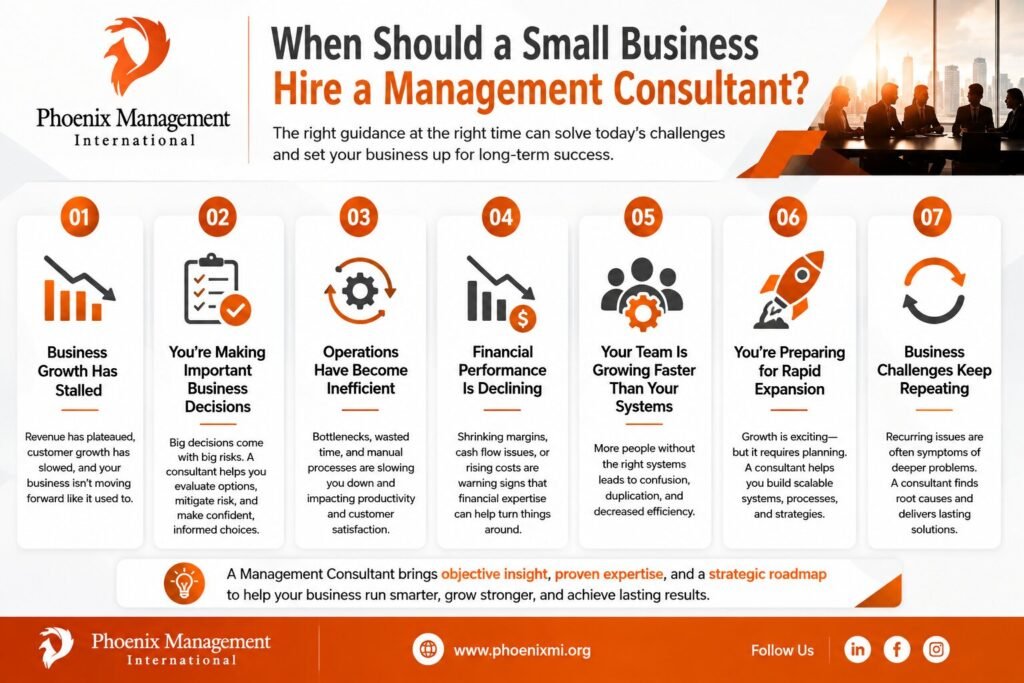
1. Business Growth Has Stalled
Many businesses experience a plateau after initial success.
Common signs include:
- Revenue has stopped increasing
- Customer acquisition has slowed
- Profit margins continue shrinking
- Marketing efforts produce fewer results
- Expansion plans remain on hold
A consultant can analyze what’s limiting growth and create a strategic roadmap to help the business move forward.
2. You’re Making Important Business Decisions
Major decisions often involve significant financial risk.
Examples include:
- Opening a new location
- Hiring senior leadership
- Launching a new product
- Expanding into new markets
- Purchasing another business
- Seeking investors
A management consultant provides objective analysis, helping business owners evaluate risks, opportunities, and long-term outcomes before making costly commitments.
3. Operations Have Become Inefficient
As businesses grow, processes that once worked often become inefficient.
Warning signs include:
- Missed deadlines
- Poor communication
- Duplicate work
- Increasing operational costs
- Customer complaints
- Workflow bottlenecks
Improving the Business Management Process helps eliminate unnecessary steps, increase productivity, and improve customer satisfaction.
4. Financial Performance Is Declining
Revenue alone doesn’t determine business health.
You may need outside expertise if:
- Expenses continue increasing
- Cash flow problems occur regularly
- Profit margins decrease
- Budget forecasting is inaccurate
- Financial reports lack meaningful insights
Consultants help business owners understand financial trends and make informed decisions that support sustainable profitability.
5. Your Team Is Growing Faster Than Your Systems
Hiring more employees doesn’t automatically improve efficiency.
Without proper systems, businesses often experience:
- Unclear responsibilities
- Leadership confusion
- Low productivity
- Employee turnover
- Poor accountability
A consultant can recommend organizational improvements that support growth without creating unnecessary complexity.
6. You’re Preparing for Rapid Expansion
Growth creates new challenges.
Expansion often requires:
- New operational systems
- Scalable workflows
- Stronger leadership
- Financial planning
- Risk assessment
- Market analysis
Professional guidance helps businesses grow strategically rather than reactively.
7. Business Challenges Keep Repeating
Recurring problems usually indicate underlying operational issues.
Examples include:
- Constant staffing issues
- Missed revenue targets
- Customer retention problems
- Inventory challenges
- Project delays
Instead of addressing symptoms, consultants identify root causes and implement long-term solutions.
Common Business Management Mistakes That Hold Companies Back
Many businesses struggle not because of poor products or services but because of avoidable management decisions.
Common Business Management Mistakes include:
- Trying to solve every problem without expert advice
- Making decisions based on assumptions instead of data
- Ignoring financial reporting
- Operating without measurable goals
- Poor delegation
- Inconsistent leadership
- Lack of documented processes
- Delaying strategic planning
- Hiring too quickly without workforce planning
- Reacting to problems instead of preventing them
Recognizing these issues early can prevent costly setbacks.
Business Management Consultant vs. Business Coach
| Business Management Consultant | Business Coach |
|---|---|
| Analyzes business operations | Focuses on personal leadership development |
| Solves operational problems | Helps improve individual performance |
| Creates strategic plans | Provides motivation and accountability |
| Recommends organizational improvements | Guides mindset and decision-making |
| Often works on company-wide initiatives | Primarily supports business owners or executives |
Many growing businesses benefit from both, but consultants are typically engaged when operational improvements or strategic business decisions are required.
Business Management Benefits
Hiring a consultant can produce measurable improvements across multiple areas of the business.
Some of the most valuable Business Management Benefits include:
Improved Strategic Planning
Clear goals supported by realistic execution plans help businesses make better long-term decisions.
Better Financial Performance
Consultants identify opportunities to reduce unnecessary expenses, improve profitability, and strengthen cash flow management.
Increased Operational Efficiency
Optimized processes reduce wasted time, improve productivity, and support consistent service delivery.
Stronger Leadership
Management consulting often includes leadership development that improves communication, accountability, and decision-making.
Objective Perspective
Business owners can become too close to daily operations. An outside expert offers unbiased insights based on experience rather than internal assumptions.
Better Risk Management
Consultants help identify operational, financial, and strategic risks before they become expensive problems.
What Does the Consulting Process Usually Look Like?
Although every engagement is different, most consultants follow a structured approach.
Step 1: Business Assessment
Review operations, financial performance, goals, and current challenges.
Step 2: Opportunity Analysis
Identify strengths, weaknesses, operational gaps, and improvement opportunities.
Step 3: Strategic Planning
Develop practical recommendations aligned with business objectives.
Step 4: Implementation Support
Assist leadership with executing recommended improvements.
Step 5: Performance Monitoring
Track progress using measurable business metrics and adjust strategies when necessary.
Real-World Example
Imagine a family-owned manufacturing company experiencing steady sales but shrinking profits. Orders are increasing, yet projects are consistently delayed, employees are working overtime, and customer complaints are rising.
Rather than hiring additional staff immediately, the owner brings in a management consultant.
After reviewing operations, the consultant discovers that outdated workflows, inconsistent scheduling, and inefficient communication, not staffing shortages, are the primary causes of the problem.
By redesigning processes, clarifying responsibilities, and introducing performance metrics, the company improves productivity, reduces operating costs, and increases profitability without significantly expanding payroll.
This illustrates how the right consulting advice can address root causes rather than temporary symptoms.
How to Choose the Right Management Consultant
Before hiring a consultant, consider the following checklist:
✔ Relevant industry experience
✔ Proven business improvement results
✔ Strong strategic planning skills
✔ Financial and operational expertise
✔ Clear communication
✔ Transparent consulting process
✔ Ability to customize recommendations
✔ Long-term partnership mindset
Avoid consultants who rely on one-size-fits-all solutions or make unrealistic promises about immediate business transformation.
Key Takeaways
- Small businesses benefit most from consulting during periods of growth, change, or operational challenges.
- Consultants provide objective insights that internal teams may overlook.
- Improving the Business Management Process often leads to stronger profitability and efficiency.
- Addressing Business Management Mistakes early can prevent long-term financial and operational issues.
- The right consultant supports sustainable growth by combining strategy, execution, and measurable outcomes.
FAQs:
When should a small business hire a management consultant?
A small business should consider hiring a management consultant when growth slows, operational challenges increase, major business decisions arise, or specialized expertise is needed to improve performance.
What does a business management consultant do?
A business management consultant evaluates operations, identifies inefficiencies, develops strategic plans, improves financial performance, and helps businesses achieve sustainable growth.
Is hiring a management consultant worth it for small businesses?
Yes. A consultant can provide objective insights, reduce costly mistakes, improve operational efficiency, strengthen leadership, and help business owners make informed decisions.
How long does a management consulting project usually take?
Project timelines vary depending on business needs. Some engagements last a few weeks for targeted improvements, while larger strategic initiatives may continue for several months.
Can a consultant help improve business profitability?
Absolutely. Consultants analyze costs, pricing strategies, workflows, financial performance, and operational efficiency to identify opportunities for increased profitability.
What’s the difference between consulting and outsourcing management?
Consulting focuses on evaluating, advising, and improving business operations, while outsourcing transfers specific operational responsibilities to an external provider.
Conclusion
Every small business faces challenges as it grows. The key is recognizing when internal resources are no longer enough to solve increasingly complex problems. Hiring a Business Management Consultant isn’t a sign that your business is struggling; it’s a strategic investment in better decision-making, stronger operations, and sustainable growth.
Whether you’re navigating expansion, improving efficiency, or overcoming recurring operational issues, experienced guidance can help you move forward with greater confidence and clarity.
Ready to Strengthen Your Business?
If you’re looking for a trusted Business Management Consultant in San Antonio, Phoenix Management International provides professional business management services in San Antonio, TX. Our team partners with small businesses to improve operations, strengthen leadership, streamline processes, and develop practical growth strategies tailored to your goals. Contact Phoenix Management International to learn how expert business management consulting can help your organization achieve long-term success.