
Running a business in San Antonio requires more than generating sales. A company can have strong demand and still struggle with profitability when inefficient processes, unnecessary expenses, unclear responsibilities, or weak financial controls slow growth.
The good news is that improving profitability does not always mean cutting costs or working longer hours. Often, the biggest gains come from improving how the business operates.
A structured approach to business management services can help owners identify operational bottlenecks, strengthen financial decision-making, improve employee productivity, manage risk, and create systems that support sustainable growth.
This guide explains practical ways San Antonio businesses can improve operations and profitability, where businesses commonly lose money, and when working with a Business Management Consultant can make sense.
Key Takeaways
- Profitability depends on both revenue and operational efficiency.
- Businesses should measure margins, cash flow, labor productivity, customer retention, and operating expenses rather than focusing only on sales.
- Standardized processes can reduce errors, delays, duplication, and unnecessary costs.
- Technology is most valuable when it solves a clearly defined operational problem.
- Employee accountability improves when responsibilities, performance expectations, and workflows are clearly documented.
- Cost reduction should focus on waste and inefficiency rather than indiscriminate cuts.
- Regular financial and operational reviews can help business owners identify problems before they become expensive.
- Professional Business Management Services can provide an outside perspective and structured support when internal resources are limited.
What Is Business Management?
Business management is the process of planning, organizing, directing, and monitoring the people, finances, systems, and resources a company uses to achieve its objectives.
Effective management connects day-to-day operations with larger business goals. Instead of treating sales, staffing, finances, customer service, and technology as separate functions, management looks at how these areas affect one another.
For example, a company may increase sales but experience declining profits because:
- Labor costs have increased faster than revenue.
- Inventory is being purchased without sufficient demand forecasting.
- Employees spend too much time on repetitive administrative tasks.
- Pricing does not reflect the true cost of delivering a product or service.
- Customer acquisition costs are increasing.
- Accounts receivable are being collected too slowly.
- Managers lack accurate information when making decisions.
The objective is not simply to make the business busier. It is to make the business more productive, financially disciplined, and scalable.
Why Operations Have a Direct Impact on Profitability
Profitability is often treated as a financial problem, but many profitability issues begin in operations.
Consider a service company that generates $2 million in annual revenue. If employees regularly duplicate work, projects run beyond budget, invoices are delayed, and managers lack visibility into workloads, revenue growth alone may not substantially improve the bottom line.
Operational efficiency affects profitability through several channels:
Lower operating costs
Efficient workflows reduce unnecessary labor, materials, software expenses, rework, and administrative overhead.
Better employee productivity
When employees understand their responsibilities and have efficient systems, more productive work can be completed within the same amount of time.
Fewer errors
Standardized processes reduce mistakes that lead to refunds, rework, customer complaints, compliance problems, or lost opportunities.
Faster cash collection
Efficient invoicing and accounts-receivable processes can improve cash flow and reduce the time between completing work and receiving payment.
Improved customer experience
Customers are more likely to remain loyal when communication, service delivery, billing, and problem resolution are consistent.
Greater management visibility
Reliable data helps owners identify trends and make decisions before small operational issues become major financial problems.
The important connection is simple: better operations can create better financial outcomes.
10 Ways San Antonio Businesses Can Improve Operations and Profitability
1. Start With a Business Performance Audit
Before changing systems, identify where the business currently stands.
A business performance audit should examine financial, operational, human-resource, customer, and technology-related factors.
Start by reviewing:
- Revenue by product or service
- Gross and net profit margins
- Operating expenses
- Payroll and labor costs
- Customer acquisition costs
- Customer retention
- Accounts receivable
- Inventory turnover
- Sales conversion rates
- Employee productivity
- Vendor expenses
- Technology and software costs
- Project profitability
- Cash-flow patterns
The goal is to identify the difference between what the business thinks is happening and what the numbers actually show.
Example
Suppose a consulting firm believes its most profitable service is its largest service by revenue.
After analyzing direct labor, subcontractor expenses, sales costs, and delivery time, management discovers that a smaller service actually generates a higher profit margin.
That insight could influence pricing, marketing, staffing, and future investment decisions.
2. Document and Standardize the Business Management Process
Many businesses depend heavily on individual employees knowing “how things are done.”
That creates risk.
If an important employee leaves, takes time off, or becomes overloaded, undocumented knowledge can disappear with them.
A documented Business Management Process gives employees a consistent framework for completing recurring tasks.
Important processes may include:
- Sales qualification
- Customer onboarding
- Order fulfillment
- Project management
- Procurement
- Inventory management
- Invoicing
- Collections
- Hiring and onboarding
- Employee performance reviews
- Customer complaint resolution
- Vendor management
- Financial reporting
A useful process document should explain:
- What needs to happen
- Who is responsible
- When it should happen
- What information is required
- What system should be used
- What happens when something goes wrong
- How performance will be measured
Standardization does not mean removing flexibility. It creates a reliable baseline while allowing managers to make informed exceptions.
3. Identify and Eliminate Operational Bottlenecks
A bottleneck is a point in a process that limits the performance of the entire operation.
For example, a company may have enough sales representatives to generate new business but only one person responsible for approving contracts. If contracts regularly sit in an approval queue, revenue growth can be constrained by that single step.
Look for:
- Long approval times
- Repeated handoffs
- Manual data entry
- Duplicate reviews
- Waiting for information
- Poor communication between departments
- Excessive meetings
- Inventory delays
- Slow customer response times
- Tasks that depend on one employee
A useful question is:
Where does work spend the most time waiting rather than being actively completed?
That question often reveals problems that traditional financial reports cannot.
4. Improve Financial Visibility
Business owners need more than a year-end profit-and-loss statement.
Management decisions are stronger when leaders regularly understand:
- Revenue trends
- Gross margin
- Net margin
- Cash position
- Accounts receivable
- Accounts payable
- Budget versus actual spending
- Department-level performance
- Product or service profitability
- Forecasted revenue
- Upcoming financial obligations
Revenue is not the same as profit
A company can generate substantial revenue while producing disappointing profits.
For example:
Business Metric | What It Tells You |
Revenue | How much the business sells |
Gross profit | How much remains after direct costs |
Gross margin | Efficiency of delivering products/services |
Operating expenses | Cost of running the business |
Net profit | What remains after expenses |
Cash flow | How money moves into and out of the business |
Accounts receivable | Money customers still owe |
Customer acquisition cost | Cost of acquiring customers |
Customer lifetime value | Potential long-term customer value |
Tracking these metrics together provides a more complete picture than revenue alone.
5. Review Pricing and Profit Margins
One of the most overlooked Business Management Benefits is gaining a clearer understanding of which products, services, customers, or contracts actually contribute to profitability.
Businesses sometimes maintain prices based on:
- Competitor pricing
- Historical rates
- Customer expectations
- Cost-plus formulas
- Informal estimates
But pricing should also account for the resources required to deliver the offering.
Review:
- Direct labor
- Materials
- Vendor costs
- Overhead
- Delivery time
- Customer support
- Sales costs
- Rework
- Discounts
- Payment processing
- Contract-specific expenses
A service that appears profitable at first glance may have a much smaller margin after all associated costs are considered.
This analysis can help determine whether to:
- Raise prices
- Restructure packages
- Eliminate unprofitable offerings
- Negotiate vendor costs
- Reduce delivery time
- Target higher-value customers
6. Reduce Waste Without Damaging Growth
Cost control is important, but aggressive cost-cutting can create new problems.
Reducing training, customer service, technology, or essential staffing simply because they appear expensive may weaken the business over time.
Instead, distinguish between necessary investment and operational waste.
Look for waste in:
- Duplicate software subscriptions
- Unused technology
- Excess inventory
- Overtime caused by poor scheduling
- Repeated administrative work
- Unnecessary meetings
- Inefficient vendor contracts
- Excessive rework
- Manual processes that could be streamlined
- Low-performing marketing channels
The question should not be:
“Where can we spend less?”
It should be:
“Which expenses produce insufficient value relative to their cost?”
That distinction leads to healthier cost management.
7. Strengthen Employee Accountability and Productivity
Employees cannot consistently meet expectations that have never been clearly defined.
Businesses can improve accountability by establishing:
- Clear job responsibilities
- Measurable performance indicators
- Defined reporting relationships
- Documented procedures
- Regular performance reviews
- Appropriate training
- Clear communication channels
- Realistic workloads
For example, instead of telling a customer-service employee to “respond quickly,” management could establish a measurable response standard appropriate to the business.
Clear expectations make performance easier to evaluate and make coaching more constructive.
Do not measure everything
Too many KPIs can become counterproductive.
Choose a small number of metrics that directly connect individual or departmental performance to business objectives.
8. Use Technology to Solve Problems, Not Create More Complexity
Technology can improve productivity, but adding software does not automatically make a business more efficient.
Before adopting a new platform, identify the underlying problem.
For example:
Problem: Employees manually enter customer information into multiple systems.
Potential solution: Integrate systems or automate data transfer.
Problem: Managers cannot easily track project profitability.
Potential solution: Implement project-management and financial reporting tools that connect relevant data.
Problem: Customers frequently ask for updates.
Potential solution: Improve communication workflows and provide proactive status notifications.
The best technology strategy is not “use more software.”
It uses the right technology to remove measurable friction from the business.
9. Improve Customer Retention
Acquiring customers can require significant marketing and sales resources. Retaining existing customers can therefore be an important part of sustainable profitability.
Review the customer journey from the first interaction through repeat business.
Ask:
- How quickly are leads contacted?
- Is onboarding consistent?
- Are customer expectations clearly established?
- How often does the business communicate?
- How are complaints handled?
- Why do customers leave?
- Which customers generate the strongest margins?
- Are repeat customers being offered relevant opportunities?
Customer retention is not solely a marketing responsibility. It is influenced by operations, service quality, communication, pricing, fulfillment, and management.
10. Build a Management Dashboard
Business owners should not have to search through multiple spreadsheets to understand whether the company is performing well.
A management dashboard can bring critical indicators together in one place.
Depending on the business, a dashboard might track:
Financial
- Revenue
- Gross margin
- Net profit
- Cash flow
- Accounts receivable
Sales
- Leads
- Conversion rate
- Average deal size
- Sales pipeline
- Customer acquisition cost
Operations
- Productivity
- Project completion time
- Capacity utilization
- Error or rework rates
- Inventory levels
Customer
- Retention
- Repeat purchases
- Complaints
- Satisfaction indicators
People
- Turnover
- Absenteeism
- Training completion
- Performance indicators
The purpose is not to create a complicated reporting system. It is to give decision-makers timely information they can actually use.
Common Business Management Mistakes That Reduce Profitability
Many businesses do not have a single major problem. Instead, profitability gradually declines because several smaller management issues compound over time.
Common Business Management Mistakes include:
Focusing on revenue instead of margins
High sales do not guarantee healthy profits.
Making decisions without reliable data
Gut instinct has a place in entrepreneurship, but important financial decisions should be supported by accurate information.
Keeping inefficient processes because “that is how we have always done it”
Familiarity is not evidence of efficiency.
Overlooking administrative costs
Small recurring expenses can become significant when accumulated across the organization.
Failing to document important procedures
Undocumented knowledge creates operational dependency and continuity risk.
Expanding before the business is operationally ready
Growth can magnify existing problems.
Treating every customer as equally profitable
Revenue contribution and profitability contribution are not always the same.
Buying technology without defining the business problem
New software can increase complexity when the underlying process is poorly designed.
Cutting costs without considering long-term impact
Some expenses are investments in productivity, customer experience, employee capability, or growth.
Should You Handle Business Management Internally or Hire a Consultant?
The right approach depends on the size, complexity, and internal capabilities of the organization.
Approach | Best For | Potential Advantage | Potential Limitation |
Internal management | Businesses with experienced leadership | Strong knowledge of the company | Limited time or outside perspective |
Operations manager | Growing companies with increasing complexity | Dedicated operational oversight | Adds staffing cost |
Specialized consultant | Businesses facing specific challenges | Outside expertise and focused analysis | Consultant must understand the business |
Ongoing management support | Companies undergoing significant growth or change | Consistent strategic and operational support | Requires ongoing investment |
A Business Management Consultant can be particularly useful when leadership recognizes that something is limiting performance but cannot easily determine the root cause.
When Should a Business Consider Business Management Services?
Professional Business Management Services may be worth considering when:
- Revenue is growing but profit is not.
- Operating expenses are difficult to control.
- Business processes vary between employees.
- Management spends too much time solving routine problems.
- Financial reporting does not provide enough decision-making information.
- Employees lack clear accountability.
- Customer complaints or service inconsistencies are increasing.
- The owner is involved in too many day-to-day decisions.
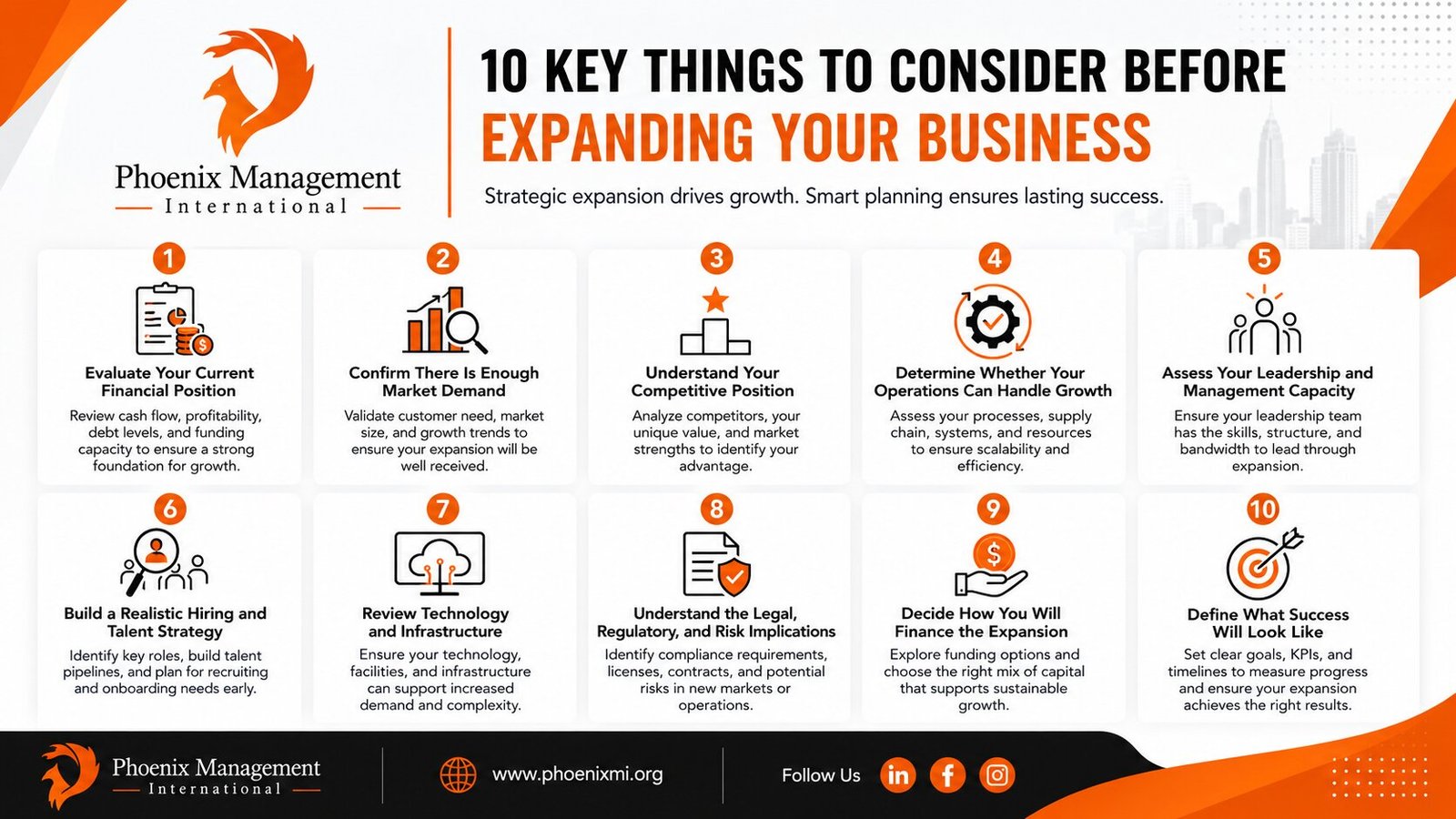
- The company is preparing for expansion.
- Leadership is restructuring the organization.
- A business needs an objective assessment of its operations.
- The company needs help developing a practical growth strategy.
A consultant should not simply provide generic recommendations. Effective management support should connect recommendations to the company’s actual financial, operational, and strategic circumstances.
What Does a Business Management Consultant Actually Do?
A consultant’s role can vary significantly depending on the organization’s needs.
A management engagement may include:
Business assessment
Reviewing current operations, financial performance, organizational structure, and business objectives.
Process improvement
Identifying inefficient workflows and creating more consistent processes.
Financial analysis
Reviewing costs, margins, budgets, cash flow, and other relevant indicators.
Strategic planning
Helping leadership translate business goals into measurable priorities and action plans.
Organizational improvement
Clarifying roles, responsibilities, reporting structures, and performance expectations.
Risk management
Identifying operational, financial, vendor, staffing, and strategic risks.
Performance management
Developing meaningful KPIs and management reporting systems.
Growth planning
Assessing whether systems, people, capital, and processes are prepared to support expansion.
The strongest engagements are practical. The goal is to help leadership understand what needs to change, why it matters, who should own the change, and how success will be measured.
A Practical 90-Day Business Improvement Framework
Businesses do not need to transform everything at once.
A focused 90-day plan can create momentum.
Days 1–30: Diagnose
Start by understanding the current state.
- Review financial statements.
- Identify major expense categories.
- Analyze profitable and unprofitable offerings.
- Map critical business processes.
- Interview key employees.
- Identify recurring operational problems.
- Review customer complaints and retention.
- Identify bottlenecks.
- Establish baseline KPIs.
Goal: Understand where the business is losing time, money, or opportunities.
Days 31–60: Improve
Prioritize the problems with the greatest potential impact.
- Standardize important workflows.
- Eliminate unnecessary process steps.
- Review vendor agreements.
- Address major cost leaks.
- Clarify employee responsibilities.
- Improve reporting.
- Review pricing and margins.
- Automate appropriate repetitive tasks.
Goal: Remove measurable sources of inefficiency.
Days 61–90: Measure and Scale
Evaluate what changed.
Compare:
- Costs before and after improvements
- Processing times
- Profit margins
- Customer response times
- Employee productivity
- Cash collection
- Error rates
- Customer retention
Keep the changes that produce measurable value and refine those that do not.
Goal: Turn successful improvements into repeatable management practices.
A Business Operations Checklist
Before making major changes, ask:
- Do we know which products or services are most profitable?
- Are our operating expenses reviewed regularly?
- Do we have documented processes for critical activities?
- Can employees clearly explain their responsibilities?
- Are important KPIs tracked consistently?
- Can management quickly identify cash-flow problems?
- Are customers receiving consistent service?
- Are we paying for technology or services we rarely use?
- Do we know where our biggest operational bottlenecks are?
- Are our prices aligned with the actual cost of delivery?
- Are employees spending time on work that could be automated?
- Do we have a realistic plan for sustainable growth?
If several answers are “no,” the business may have significant opportunities for operational improvement.
How Local Businesses Can Build More Sustainable Growth
San Antonio businesses operate across a diverse range of industries, from professional services and healthcare to construction, hospitality, retail, logistics, and other service-based businesses.
The operational challenges differ, but the underlying management principles remain similar:
Know the numbers.
Improve the process.
Clarify accountability.
Measure performance.
Protect cash flow.
Invest strategically.
Local growth should not come at the expense of operational stability.
A business that develops reliable systems before expanding is generally better positioned to manage increased customers, employees, vendors, and financial complexity.
That is especially important for owners who want to move from being deeply involved in every operational decision to leading the organization at a strategic level.
Key Takeaways for San Antonio Business Owners
Improving profitability is not simply a matter of increasing sales or reducing expenses.
A stronger approach is to improve the entire operating system of the business.
Start by:
- Auditing financial and operational performance.
- Identifying bottlenecks and unnecessary work.
- Documenting critical processes.
- Reviewing pricing and margins.
- Improving financial visibility.
- Clarifying employee responsibilities.
- Using technology strategically.
- Strengthening customer retention.
- Tracking meaningful KPIs.
- Creating a structured plan for continuous improvement.
When these areas work together, businesses can make better decisions and create a stronger foundation for sustainable growth.
FAQs
What is the best way to improve business profitability?
The best starting point is to identify where profit is being lost. Review margins, operating expenses, labor productivity, pricing, customer retention, cash flow, and inefficient processes before deciding which changes to make.
How can a small business improve operational efficiency?
Small businesses can improve efficiency by documenting recurring processes, eliminating unnecessary steps, clarifying employee responsibilities, reducing duplicate work, monitoring key performance indicators, and using technology where it solves a specific operational problem.
What are the most common business management mistakes?
Common mistakes include focusing only on revenue, failing to monitor margins, relying on undocumented processes, making decisions without accurate data, ignoring operational bottlenecks, adding unnecessary technology, and cutting costs without considering their long-term impact.
When should a business hire a management consultant?
A business may benefit from a consultant when leadership needs an objective assessment, profitability is not keeping pace with revenue, operational problems are recurring, internal management lacks sufficient time or expertise, or the company is preparing for significant growth or organizational change.
What are the benefits of professional business management services?
Professional business management services can provide structured operational analysis, process improvement, financial and performance reviews, strategic planning, organizational guidance, risk assessment, and practical recommendations designed around a company’s specific goals.
Can improving operations increase profitability without increasing sales?
Yes. Improving operational efficiency can increase profitability by reducing waste, lowering avoidable costs, improving productivity, reducing errors, strengthening margins, accelerating collections, and making better use of existing resources.
Final Thoughts
A profitable business is not necessarily the business with the most customers, employees, or revenue. It is a business that understands how its resources are being used and has systems in place to turn those resources into sustainable value.
For San Antonio business owners, the first step is often not another marketing campaign or a major expansion. It may be a closer look at the processes, expenses, people, and decisions already shaping the company every day.
If you are searching for a Business Management Consultant in san antino, focus on finding a partner who looks beyond surface-level cost cutting and takes the time to understand how your business actually operates.
Phoenix Management International is providing business management services in San Santino, TX to help businesses evaluate operations, strengthen management practices, improve decision-making, and build a stronger foundation for sustainable growth.