
Businesses rarely fail overnight. More often, declining profitability, cash flow challenges, operational inefficiencies, or changing market conditions gradually weaken a company’s position. The good news is that many struggling organizations can recover with a structured turnaround strategy focused on stabilizing finances, improving operations, and rebuilding sustainable growth.
This step-by-step guide explains how successful business turnarounds work, when they’re necessary, and the practical actions leaders can take to restore financial health. Whether you’re a business owner, executive, investor, or entrepreneur, you’ll learn proven turnaround strategies, common mistakes to avoid, and the key metrics that determine long-term success.
What Is a Business Turnaround?
A business turnaround is a structured process of reversing declining business performance by identifying underlying problems, implementing strategic changes, improving financial stability, and restoring profitability.
Rather than simply cutting costs, an effective turnaround addresses the root causes of poor performance while positioning the company for sustainable growth.
Quick Definition
A successful business turnaround is the process of transforming an underperforming company into a financially stable and competitive business through strategic planning, operational improvements, financial restructuring, and strong leadership.
Signs Your Business May Need a Turnaround
Many companies wait too long before taking corrective action. Recognizing early warning signs can significantly improve recovery outcomes.
Common indicators include:
- Declining revenue over multiple quarters
- Consistent cash flow shortages
- Rising operating expenses
- Increasing debt obligations
- Falling customer satisfaction
- High employee turnover
- Supply chain disruptions
- Loss of market share
- Reduced profit margins
- Difficulty securing financing
The earlier these issues are addressed, the greater the likelihood of a successful recovery.
Why Business Turnarounds Succeed
Companies that recover successfully usually focus on solving problems systematically instead of reacting to symptoms.
Successful turnarounds often involve:
- Honest assessment of current challenges
- Strong executive leadership
- Fast but informed decision-making
- Financial discipline
- Operational improvements
- Customer retention initiatives
- Data-driven performance monitoring
- Clear communication with stakeholders
Every successful turnaround starts with the right strategy. Whether you’re looking to improve operations, strengthen leadership, or increase profitability, Phoenix Management International offers professional business management services in San Antonio, TX designed to help your business move forward with confidence.
Step-by-Step Guide to a Successful Business Turnaround
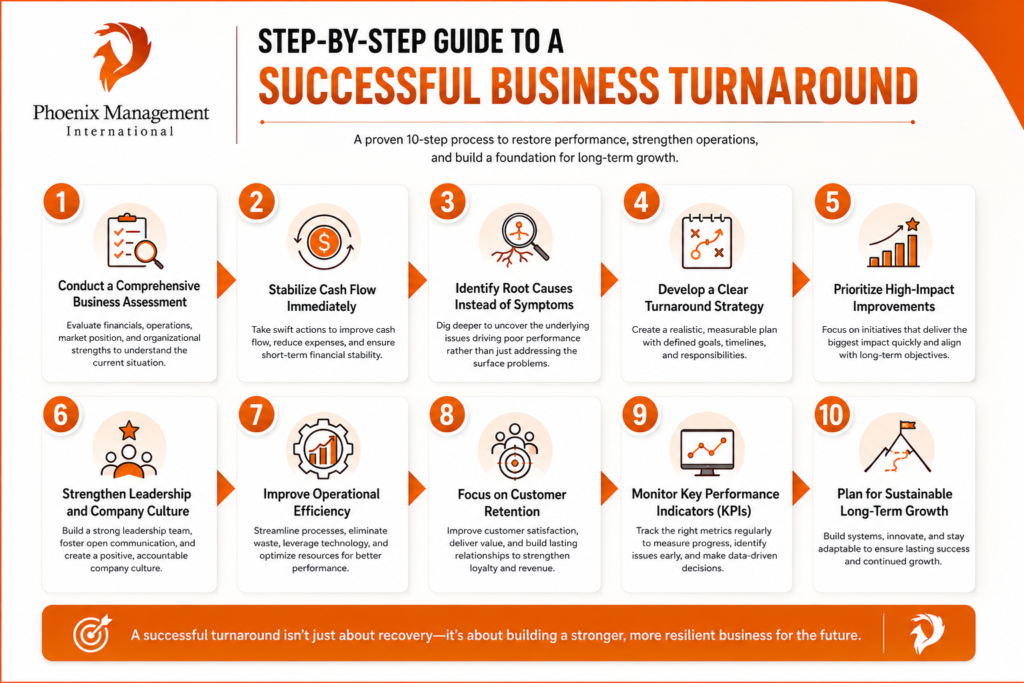
Step 1: Conduct a Comprehensive Business Assessment
Every turnaround begins with understanding what is actually causing poor performance.
Evaluate every major business function, including:
Financial Performance
Review:
- Cash flow
- Revenue trends
- Profit margins
- Debt obligations
- Accounts receivable
- Accounts payable
- Operating costs
Operational Performance
Assess:
- Workflow efficiency
- Production bottlenecks
- Inventory management
- Technology usage
- Vendor relationships
- Process effectiveness
Market Position
Analyze:
- Competitor performance
- Customer expectations
- Industry trends
- Pricing strategy
- Brand reputation
Leadership and Organizational Structure
Determine whether:
- Roles are clearly defined
- Leadership decisions are timely
- Departments collaborate effectively
- Employees understand business goals
Key takeaway: Avoid making decisions based on assumptions. Use measurable data to identify the real issues.
Step 2: Stabilize Cash Flow Immediately
Cash flow is often the most urgent concern during a turnaround.
Short-term stabilization strategies include:
- Reducing unnecessary expenses
- Renegotiating supplier agreements
- Improving collections on outstanding invoices
- Delaying non-essential capital expenditures
- Managing inventory more efficiently
- Reviewing pricing strategies
- Identifying underperforming assets
Positive cash flow provides the flexibility needed to implement longer-term improvements.
Step 3: Identify Root Causes Instead of Symptoms
Declining sales may not be the actual problem.
For example:
| Symptom | Possible Root Cause |
|---|---|
| Lower revenue | Outdated products, poor marketing, changing customer demand |
| High expenses | Inefficient operations, excess staffing, rising supplier costs |
| Low customer retention | Poor service, inconsistent quality, weak customer experience |
| Low productivity | Inefficient processes, outdated technology, unclear responsibilities |
Addressing root causes prevents recurring problems.
Step 4: Develop a Clear Turnaround Strategy
Once challenges have been identified, create a realistic recovery plan with measurable goals.
Your strategy should include:
Financial Objectives
Examples:
- Improve cash flow
- Reduce debt
- Increase profitability
- Strengthen working capital
Operational Goals
Such as:
- Reduce waste
- Improve efficiency
- Automate repetitive tasks
- Optimize inventory
Market Goals
Focus on:
- Customer retention
- Market expansion
- Product improvements
- Brand positioning
Leadership Objectives
Include:
- Better accountability
- Faster decision-making
- Stronger communication
- Performance management
Every initiative should have defined responsibilities and measurable deadlines.
Step 5: Prioritize High-Impact Improvements
Attempting to fix everything at once usually leads to failure.
Instead, rank initiatives based on:
- Financial impact
- Speed of implementation
- Resource requirements
- Long-term value
High-priority improvements often include:
- Eliminating unnecessary expenses
- Improving pricing
- Optimizing staffing
- Streamlining operations
- Enhancing customer service
Quick wins build momentum while supporting broader transformation efforts.
Step 6: Strengthen Leadership and Company Culture
Business turnarounds depend heavily on leadership.
Effective leaders:
- Communicate transparently
- Build employee trust
- Encourage accountability
- Make timely decisions
- Focus on measurable outcomes
Employees are more likely to support change when leadership explains the purpose behind each initiative.
Step 7: Improve Operational Efficiency
Operational improvements often create immediate financial benefits.
Common optimization opportunities include:
Process Improvement
- Remove redundant tasks
- Standardize workflows
- Improve documentation
Technology Adoption
Implement tools for:
- Accounting
- Inventory management
- Customer relationship management (CRM)
- Business analytics
- Project management
Supply Chain Optimization
Review:
- Vendor performance
- Purchasing strategies
- Logistics
- Inventory turnover
Small operational improvements can produce substantial long-term savings.
Step 8: Focus on Customer Retention
Acquiring new customers typically costs more than retaining existing ones.
Strengthen customer relationships by:
- Improving response times
- Personalizing customer experiences
- Resolving complaints quickly
- Offering loyalty incentives
- Collecting customer feedback
- Enhancing product or service quality
Satisfied customers often become repeat buyers and brand advocates.
Step 9: Monitor Key Performance Indicators (KPIs)
A turnaround strategy should be measured continuously.
Track metrics such as:
- Revenue growth
- Gross profit margin
- Net profit
- Cash flow
- Customer retention rate
- Employee productivity
- Customer acquisition cost
- Operating expenses
- Inventory turnover
- Return on investment (ROI)
Regular performance reviews allow leaders to adjust strategies before problems worsen.
Step 10: Plan for Sustainable Long-Term Growth
A turnaround doesn’t end when profitability returns.
Successful organizations continue improving through:
- Strategic planning
- Innovation
- Employee development
- Technology investments
- Market diversification
- Continuous performance monitoring
Long-term resilience is built through ongoing adaptation.
You don’t have to navigate business challenges alone. Partner with Phoenix Management International for trusted business management services in San Antonio, TX that provide strategic guidance, operational insights, and customized solutions to help your business achieve sustainable growth.
Common Business Turnaround Mistakes
Many turnaround efforts fail because businesses make avoidable mistakes.
Common pitfalls include:
- Waiting too long to act
- Cutting costs without a long-term strategy
- Ignoring customer experience
- Making decisions without reliable data
- Poor communication with employees
- Failing to monitor performance
- Resisting organizational change
- Overlooking leadership development
Avoiding these mistakes significantly increases the chances of recovery.
Benefits of a Successful Business Turnaround
Organizations that execute turnaround strategies effectively often experience:
- Improved profitability
- Stronger cash flow
- Better operational efficiency
- Higher employee engagement
- Increased customer loyalty
- Enhanced competitive advantage
- Greater organizational resilience
- Sustainable long-term growth
Beyond financial recovery, turnarounds often create stronger, more adaptable businesses.
When Should You Seek Professional Business Turnaround Support?
Some situations require outside expertise, particularly when multiple business functions are under pressure.
Professional advisors can add value when your organization faces:
- Severe cash flow problems
- Declining profitability
- Debt restructuring needs
- Leadership transitions
- Business expansion challenges
- Mergers or acquisitions
- Operational restructuring
- Strategic planning gaps
Experienced consultants provide objective analysis, industry knowledge, and structured implementation support that internal teams may struggle to deliver while managing day-to-day operations.
For organizations in Texas, professional Business Management Services in San Antino can also provide localized expertise for strategic planning, operational improvement, and sustainable business growth.
Business Turnaround Checklist
Use this checklist to evaluate your recovery efforts:
✔ Assess financial health
✔ Analyze operational performance
✔ Identify root causes
✔ Stabilize cash flow
✔ Develop a turnaround strategy
✔ Prioritize high-impact initiatives
✔ Improve leadership communication
✔ Optimize business operations
✔ Strengthen customer relationships
✔ Monitor KPIs regularly
✔ Review progress monthly
✔ Plan for long-term growth
Key Takeaways
- Business turnarounds require structured planning rather than reactive decision-making.
- Early intervention significantly improves recovery success.
- Cash flow stabilization should be the first priority.
- Sustainable improvements focus on addressing root causes, not just symptoms.
- Strong leadership, operational efficiency, and customer retention are essential for lasting success.
- Continuous performance measurement helps businesses adapt and maintain growth after recovery.
FAQs
How long does a business turnaround usually take?
The timeline depends on the company’s size, financial condition, and the complexity of its challenges. Some businesses see measurable improvements within a few months, while larger transformations may take 12 to 24 months to achieve sustainable results.
What is the first step in a business turnaround?
The first step is conducting a thorough assessment of the company’s financial performance, operations, leadership, and market position. Understanding the root causes of decline helps guide effective recovery strategies.
Can small businesses benefit from turnaround strategies?
Yes. Business turnaround principles apply to organizations of all sizes. Small businesses can improve profitability, cash flow, and operational efficiency by identifying weaknesses early and implementing targeted improvements.
What are the biggest causes of failed business turnarounds?
Common reasons include delayed action, poor leadership, inadequate cash flow management, lack of strategic planning, ineffective communication, and failure to monitor performance metrics consistently.
Should a business hire a turnaround consultant?
If a business is experiencing persistent financial difficulties, operational inefficiencies, leadership challenges, or rapid market changes, an experienced turnaround consultant can provide objective guidance, specialized expertise, and a structured recovery plan.
Conclusion
A successful business turnaround is about more than surviving difficult circumstances, it’s about creating a stronger, more resilient organization. By assessing your current position, stabilizing finances, addressing root causes, improving operations, and tracking meaningful performance metrics, you can build a clear path toward sustainable growth.
If your business is ready to improve performance, overcome operational challenges, or build a strategy for sustainable growth, Phoenix Management International is here to help. Our experienced team provides business management services in San Antonio, TX, offering customized solutions in strategic planning, operational improvement, financial guidance, and organizational development. Contact us today to discover how we can help your business navigate change with confidence and achieve long-term success.