
A strategic growth strategy is a deliberate, long-term plan for increasing a company’s revenue, market reach, profitability, or capacity without outgrowing its people, cash flow, or operating systems. It connects market opportunities with clear choices, resource allocation, execution milestones, risk controls, and measurable key performance indicators.
Unlike a collection of sales or marketing tactics, a strategic growth strategy explains where the business will compete, how it will create an advantage, what capabilities it must build, and how leaders will measure progress.
What Is a Strategic Growth Strategy?
A strategic growth strategy is the framework a business uses to move from its current position to a stronger future position through intentional, evidence-based growth. It combines strategic planning, market analysis, financial discipline, operational capacity, customer needs, and performance measurement.
The word “strategic” matters. Growth is not automatically healthy. A company can increase sales while weakening margins, exhausting employees, creating cash flow pressure, or lowering service quality. Strategic growth focuses on expansion that the organization can fund, deliver, and sustain.
IMD describes business strategy as an organizational plan that guides major decisions and aligns departments around shared goals. A growth strategy applies that discipline specifically to expansion, value creation, and competitive advantage. Review IMD’s business strategy guide.
How Is a Growth Strategy Different From a Business Plan?
| Document | Main Purpose | Main Question |
|---|---|---|
| Business plan | Explains the business model, market, operations, and finances | How will the business operate and make money? |
| Strategic plan | Sets broader organizational direction | Where is the organization going? |
| Strategic growth strategy | Selects and coordinates paths to expansion | Where will growth come from, and how will it remain sustainable? |
| Annual operating plan | Converts strategy into budgets, projects, and deadlines | What must we execute this year? |
The U.S. Small Business Administration describes a business plan as a roadmap for structuring, running, and growing a company. A strategic growth strategy goes deeper into the choices, investments, and capabilities required for expansion. Explore the SBA’s business-planning guidance.
Why Do Businesses Need a Strategic Growth Strategy?
Every growth opportunity competes for limited cash, time, leadership attention, technology, and talent. A documented strategy helps leaders decide what to pursue, what to postpone, and what to decline.
An effective growth strategy can help a business:
- Focus resources on the highest-value opportunities
- Align sales, marketing, finance, operations, and leadership
- Test whether expansion is financially and operationally realistic
- Protect the customer experience as demand increases
- Establish measurable goals and accountability
- Respond faster when customer needs or market conditions change
Businesses already thinking several years ahead can strengthen their process with a long-term business growth strategy. Leaders still turning broad ambitions into priorities should also review the strategic planning mistakes that can hold businesses back.
What Are the Core Components of a Strategic Growth Strategy?
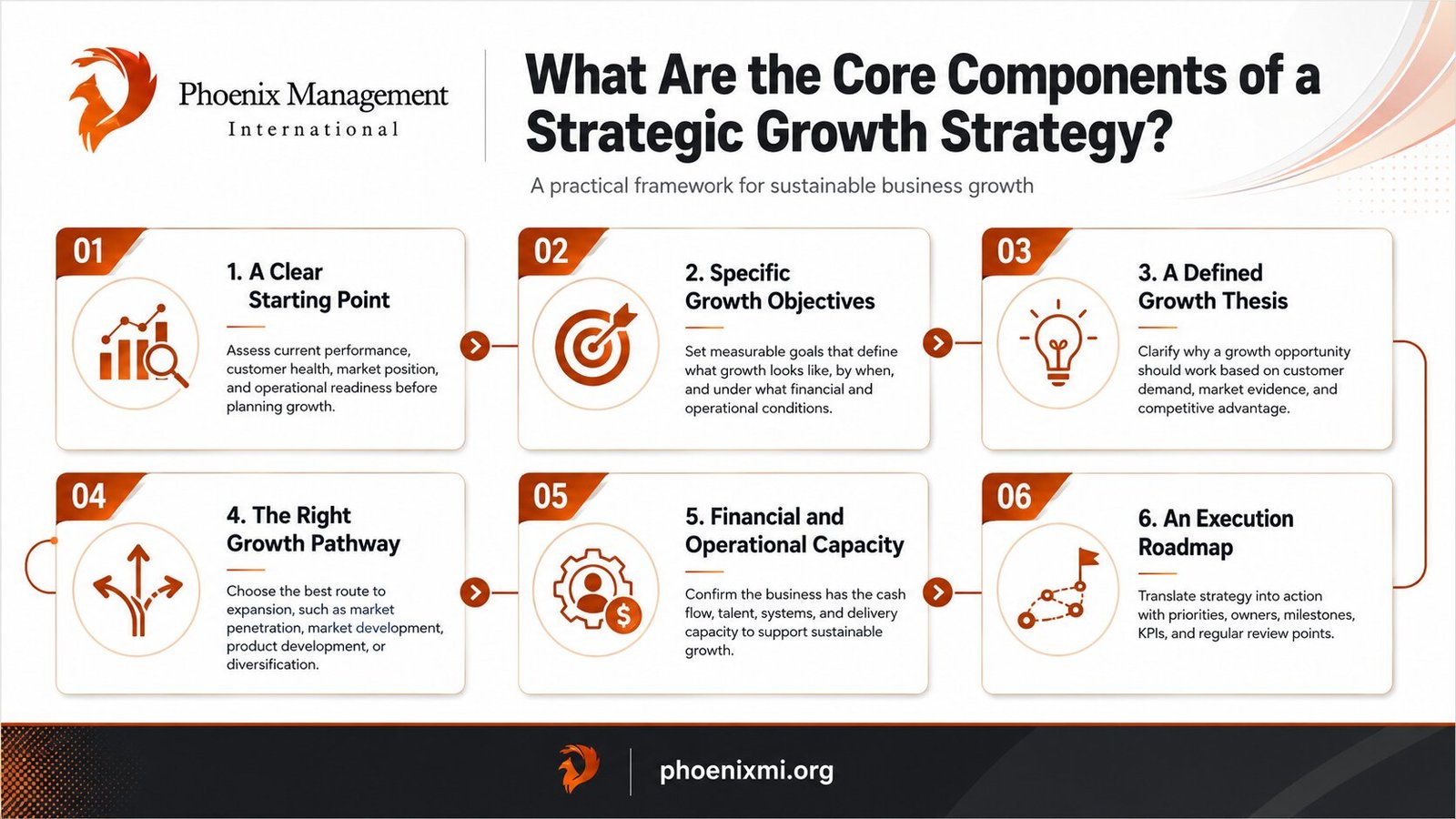
1. A Clear Starting Point
Before choosing a growth direction, assess the company’s current:
- Revenue and profitability
- Customer concentration
- Customer retention
- Sales conversion
- Operational capacity
- Cash flow
- Team capabilities
- Technology
- Market position
- Competitive advantages
A SWOT analysis can organize these findings, but the exercise should not end with a list. Each strength, weakness, opportunity, and threat should lead to a decision, priority, or testable question.
2. Specific Growth Objectives
“Grow revenue” is not a strategy. Effective strategic objectives define the desired result, time frame, customer or market focus, and important financial or operational guardrails.
For example:
Increase recurring revenue from existing small-business clients during the next 18 months while maintaining the company’s target gross margin and service-response standards.
This objective gives teams clearer direction than a broad revenue target. It also makes it easier to identify appropriate initiatives, allocate resources, and measure progress.
3. A Defined Growth Thesis
A growth thesis explains why an opportunity should produce results. It combines customer evidence, market conditions, competitive positioning, and internal strengths.
For example:
Mid-sized professional-service firms need stronger operational reporting but cannot justify building a full internal analytics team. We can grow by packaging our existing expertise into a recurring advisory service.
Before committing significant resources, test the thesis through customer interviews, market research, pricing analysis, prototypes, or a limited pilot.
The SBA recommends using market research and competitive analysis to understand demand, market size, saturation, pricing, and potential competitive advantages. Use the SBA’s planning resources to guide this research.
4. The Right Growth Pathway
A business can pursue growth through several routes:
| Growth Path | Meaning | Example | Relative Risk |
| Market penetration | Sell more existing offerings within current markets | Improve conversion, retention, referrals, or upselling | Lower |
| Market development | Take existing offerings to new customer segments or locations | Expand from San Antonio into another Texas market | Moderate |
| Product development | Add new or improved offerings for current customers | Introduce a premium service tier | Moderate |
| Diversification | Enter new markets with new offerings | Launch an unrelated business line | Higher |
| Partnerships or acquisitions | Gain reach, customers, or capabilities externally | Form an alliance or acquire a complementary company | Varies |
The first four pathways are commonly organized through the Ansoff Matrix. Risk generally increases when the business moves into unfamiliar products, markets, or both.
The best path depends on demand, economics, execution capacity, leadership experience, and risk tolerance. Leaders should compare exciting new opportunities against simpler ways to create value from existing customers, capabilities, and markets.
5. Financial and Operational Capacity
Growth usually consumes resources before it produces returns. Businesses should model:
- Hiring requirements
- Working capital
- Technology costs
- Marketing investment
- Delivery capacity
- Gross margins
- Break-even timing
- Cash flow
- Downside scenarios
Revenue growth can create financial pressure when receivables, payroll, inventory, or implementation costs rise faster than available cash. Phoenix Management International explains this risk in its guide to how poor financial management can affect business growth.
Operational readiness matters too. Leaders must confirm that workflows, roles, quality controls, vendors, and systems can support additional demand. Businesses with process bottlenecks can review the role of business management consulting in improving operational efficiency.
6. An Execution Roadmap
A useful growth roadmap identifies:
- Priority initiatives
- Initiative owners
- Budgets and resources
- Milestones
- Dependencies
- Risks
- Review dates
- Key performance indicators
- Conditions for continuing, changing, pausing, or stopping an initiative
The roadmap should limit the number of major priorities. Pursuing too many markets, products, and channels at the same time usually weakens execution and divides leadership attention.
How Do You Develop a Strategic Growth Strategy?
Step 1: Establish the Baseline
Document current revenue, profitability, customer mix, retention, sales performance, operational capacity, cash position, and competitive position. Leaders need an accurate starting point before setting realistic growth targets.
Step 2: Set Measurable Goals
Choose one to three strategic growth objectives. Each objective should be specific enough to guide investment decisions, resource allocation, and trade-offs.
Step 3: Research Customers and Competitors
Study customer needs, buying behavior, market demand, alternatives, pricing, acquisition channels, barriers to entry, and relevant market trends. Combine reliable secondary data with direct customer feedback.
Step 4: Compare Growth Options
Score potential growth pathways against criteria such as:
- Strategic fit
- Revenue potential
- Expected margin
- Required capital
- Time to impact
- Operational complexity
- Competitive intensity
- Leadership capacity
- Financial risk
This prevents leaders from choosing a direction simply because it appears exciting or because a competitor is pursuing it.
Step 5: Validate the Economics
Build realistic revenue, expense, cash flow, capacity, and return-on-investment scenarios. Include a downside case rather than relying only on the most optimistic forecast.
Major funding, acquisition, restructuring, or capital-allocation decisions may also require corporate finance advisory.
Step 6: Build the Roadmap
Select the few initiatives with the strongest combination of strategic fit, customer demand, and achievable financial returns. Assign owners, budgets, milestones, dependencies, and review dates.
Step 7: Align People and Operations
Confirm that leadership, staffing, processes, incentives, technology, and reporting systems support the plan.
Phoenix Management International’s business management services address operations, processes, financial health, and scalable business systems.
Step 8: Measure and Adapt
Review leading and lagging indicators regularly. Continue initiatives showing meaningful traction, repair fixable problems, and stop work that no longer supports the strategy.
A growth strategy should provide direction without preventing adaptation. When evidence changes, leaders should reassess assumptions rather than defending an outdated plan.
Which KPIs Should Measure Business Growth?
| Objective | Useful KPIs | Important Guardrail |
| Revenue growth | Growth rate, average deal size, recurring revenue | Gross margin |
| Customer acquisition | Qualified leads, conversion rate, customer acquisition cost | Payback period |
| Customer retention | Retention, churn, repeat purchases, customer lifetime value | Service quality |
| Market expansion | Revenue from new segment or location, qualified pipeline | Entry cost and timing |
| Operational scalability | Cycle time, capacity, error rate, cost per transaction | Employee workload |
| Profitability | Gross margin, operating margin, cash conversion | Customer impact |
Do not measure success through top-line revenue alone. A plan that raises sales but damages margin, cash flow, retention, employee capacity, or service quality may be creating fragile growth.
What Does a Strategic Growth Strategy Look Like in Practice?
Consider three hypothetical examples.
Local Service Company
A San Antonio home-services company improves local visibility, referral generation, repeat-service plans, and scheduling efficiency before investing in a second location.
Startup
A software founder validates one high-value feature with existing customers, improves user activation and retention, and delays geographic expansion until the business has proven repeatable acquisition economics.
Established Professional-Services Firm
A professional-services company packages an existing capability for a new industry, tests customer demand, trains its delivery team, and establishes margin and customer-satisfaction guardrails before a full launch.
The route differs in each example, but the discipline remains consistent: validate demand, choose priorities, fund the plan, prepare operations, assign accountability, and measure results.
What Are the Most Common Growth Strategy Mistakes?
Common mistakes include:
- Setting vague goals
- Copying competitors without validating customer demand
- Treating marketing tactics as the entire strategy
- Pursuing too many initiatives simultaneously
- Ignoring cash flow and working-capital needs
- Scaling demand before operations are ready
- Expanding without a clear competitive advantage
- Failing to assign owners or deadlines
- Measuring revenue without profitability or quality guardrails
- Continuing underperforming initiatives for too long
A strategic growth strategy should reduce complexity by making priorities, assumptions, and trade-offs explicit.
When Should a Business Hire a Growth Strategy Consultant?
External support may be valuable when:
- Growth has stalled
- Leaders disagree on priorities
- The company is entering a new market
- Operations cannot support increasing demand
- Financial performance is weakening
- The organization is considering an acquisition or partnership
- Leadership needs an objective assessment
- The company has a strategy but struggles with execution
A qualified consultant should help assess the business objectively, evaluate growth options, define priorities, build an execution roadmap, and establish accountability.
Phoenix Management International provides strategic consulting services for entrepreneurs, growing businesses, and larger organizations, with an emphasis on vision, operational alignment, implementation, and measurable results.
Business owners can also review how growth strategy consulting can accelerate business expansion.
How Should San Antonio Businesses Approach Growth?
San Antonio businesses should combine internal company data with reliable local market evidence.
U.S. Census QuickFacts for San Antonio reports 22,307 employer firms for reference year 2022. The City of San Antonio also provides small-business support related to mentoring, consulting, access to capital, and contracting opportunities. Review San Antonio’s small-business assistance programs.
A locally informed strategy should evaluate:
- Regional customer demand
- Customer purchasing behavior
- Workforce availability
- Government and corporate procurement opportunities
- Local competitors
- Operating and real-estate costs
- Industry clusters
- Access to capital
- The economics of expanding into other Texas markets
Local knowledge should support the strategy, but decisions should still be based on the company’s specific capabilities, customers, economics, and risk tolerance.
Frequently Asked Questions
What is the main purpose of a strategic growth strategy?
Its main purpose is to identify the most promising and sustainable sources of business growth, then align resources, operations, leadership, finances, and performance measurement around those opportunities.
What is the best growth strategy for a startup?
Most startups should validate demand, improve product-market fit, protect cash runway, and establish repeatable customer acquisition before pursuing complex geographic expansion or diversification. The right strategy depends on the startup’s stage, market, funding, and customer evidence.
Is strategic growth the same as scaling?
No. Growth means increasing business results, often with additional costs. Scaling means increasing output or revenue without costs rising at the same rate. A company can grow without becoming more scalable.
How long should a growth strategy cover?
Many strategic growth plans cover one to five years, with more detailed priorities for the next 12 months. The appropriate horizon depends on the industry, capital requirements, company stage, and speed of market change.
How often should a growth strategy be reviewed?
Performance should generally be reviewed monthly or quarterly, with a deeper strategic reassessment at least annually. A review may be needed sooner after a significant customer, market, financial, regulatory, or operational change.
How much does growth strategy consulting cost?
Pricing varies according to business size, project scope, complexity, research requirements, duration, and implementation support. Businesses should compare consultants using a defined scope, deliverables, responsibilities, timeline, and measurement approach.
Can a small business create a strategic growth strategy?
Yes. Small businesses benefit from the same strategic discipline as larger companies, although their plans may be shorter and more focused. A small business can begin with one primary objective, one growth pathway, a realistic budget, and a small set of KPIs.
Key Takeaways
- Strategic growth connects expansion goals with evidence, choices, resources, execution, and measurement.
- The strongest strategy is one the business can fund and execute sustainably.
- Different growth pathways carry different capital, capability, and risk requirements.
- Cash flow, operational capacity, leadership alignment, and customer experience are essential guardrails.
- Regular measurement allows leaders to adapt the strategy when evidence or market conditions change.
Build a Clearer Path to Sustainable Growth
Business owners do not need more disconnected growth ideas. They need a practical way to evaluate opportunities, choose priorities, prepare the organization, and execute with accountability.
Based in San Antonio, Phoenix Management International helps business owners and executives connect strategy with operational improvement, business management, and implementation. Explore its strategic consulting services or schedule a consultation to discuss the next stage of your business.