
Business restructuring can be a powerful strategy for improving profitability, adapting to market changes, and positioning a company for long-term growth. However, restructuring is also one of the most complex transitions an organization can undertake. Even businesses with strong leadership can make costly decisions that disrupt operations, lower employee morale, and delay expected results.
Understanding the most common restructuring mistakes businesses should avoid can help leaders make informed decisions, reduce risk, and create a smoother path toward sustainable success.
What Is Business Restructuring?
Business restructuring is the process of reorganizing a company’s operations, finances, leadership, workforce, or business model to improve performance, solve operational challenges, or prepare for future growth.
Organizations may restructure for several reasons, including:
- Declining profitability
- Rapid business expansion
- Market disruptions
- Mergers or acquisitions
- Financial distress
- Technological transformation
- Leadership transitions
- Changing customer demands
When planned strategically, restructuring strengthens operational efficiency, improves financial health, and creates a more agile organization. Poor planning, however, often leads to unnecessary setbacks.
Why Businesses Fail During Restructuring
Many restructuring initiatives fail not because restructuring is the wrong decision, but because execution lacks strategy, communication, and expert guidance.
Common consequences include:
- Employee resistance
- Reduced productivity
- Customer dissatisfaction
- Increased operating costs
- Cash flow problems
- Leadership conflicts
- Delayed implementation
- Loss of competitive advantage
Recognizing these risks early allows organizations to build a restructuring plan that minimizes disruption.
Avoid costly restructuring mistakes. Partner with Phoenix Management International in San Antonio, TX for strategic business guidance, operational improvements, and expert corporate advisory services designed to strengthen your organization’s future.
10 Common Restructuring Mistakes Businesses Should Avoid
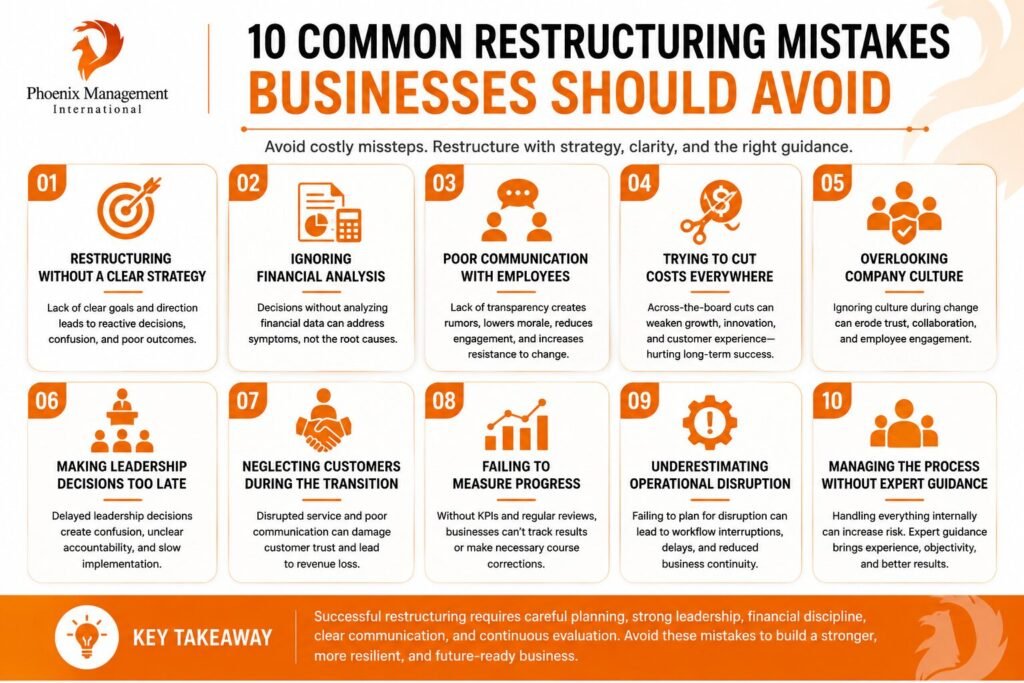
1. Restructuring Without a Clear Strategy
One of the biggest mistakes is treating restructuring as a quick fix instead of a strategic transformation.
Without clearly defined goals, businesses often make reactive decisions that solve short-term problems while creating long-term challenges.
A successful restructuring strategy should answer questions such as:
- What problems are we solving?
- What outcomes define success?
- Which departments will be affected?
- How will progress be measured?
- What is the implementation timeline?
Every restructuring decision should align with the organization’s long-term business objectives.
2. Ignoring Financial Analysis
Financial assumptions should never replace financial data.
Businesses sometimes restructure based on declining sales or rising costs without thoroughly analyzing:
- Cash flow
- Profit margins
- Operating expenses
- Revenue trends
- Debt obligations
- Department performance
- Cost-to-profit ratios
A comprehensive financial review helps identify the true causes of underperformance rather than treating symptoms.
3. Poor Communication With Employees
Employees naturally become concerned when restructuring is announced.
A lack of transparency often leads to:
- Rumors
- Reduced morale
- Lower engagement
- Increased turnover
- Resistance to change
Effective communication should explain:
- Why restructuring is happening
- What changes employees can expect
- The implementation timeline
- Available support resources
- Leadership’s long-term vision
Employees are far more likely to support change when they understand its purpose.
4. Trying to Cut Costs Everywhere
Reducing expenses is often part of restructuring, but excessive cost-cutting can damage future growth.
Businesses sometimes reduce spending in areas that directly influence competitiveness, such as:
- Customer service
- Marketing
- Employee development
- Technology
- Product innovation
Instead of making across-the-board cuts, leaders should identify inefficient processes and eliminate unnecessary expenses while protecting high-value investments.
5. Overlooking Company Culture
Culture plays a significant role in successful organizational change.
Restructuring can unintentionally weaken workplace culture by:
- Changing reporting structures
- Eliminating leadership roles
- Creating uncertainty
- Increasing workloads
- Reducing collaboration
Successful organizations actively preserve trust, accountability, and employee engagement throughout the transition.
6. Making Leadership Decisions Too Late
Strong leadership is essential during organizational change.
Delaying decisions about leadership responsibilities often creates confusion regarding:
- Decision-making authority
- Team accountability
- Department priorities
- Performance expectations
Leadership roles should be clearly defined before implementation begins.
7. Neglecting Customers During the Transition
Businesses sometimes become so focused on internal restructuring that customer experience declines.
Potential warning signs include:
- Longer response times
- Service interruptions
- Product delays
- Inconsistent communication
- Lower customer satisfaction
Customers should continue receiving reliable service throughout the restructuring process. Maintaining strong client relationships protects revenue while internal improvements take place.
8. Failing to Measure Progress
Restructuring is not a one-time event.
Without measurable performance indicators, businesses cannot determine whether changes are delivering results.
Useful performance metrics include:
- Revenue growth
- Customer retention
- Employee engagement
- Operating costs
- Productivity
- Profitability
- Project completion rates
Regular performance reviews allow leaders to adjust strategies before small issues become larger problems.
9. Underestimating Operational Disruption
Even positive organizational changes can temporarily disrupt daily operations.
Businesses should prepare contingency plans for:
- Workflow interruptions
- Technology implementation
- Staffing adjustments
- Supply chain changes
- Customer support continuity
Planning for disruption reduces downtime and improves business continuity.
10. Managing the Process Without Expert Guidance
Business restructuring often involves strategic planning, financial analysis, operational improvements, leadership alignment, and organizational change management.
Attempting to manage every aspect internally can increase risk, particularly for growing or complex organizations.
Experienced business advisors provide objective insights, identify hidden risks, and help businesses implement structured, measurable improvements. Many organizations also benefit from professional business management services, strategic consulting, or specialized corporate advisory support to navigate restructuring with greater confidence and long-term focus.
Turn business challenges into growth opportunities. Contact Phoenix Management International today for trusted Corporate Advisory, Business Management, Strategic Consulting, and Brokerage Services in San Antonio, TX, and build a stronger, more resilient business.
Common Restructuring Mistakes vs. Best Practices
| Mistake | Better Approach |
|---|---|
| No clear restructuring plan | Create measurable goals and implementation milestones |
| Poor communication | Maintain transparent communication with employees and stakeholders |
| Aggressive cost-cutting | Focus on efficiency instead of indiscriminate reductions |
| Ignoring financial data | Base decisions on detailed financial analysis |
| Weak leadership alignment | Clearly define leadership roles and responsibilities |
| No performance tracking | Monitor KPIs and adjust strategies regularly |
| Ignoring customer experience | Protect service quality throughout the transition |
| Handling everything internally | Seek experienced external guidance when needed |
Signs Your Business May Need Restructuring
Business restructuring may be appropriate if your organization is experiencing:
- Consistently declining profits
- Cash flow challenges
- Rapid operational growth
- Inefficient internal processes
- Leadership conflicts
- High employee turnover
- Declining customer satisfaction
- Difficulty adapting to market changes
- Frequent operational bottlenecks
Recognizing these indicators early allows businesses to make proactive improvements rather than reacting during a crisis.
Best Practices for a Successful Business Restructuring
Organizations that successfully restructure typically follow several key principles:
Develop a long-term strategic plan
Avoid making isolated decisions. Every restructuring initiative should support broader business objectives.
Analyze reliable business data
Use financial reports, operational metrics, and market insights to guide decision-making.
Prioritize communication
Keep employees, managers, investors, and stakeholders informed throughout the process.
Protect your customers
Ensure operational changes do not negatively affect customer experience.
Review progress regularly
Monitor performance using measurable KPIs and adjust the strategy when necessary.
Seek experienced advisors
Complex restructuring often benefits from outside expertise in organizational planning, operational improvement, and executive decision-making. Businesses exploring Corporate Advisory in san antino can gain valuable strategic guidance to navigate restructuring while minimizing operational risk.
Key Takeaways
Successful restructuring is not simply about reducing costs or changing organizational charts. It requires thoughtful planning, strong leadership, financial discipline, transparent communication, and continuous evaluation.
Businesses that avoid common restructuring mistakes are better positioned to:
- Improve operational efficiency
- Strengthen financial performance
- Support employee engagement
- Enhance customer satisfaction
- Build long-term resilience
- Create sustainable growth opportunities
Approaching restructuring as a strategic business transformation rather than a short-term reaction significantly increases the likelihood of lasting success.
FAQs
What is the biggest mistake businesses make during restructuring?
The most common mistake is restructuring without a clear strategic plan. Organizations that fail to define objectives, timelines, and measurable outcomes often experience confusion, delays, and inconsistent results.
How long does business restructuring typically take?
The timeline varies depending on the organization’s size, complexity, and goals. Smaller operational changes may take a few months, while enterprise-wide restructuring initiatives can extend over a year or more.
Should small businesses consider restructuring?
Yes. Restructuring is not limited to large corporations. Small businesses can benefit by improving operational efficiency, reducing unnecessary costs, strengthening leadership, and preparing for future growth.
How can employees be supported during restructuring?
Transparent communication, leadership visibility, training opportunities, and clearly defined expectations help employees adapt more effectively while maintaining engagement and productivity.
When should a business seek outside restructuring expertise?
Organizations should consider external advisors when restructuring involves multiple departments, financial challenges, leadership transitions, operational inefficiencies, mergers, acquisitions, or significant growth initiatives. Independent experts provide objective insights and structured implementation strategies.
Final Thoughts
Business restructuring presents an opportunity to strengthen an organization, but only when approached with careful planning and disciplined execution. Avoiding common mistakes such as poor communication, reactive cost-cutting, weak financial analysis, and unclear leadership can make the difference between temporary disruption and lasting improvement.
Planning a business restructuring? Phoenix Management International provides expert Corporate Advisory, Strategic Consulting, Business Management, and Brokerage Services in San Antonio, TX to help businesses navigate change with confidence and achieve sustainable growth.